
What Is a Weighted Average?
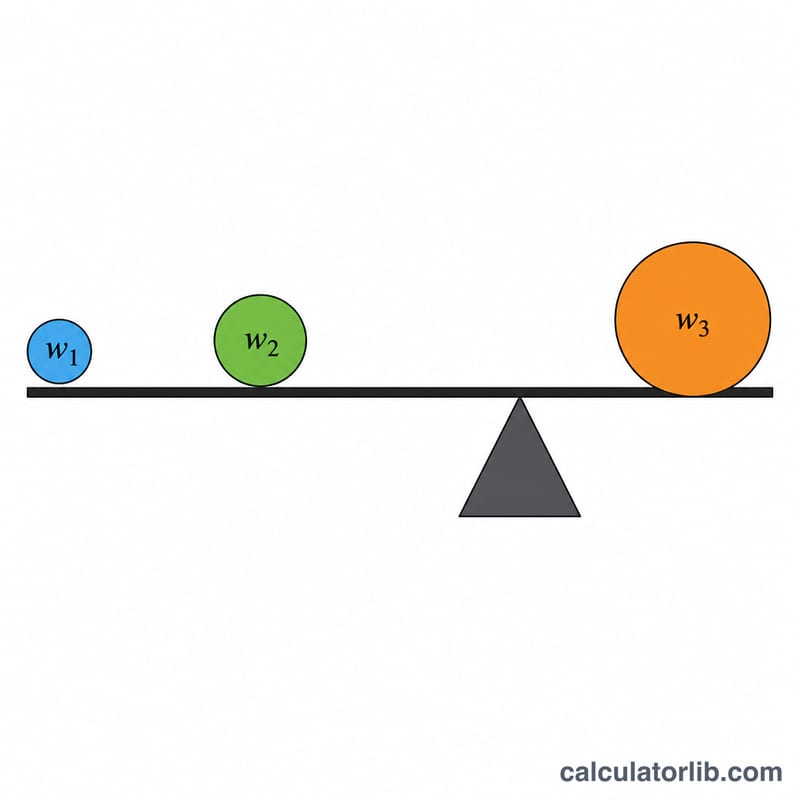
A weighted average gives different importance (weight) to each value in a data set, unlike a simple average where every value counts equally. It is widely used for school grades, investment portfolios, customer ratings, survey results, and any situation where some numbers should matter more than others.
How to Use This Calculator
Enter your values as a comma-separated list, then enter the matching weights in the same order. For example, values 90, 80, 70 with weights 3, 2, 1. The calculator pairs each value with its weight, multiplies them, sums the products, and divides by the total weight. Make sure both lists have the same number of entries.
The Formula Explained
The weighted average is calculated as \(\frac{\sum (w_i \cdot x_i)}{\sum (w_i)}\). Each value \(x_i\) is multiplied by its weight \(w_i\); these products are added together and then divided by the sum of all the weights. If every weight is equal, the result is identical to a plain arithmetic mean.
$$\bar{x}_w = \frac{\sum_{i=1}^{n} w_i \cdot x_i}{\sum_{i=1}^{n} w_i}$$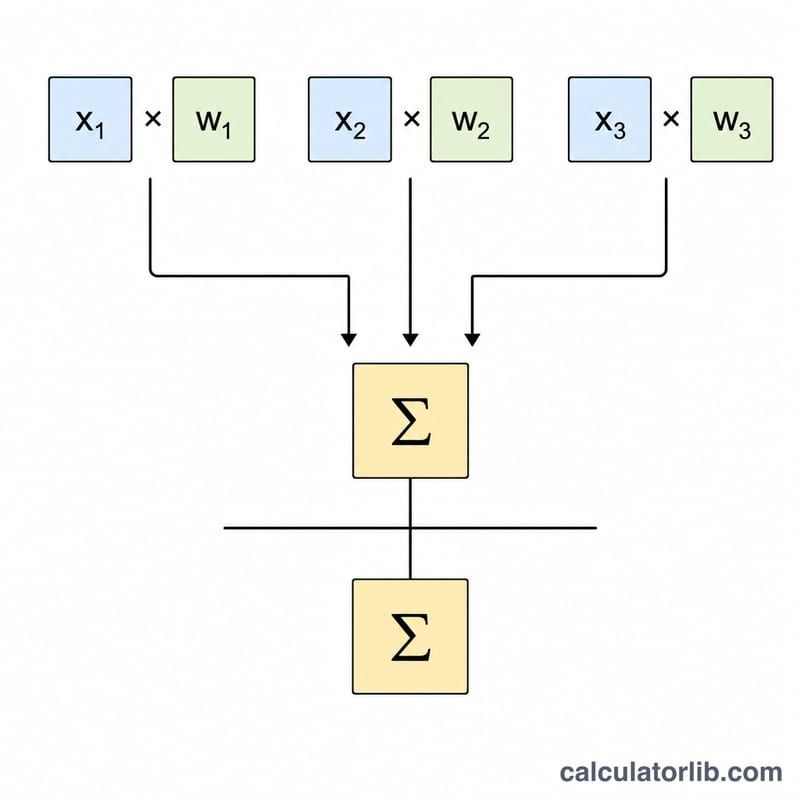
Worked Example
Suppose a student scores 90 on an exam worth 3 credits, 80 on one worth 2 credits, and 70 on one worth 1 credit. The numerator is
$$(3 \times 90) + (2 \times 80) + (1 \times 70) = 270 + 160 + 70 = 500$$The total weight is \(3 + 2 + 1 = 6\). The weighted average is \(500 \div 6 \approx\) 83.33, higher than the simple average of 80 because the strongest score carries the most weight.
FAQ
What if my weights don't add up to 1 or 100? That's fine — the formula divides by the total weight, so any positive numbers work as weights.
Can I use percentages as weights? Yes. Percentages, fractions, or raw counts all work because they are normalized by the division step.
What happens if values and weights lists differ in length? Only the matching pairs are used (up to the length of the shorter list), so keep the two lists aligned for accurate results.