
What Is the Average Rate of Change?
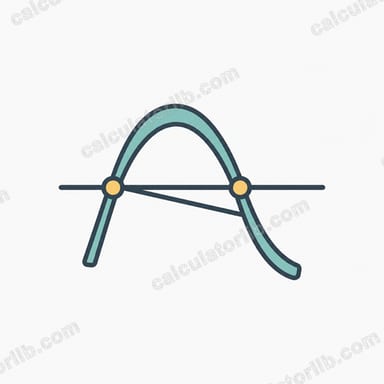
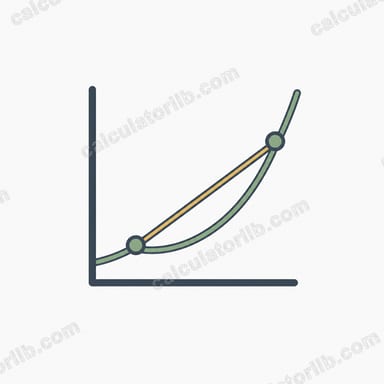
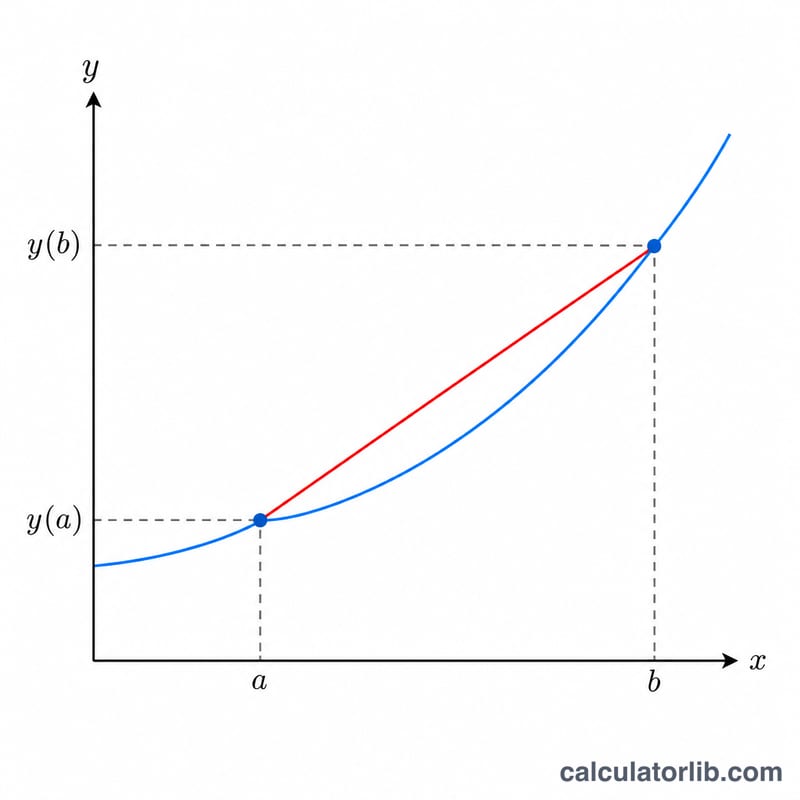
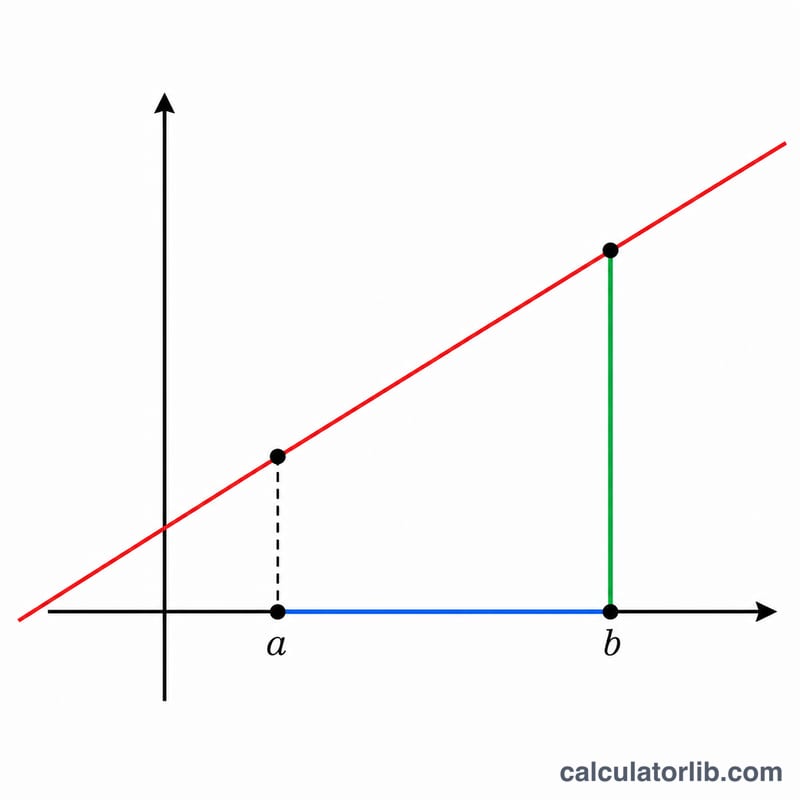
The average rate of change (ARC) measures how much a function's output changes, on average, for each unit increase in its input across an interval [a, b]. Geometrically it is the slope of the secant line connecting the two points (a, f(a)) and (b, f(b)) on the graph of the function. It is one of the most fundamental ideas in algebra and calculus, bridging the concept of slope with the derivative.
How to Use This Calculator
Enter four values: the function value at the first point f(a), the first input a, the function value at the second point f(b), and the second input b. The calculator subtracts the outputs, subtracts the inputs, and divides to give the average rate of change. The two helper rows show the numerator (change in f) and denominator (change in x) so you can follow the work.
The Formula Explained
The formula is $$\text{ARC} = \frac{f(b) - f(a)}{b - a}$$ The numerator, \(f(b) - f(a)\), is the total change in the function's value (often written \(\Delta y\)). The denominator, \(b - a\), is the total change in the input (\(\Delta x\)). Their ratio \(\Delta y / \Delta x\) is the slope between the two points. If \(b - a\) equals zero the rate is undefined, since you cannot divide by zero.
Worked Example
Suppose \(f(x) = x^2\) so that \(f(1) = 1\) and \(f(3) = 9\). Here \(a = 1\), \(b = 3\), \(f(a) = 1\), \(f(b) = 9\). $$\text{ARC} = \frac{9 - 1}{3 - 1} = \frac{8}{2} = 4$$ So over the interval [1, 3] the function rises by 4 units of f for every unit of x.
More Worked Examples
Each example uses the average rate of change formula \(A = \dfrac{f(b) - f(a)}{b - a}\). The numerator is the change in output (\(\Delta y\)); the denominator is the change in input (\(\Delta x\)).
Example 1 — Linear function (constant ARC)
Let \(f(x) = 3x + 2\) on the interval \([1, 5]\).
- \(f(a) = f(1) = 3(1) + 2 = 5\)
- \(f(b) = f(5) = 3(5) + 2 = 17\)
Substitute into the formula:
$$A = \frac{17 - 5}{5 - 1} = \frac{12}{4} = 3$$The result is 3. For any linear function the ARC equals the slope of the line, so it is the same over every interval — a constant rate of change.
Example 2 — Decreasing function (negative ARC)
Let \(f(x) = -x^2 + 4\) on the interval \([1, 3]\).
- \(f(a) = f(1) = -(1)^2 + 4 = 3\)
- \(f(b) = f(3) = -(3)^2 + 4 = -5\)
Substitute:
$$A = \frac{-5 - 3}{3 - 1} = \frac{-8}{2} = -4$$The result is -4. A negative value means the output is falling on average across the interval — the function is decreasing there.
Example 3 — Square root with non-integer output, \(f(x)=\sqrt{x}\) on \([1,4]\)
- \(f(a) = \sqrt{1} = 1\)
- \(f(b) = \sqrt{4} = 2\)
Substitute:
$$A = \frac{2 - 1}{4 - 1} = \frac{1}{3} \approx 0.3333$$The result is \(\tfrac{1}{3} \approx\) 0.3333. The small positive value shows the square root function rises slowly over this interval.
Interpreting Your Result
The average rate of change tells you how fast, and in which direction, the output of a function changes per unit of input across an interval \([a,b]\).
- Positive ARC: the output increases on average — the function rises from \(a\) to \(b\). The larger the value, the steeper the average climb.
- Negative ARC: the output decreases on average — the function falls across the interval.
- Zero ARC: the net change is zero; \(f(a) = f(b)\). The function returns to the same output value even though it may have risen and fallen in between.
Magnitude = steepness. The absolute value \(|A|\) measures how steeply the function changes on average; an ARC of \(6\) describes twice the average steepness of an ARC of \(3\), and an ARC of \(-4\) is steeper than one of \(2\).
Units. The ARC carries the units of the output divided by the units of the input — "output units per input unit." For example, dollars per year, meters per second, or degrees per minute. Always state units in applied problems so the number is meaningful.
Relationship to slope and applied rates
Geometrically, the average rate of change equals the slope of the secant line joining the two points \((a, f(a))\) and \((b, f(b))\) on the graph — exactly the rise-over-run between those points.
In applied contexts the same formula has familiar names. When \(f\) is position as a function of time, the ARC is the average velocity \(\Delta x / \Delta t\); when \(f\) is velocity over time, it is the average acceleration \(\Delta v / \Delta t\). As the interval shrinks toward a single point, the average rate of change approaches the instantaneous rate of change — the derivative.
Definitions & Glossary
- Average rate of change (ARC)
- The change in a function's output divided by the change in its input over an interval: \(A = \dfrac{f(b) - f(a)}{b - a}\). It describes the function's net per-unit change across \([a,b]\).
- Interval \([a,b]\)
- The closed range of input values from the lower endpoint \(a\) to the upper endpoint \(b\) over which the rate of change is measured, with \(a \neq b\).
- \(f(a)\) and \(f(b)\)
- The function's output values at the endpoints of the interval — the starting output \(f(a)\) and the ending output \(f(b)\).
- \(\Delta y\) (change in output)
- The difference in output values, \(\Delta y = f(b) - f(a)\); the numerator of the ARC, also called the "rise."
- \(\Delta x\) (change in input)
- The difference in input values, \(\Delta x = b - a\); the denominator of the ARC, also called the "run."
- Secant line
- A straight line that passes through two points on a curve, here \((a, f(a))\) and \((b, f(b))\). The ARC equals the slope of this secant line.
- Slope
- The steepness of a line, measured as rise over run, \(\Delta y / \Delta x\). The average rate of change is the slope of the secant line between the two chosen points.
- Instantaneous rate of change (derivative)
- The rate of change at a single point, \(f'(x)\), obtained as the limit of the average rate of change as the interval length approaches zero. It equals the slope of the tangent line at that point.
FAQ
Is the average rate of change the same as the slope? Yes — for a straight line the average rate of change is exactly the constant slope. For curves it is the slope of the secant line over the chosen interval.
How does it relate to the derivative? As the interval [a, b] shrinks toward a single point, the average rate of change approaches the instantaneous rate of change, which is the derivative.
Can the result be negative? Yes. A negative ARC means the function decreases over the interval; a positive value means it increases.