
What Is a Unit Rate?
A unit rate expresses how much of one quantity corresponds to a single unit of another. It answers questions like "how much per item," "how many miles per hour," or "what's the cost per ounce." Unit rates make it easy to compare options that come in different package sizes or amounts, which is why they're a cornerstone of everyday math, shopping, and science.
How to Use This Calculator
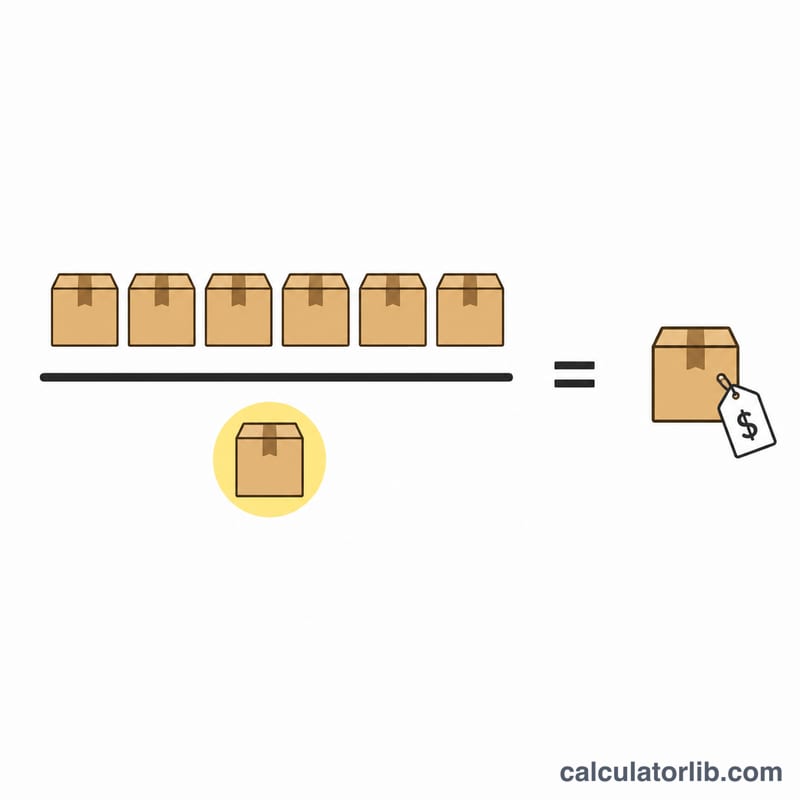
Enter the Total Amount (for example, the total price, distance, or quantity) and the Number of Units (such as items, hours, or ounces). The calculator divides the total by the number of units and instantly returns the unit rate.
The Formula Explained
The unit rate is simply division: \(\text{Unit Rate} = \text{Total Amount} \div \text{Number of Units}\). The result tells you how much corresponds to exactly one unit. Because we divide by units, the number of units must not be zero.
$$\text{Unit Rate} = \dfrac{\text{Total Amount}}{\text{Number of Units}}$$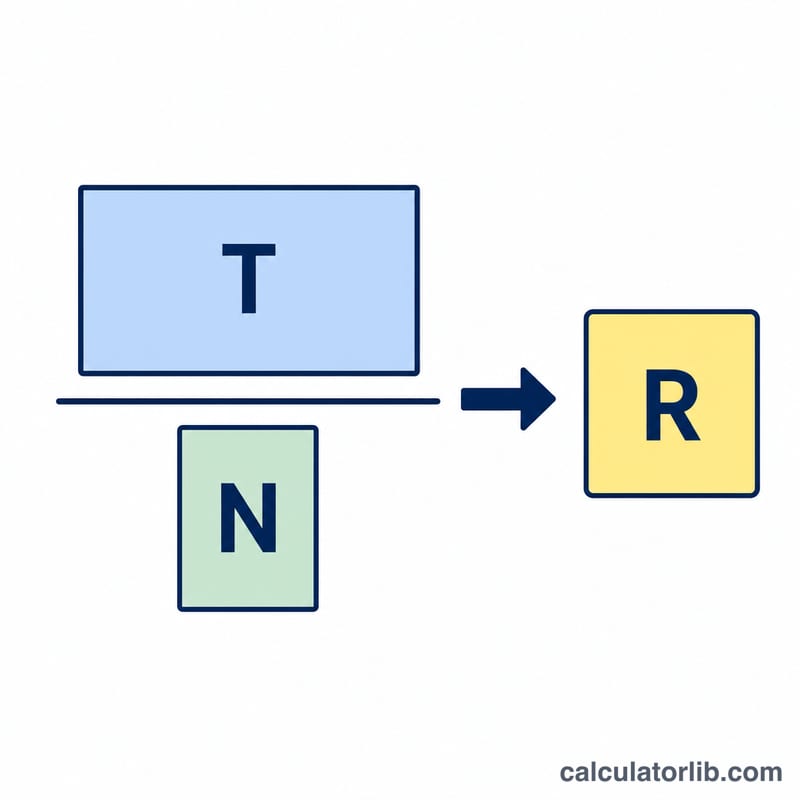
Worked Example
Suppose a 12-pack of soda costs $9.00. To find the price per can, divide the total amount by the number of units: \(9 \div 12 = \$0.75\) per can. If a second store sells a 6-pack for $4.80, the unit rate is \(4.80 \div 6 = \$0.80\) per can — so the 12-pack is the better deal.
$$9 \div 12 = \$0.75 \text{ per can}$$FAQ
What's the difference between a ratio and a unit rate? A ratio compares two quantities; a unit rate is a ratio reduced so the second quantity equals one.
Can the unit rate be a decimal? Yes. Unit rates are frequently decimals, such as $0.75 per item or 62.5 miles per hour.
Why can't the number of units be zero? Dividing by zero is undefined, so there is no meaningful rate when there are no units.