
What Is the Velocity Calculator?
This Velocity Calculator finds average velocity — the rate at which an object covers distance over time. By definition, velocity equals distance divided by time. While "velocity" in physics is technically a vector with direction, for everyday speed calculations we treat it as the magnitude (speed). The tool accepts distance in meters, kilometers, or miles and time in seconds, minutes, or hours, then returns the result in m/s, km/h, and mph.
How to Use It
Enter the total distance traveled and choose its unit. Enter the elapsed time and choose its unit. Press calculate to see the average velocity in three common units. This works for runners, cyclists, drivers, falling objects, or any situation where you know how far something moved and how long it took.
The Formula Explained
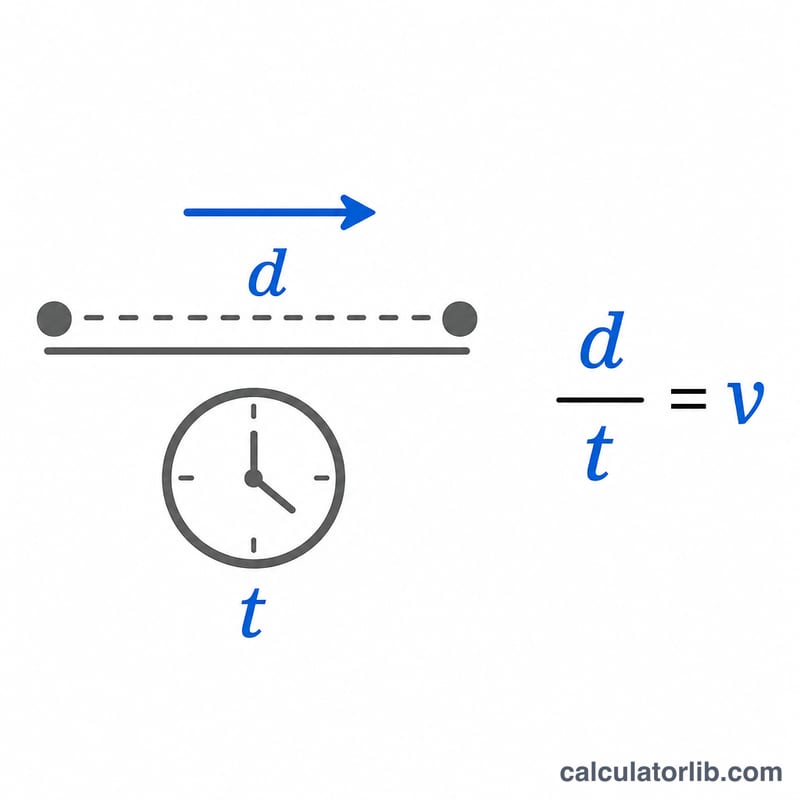
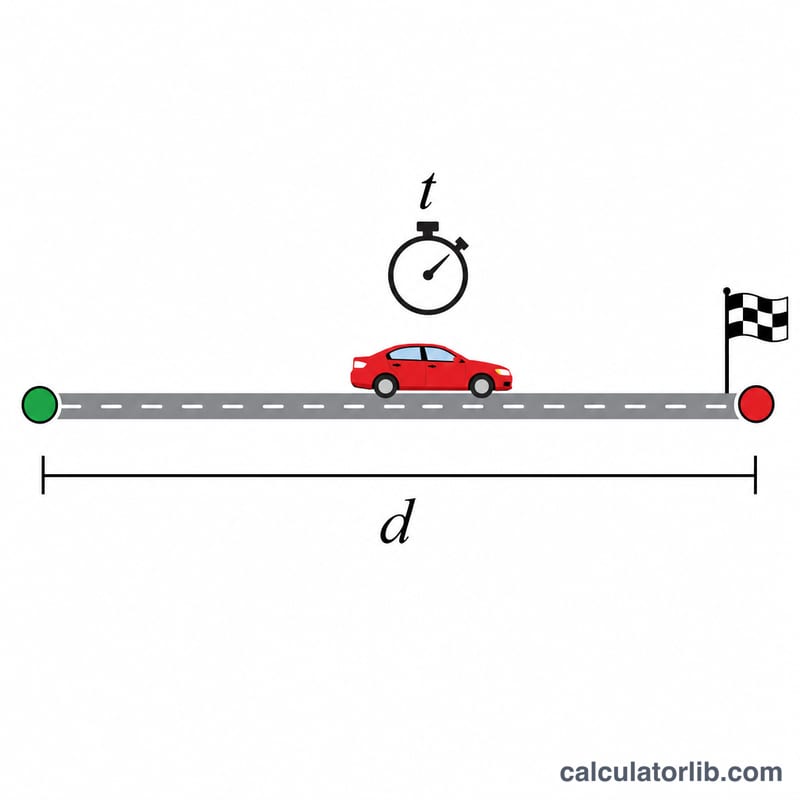
The core equation is $$v = \dfrac{d}{t}$$ where \(v\) is velocity, \(d\) is distance, and \(t\) is time. Internally the calculator converts your distance to meters and your time to seconds, divides them, and then converts the resulting m/s value into km/h (\(\times 3.6\)) and mph (\(\times 2.23694\)).
Worked Example
Suppose a car travels 150 kilometers in 2 hours. Convert: 150 km = 150,000 m and 2 h = 7,200 s. Then $$v = \frac{150{,}000}{7{,}200} = 20.83 \text{ m/s},$$ which equals 75 km/h or about 46.6 mph.
FAQ
Is velocity the same as speed? In casual use, yes. In physics, speed is the magnitude and velocity also includes direction. This calculator gives the magnitude.
What if time is zero? Velocity is undefined when time is zero (you can't divide by zero), so enter a positive time value.
Does this give average or instantaneous velocity? It gives average velocity over the entire distance and time you enter, not the instantaneous speed at any single moment.