
What is generation time?
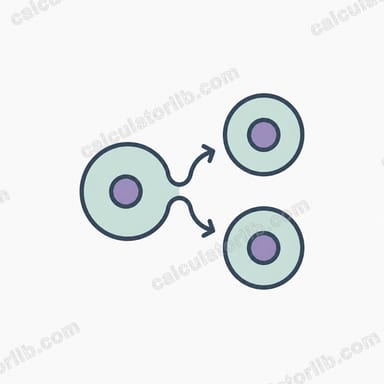
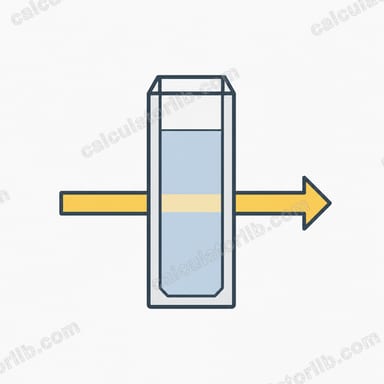
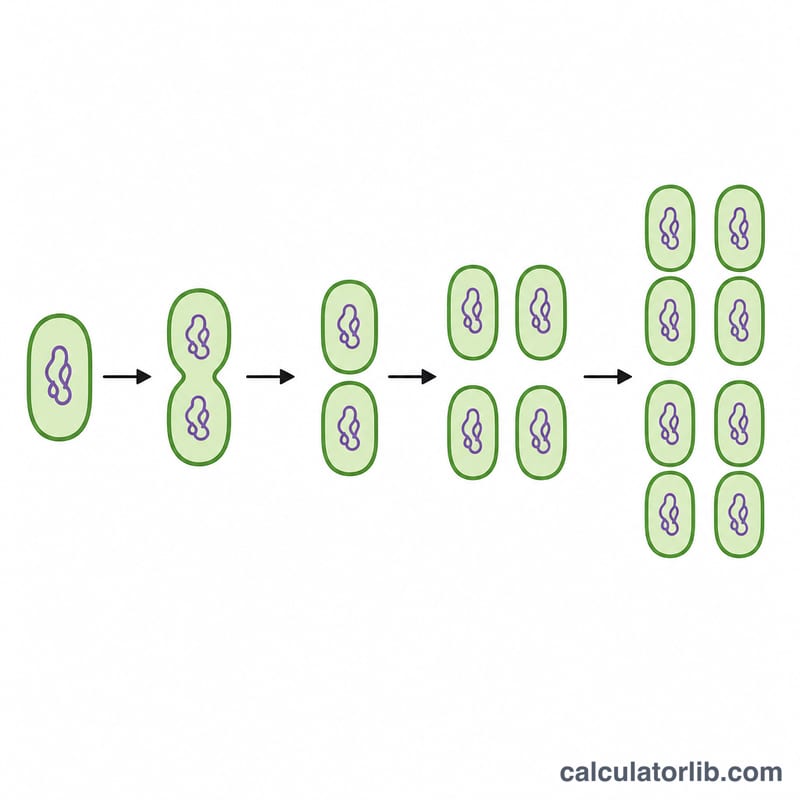
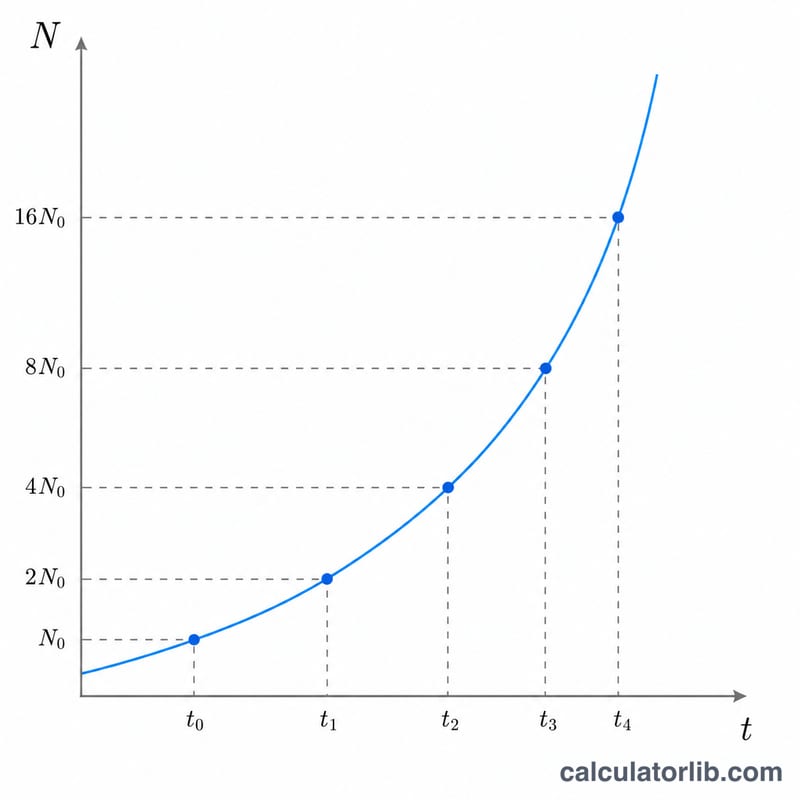
Generation time (also called doubling time) is the interval required for a population of dividing cells — typically bacteria — to double in number. During exponential growth, each generation doubles the cell count. Measuring how long this takes is a fundamental way to characterize microbial growth rates in microbiology, food safety, and biotechnology.
How to use this calculator
Enter the total time elapsed in minutes, the initial number of cells (N₀) at the start of the interval, and the final number of cells (Nₜ) at the end. The calculator returns the generation time in minutes, the number of generations that occurred, and the growth rate in generations per minute.
The formula explained
The number of generations is \(n = 3.3 \times \log_{10}(N_t/N_0)\). The factor 3.3 comes from \(1/\log_{10}(2) \approx 3.322\), which converts a base-10 logarithm into the number of doublings (base-2). Generation time is simply the total time divided by the number of generations:
$$g = \frac{t}{n} = \frac{t}{3.3 \times \log_{10}\!\left(\dfrac{N_t}{N_0}\right)}$$
Worked example
Suppose a culture grows from 1,000 cells to 64,000 cells in 60 minutes. The ratio \(N_t/N_0 = 64\), and \(\log_{10}(64) \approx 1.806\). The number of generations is \(3.3 \times 1.806 \approx 5.96\), which is close to the 6 true doublings (\(1{,}000 \to 64{,}000 = \times 64 = 2^6\)). Generation time:
$$g = \frac{60}{5.96} \approx 10.07 \text{ minutes per generation}$$
FAQ
Why 3.3 instead of 3.322? Many textbooks round \(1/\log_{10}(2)\) to 3.3 for convenience. This calculator uses 3.3 to match the standard textbook formula, which introduces a small approximation.
What if N₀ equals Nₜ? If there is no growth, \(\log_{10}(1) = 0\) and generation time is undefined (division by zero), so the result is shown as zero.
Can I use any unit of time? Yes — generation time comes out in whatever time unit you enter for \(t\). Minutes is most common for bacteria, but hours or days work the same way.