
What is the Ligation Calculator?
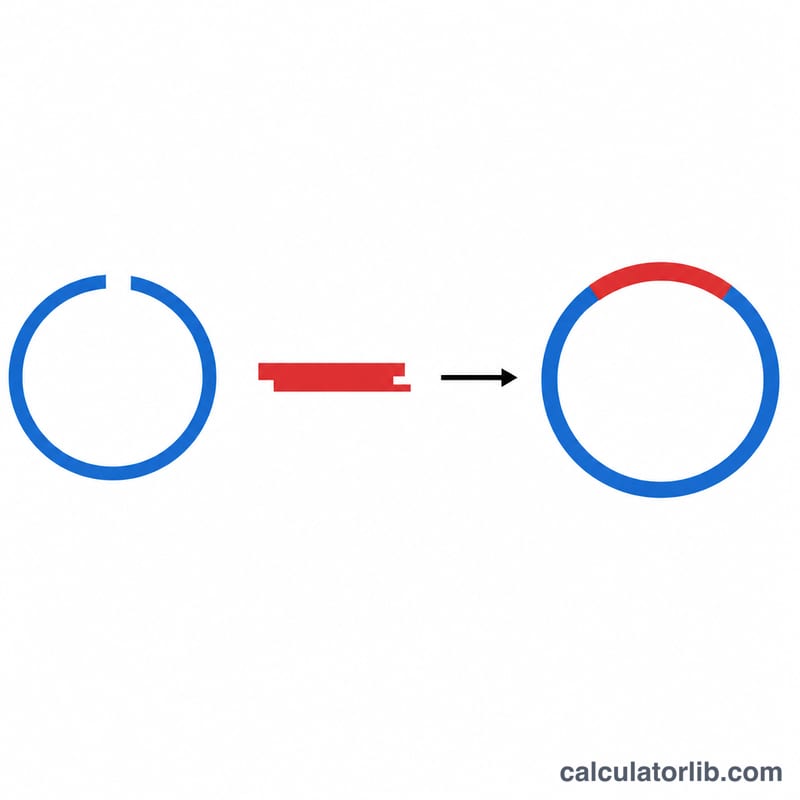
The Ligation Calculator works out how much insert DNA you need to set up a ligation reaction so that the insert and vector are present at a chosen molar ratio. Because longer DNA fragments weigh more per molecule, you cannot simply mix equal masses of insert and vector — you have to scale the insert mass by the relative lengths and the desired molar ratio. This tool is universal and applies to standard molecular cloning regardless of laboratory or country.
How to use it
Enter the mass of vector you plan to use (in nanograms), the length of the vector in base pairs (bp), the length of your insert in bp, and the insert:vector molar ratio you want (a 3:1 insert-to-vector ratio is a common starting point for sticky-end ligations). The calculator returns the mass of insert, in ng, to combine with the vector.
The formula explained
The required insert mass is given by:
$$\text{insert mass} = \frac{\text{ratio} \times \text{insert length} \times \text{vector mass}}{\text{vector length}}$$
The fraction (insert length / vector length) converts a 1:1 mass ratio into a 1:1 molar ratio, and multiplying by the desired molar ratio scales it to your target. The result is expressed in the same mass unit as the vector mass (ng).

Worked example
Suppose you use 50 ng of a 5000 bp vector and want a 3:1 molar ratio with a 1000 bp insert. Then $$\text{insert mass} = \frac{3 \times 1000 \times 50}{5000} = \frac{150000}{5000} = 30 \text{ ng}.$$ So you would add 30 ng of insert to the reaction.
FAQ
What molar ratio should I use? A 3:1 insert:vector ratio is typical for cohesive-end ligations; ratios from 1:1 up to 5:1 (or higher for blunt ends) are common — try a few if cloning is difficult.
Is the answer in ng? Yes. The insert mass is returned in the same unit you used for vector mass, which is nanograms here.
Does length include the vector backbone? Use the full length of each linearized molecule in base pairs, including the backbone for the vector and the entire fragment for the insert.