
What is Percent by Mass (%w/w)?
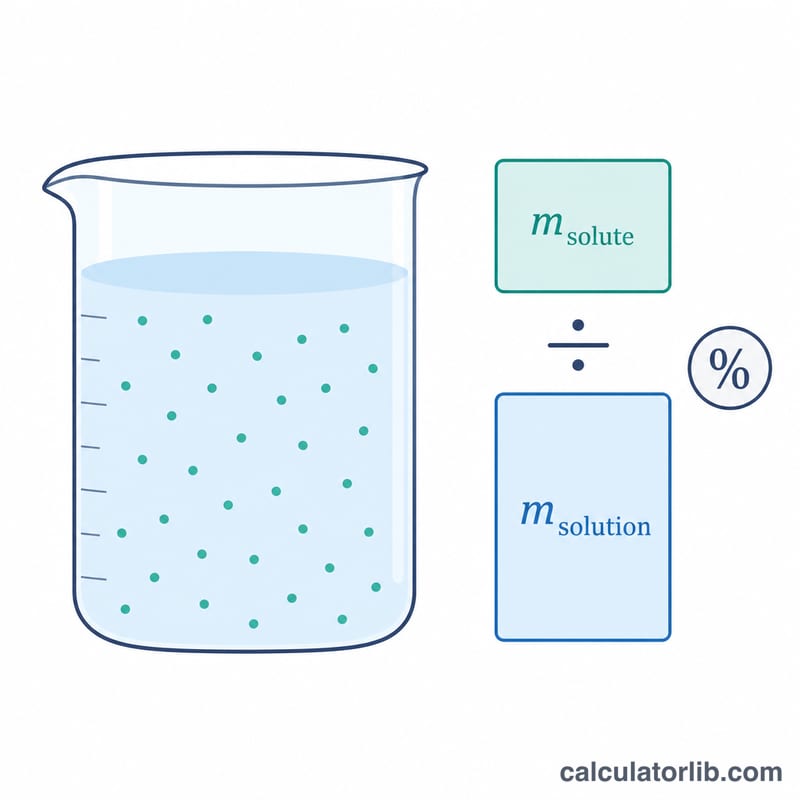
Percent by mass, often written as %w/w (weight/weight) or %m/m (mass/mass), expresses the concentration of a solution as the mass of solute divided by the total mass of the solution, multiplied by 100. It is one of the most common ways to report concentration because it is independent of temperature and does not depend on the density of the solution. A 10% w/w salt solution contains 10 grams of salt in every 100 grams of solution.
How to Use This Calculator
Enter the mass of the solute (the dissolved substance) and the mass of the entire solution. Make sure both values use the same unit of mass — grams are typical, but any consistent unit works. The calculator divides the solute mass by the solution mass and multiplies by 100 to return the percent by mass, and also reports the mass of solvent (solution mass minus solute mass).
The Formula Explained
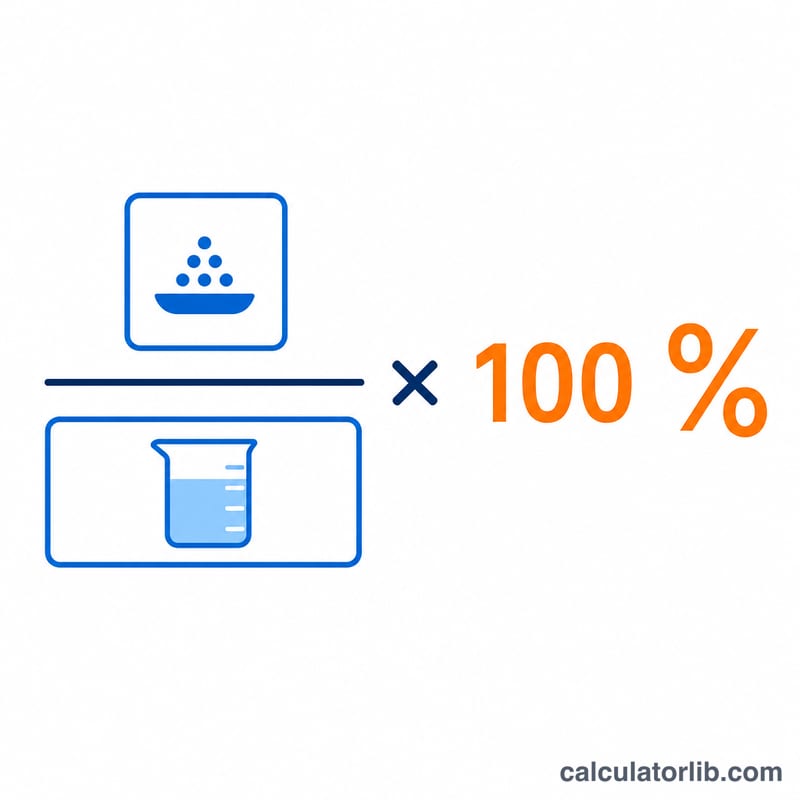
The equation is: $$\%\,\text{w/w} = \frac{\text{Mass of Solute (g)}}{\text{Mass of Solution (g)}} \times 100$$ The "mass of solution" is the total mass, equal to the solute plus the solvent (for example, sugar plus water). A common mistake is to divide by the mass of solvent instead of the mass of solution — always use the total.
Worked Example
Suppose you dissolve 25 g of sodium chloride in enough water to make 200 g of solution. The percent by mass is $$(25 \div 200) \times 100 = 12.5\%\ \text{w/w}.$$ The mass of solvent (water) is \(200 - 25 = 175\) g.
FAQ
Is %w/w the same as %w/v? No. %w/w uses mass of solution in the denominator, while %w/v uses volume of solution (grams per 100 mL).
Why use mass of solution, not solvent? By convention concentration is referenced to the total solution. Dividing by solvent gives a different, non-standard ratio.
Does temperature affect %w/w? No. Because mass does not change with temperature, %w/w is temperature-independent, unlike volume-based measures.