
What Is Percent Composition?
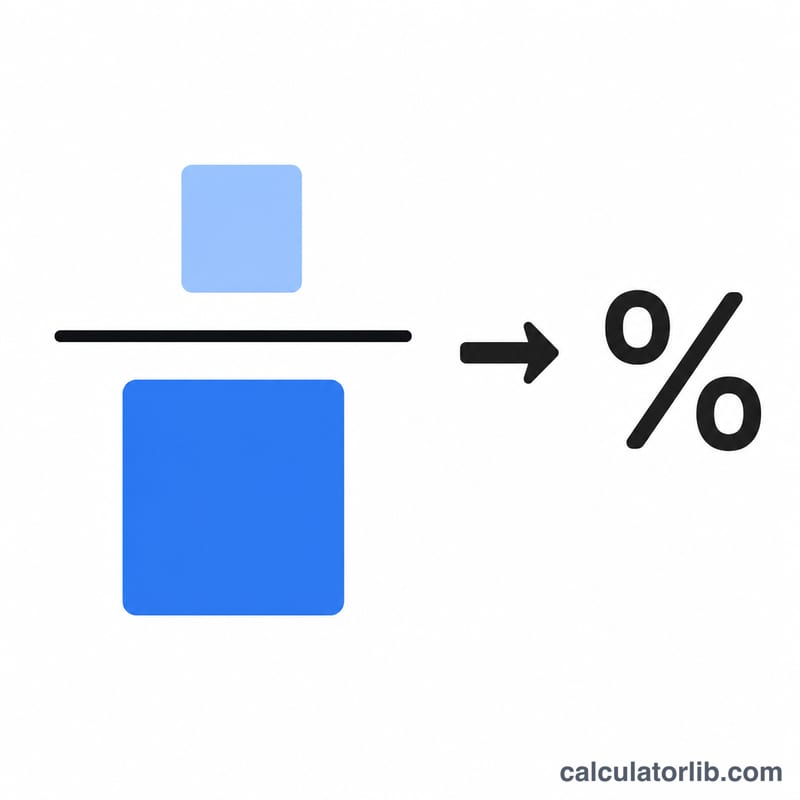
Percent composition (mass percent) tells you what fraction of a compound's total mass comes from a particular element. It is a core concept in stoichiometry, used to verify chemical formulas, compute empirical formulas, and predict yields. For any element in a compound, the percent composition is the mass that element contributes to one mole of the compound divided by the compound's molar mass, multiplied by 100.
How to Use This Calculator
Enter two values: the mass of the element contained in one mole of the compound (in grams) and the molar mass of the entire compound (in g/mol). The mass of an element in one mole equals the number of atoms of that element in the formula multiplied by its atomic mass. The calculator divides the two and multiplies by 100 to give the percent by mass.
The Formula Explained
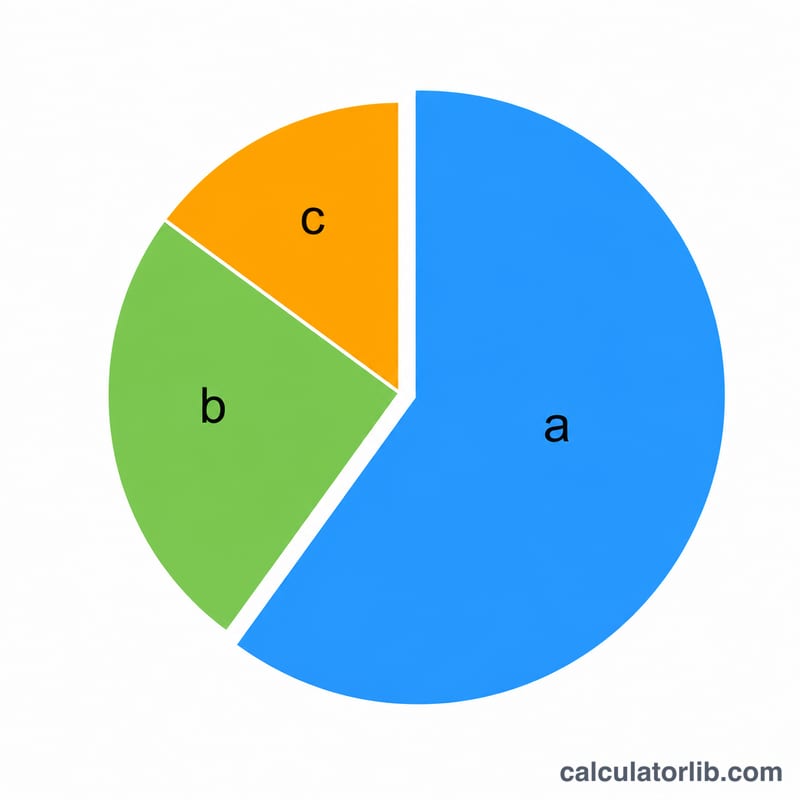
The equation is $$\%\ \text{element} = \frac{\text{mass of element in 1 mol}}{\text{molar mass of compound}} \times 100$$. The numerator is the contribution of one element; the denominator is the sum of all atomic masses in the formula. Because every element's percentage is computed against the same molar mass, all the percentages for a compound add up to 100%.
Worked Example
Consider water, H₂O. Oxygen contributes 16.00 g per mole, and water's molar mass is 18.015 g/mol. The percent composition of oxygen is $$\left(16.00 \div 18.015\right) \times 100 \approx 88.82\%.$$ The remaining ~11.18% is hydrogen (\(2 \times 1.008 = 2.016\) g \(\div\) \(18.015 \times 100\)).
FAQ
How do I find the mass of an element in one mole? Multiply the number of atoms of that element in the chemical formula by its atomic mass from the periodic table.
Should all percentages add to 100%? Yes — small rounding differences aside, the sum of the mass percents of every element equals 100%.
Does this work for hydrates or mixtures? Use the full molar mass including water of crystallization for hydrates; treat each element's total contribution as the numerator.