
What Is a Percent Solution?
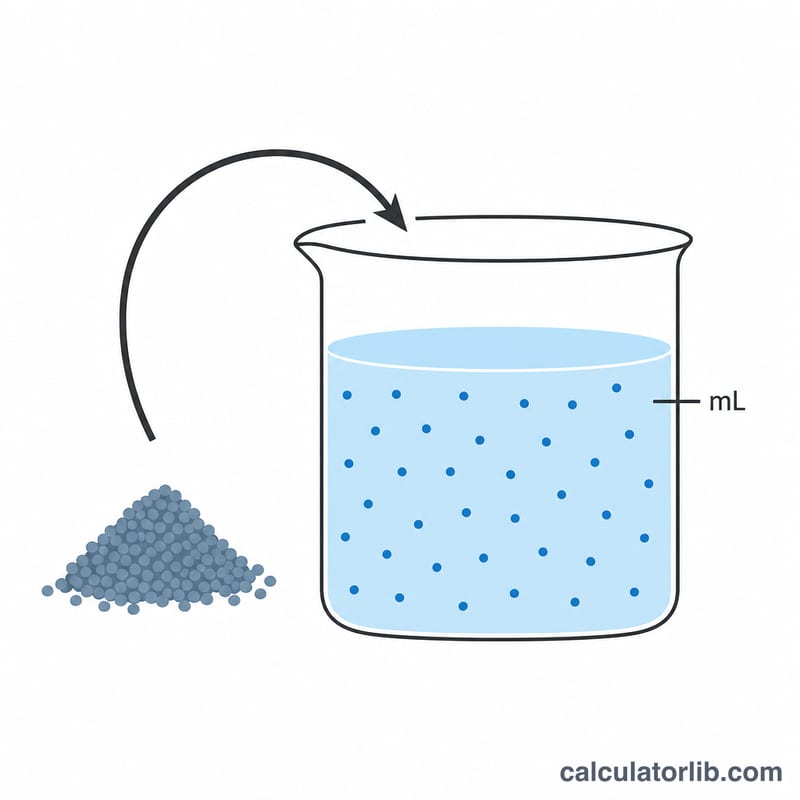
A percent solution expresses how much solute is dissolved in a given amount of solution. The most common form in chemistry and biology labs is weight/volume percent (%w/v), defined as the grams of solute per 100 milliliters of total solution. For example, a 5% w/v NaCl solution contains 5 grams of sodium chloride in every 100 mL of solution. This calculator lets you solve for the percent concentration, the mass of solute needed, or the final volume of solution.
How to Use This Calculator
Choose what you want to calculate, then enter the two known values:
- Percent (%w/v) — enter the mass of solute (g) and the volume of solution (mL).
- Mass of solute — enter the desired percent and the solution volume.
- Volume of solution — enter the mass of solute and the desired percent.
The Formula Explained
The core equation is:
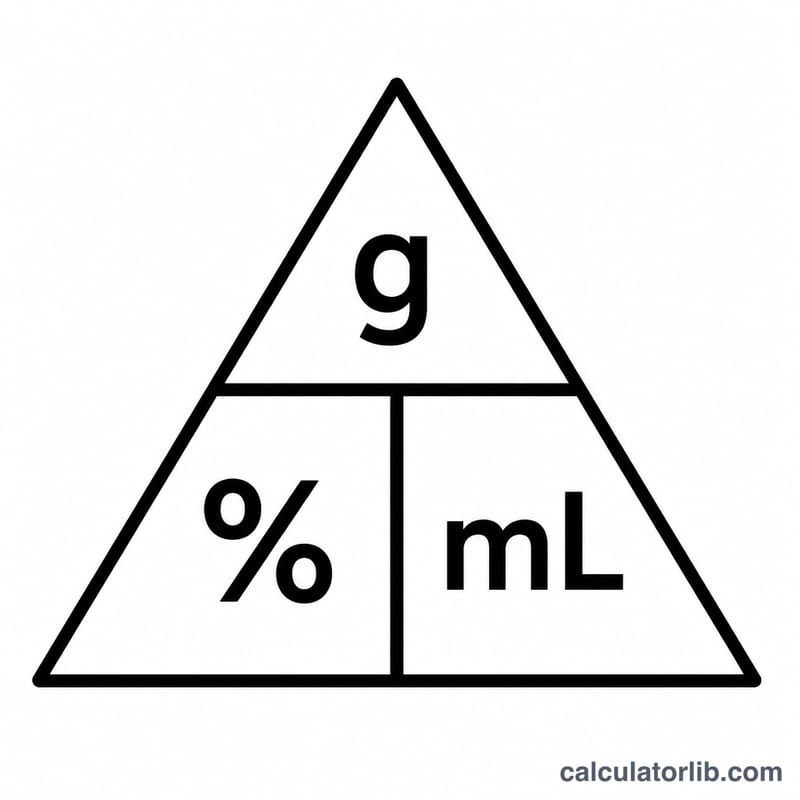
$$\text{\%w/v} = \frac{\text{Mass (g)}}{\text{Volume (mL)}} \times 100$$
Rearranging lets you find any single unknown. To find mass: \(\text{Mass} = \frac{\text{Percent (\%w/v)}}{100} \times \text{Volume (mL)}\). To find volume: \(\text{Volume} = \frac{\text{Mass (g)}}{\frac{\text{Percent (\%w/v)}}{100}}\). Always measure the volume of the final solution, not just the solvent added.
Worked Example
You dissolve 8 g of glucose and dilute to a final volume of 200 mL. The concentration is $$(8 \div 200) \times 100 = 4\% \text{ w/v}$$ Conversely, to make 250 mL of a 2% w/v solution you need $$(2 \div 100) \times 250 = 5 \text{ g}$$ of solute.
FAQ
Is %w/v the same as %w/w? No. %w/v uses grams per 100 mL of solution, while %w/w uses grams of solute per 100 g of solution. They are only equal when the solution density is 1 g/mL.
Does temperature matter? Volume changes slightly with temperature, so prepare and measure solutions at a consistent, stated temperature for accuracy.
Can I use it for any solvent? Yes — the %w/v definition is independent of the solvent, as long as you measure the total solution volume in mL and solute mass in grams.