
What is a reconstitution calculator?
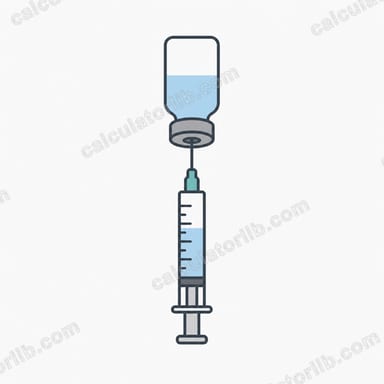
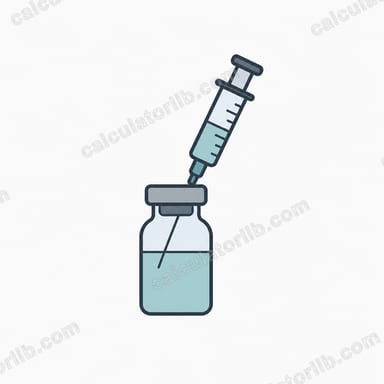
Many medications, especially injectable antibiotics and biologics, are supplied as a dry powder that must be dissolved in a sterile liquid (the diluent) before use. This process is called reconstitution. Once mixed, you need to know the resulting concentration and exactly how much liquid to draw up to deliver the prescribed dose. This calculator does both in one step.
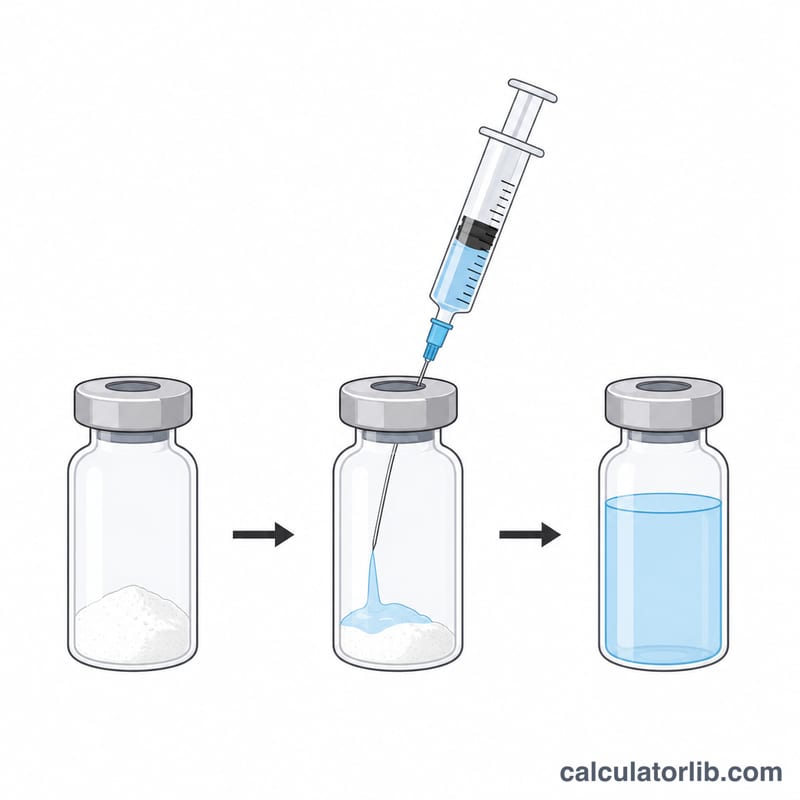
How to use it
Enter the total drug amount in the vial (for example 1000 mg), the diluent volume you add (for example 10 mL), and the desired dose you need to give (for example 250 mg). The tool returns the final concentration in mg/mL and the volume in mL you should administer.
The formula explained
The final concentration is simply the drug amount spread evenly through the liquid you added: \(\text{Concentration} = \text{Total drug} \div \text{Diluent volume}\). The volume to administer is the dose you want divided by that concentration: \(\text{Dose volume} = \text{Desired dose} \div \text{Concentration}\). Both steps assume the powder adds negligible volume; if the manufacturer specifies a displacement value, use the stated final volume instead of the raw diluent volume.
$$\text{Dose Volume} = \frac{\text{Desired Dose (mg)}}{\left(\dfrac{\text{Drug Amount (mg)}}{\text{Diluent Volume (mL)}}\right)}$$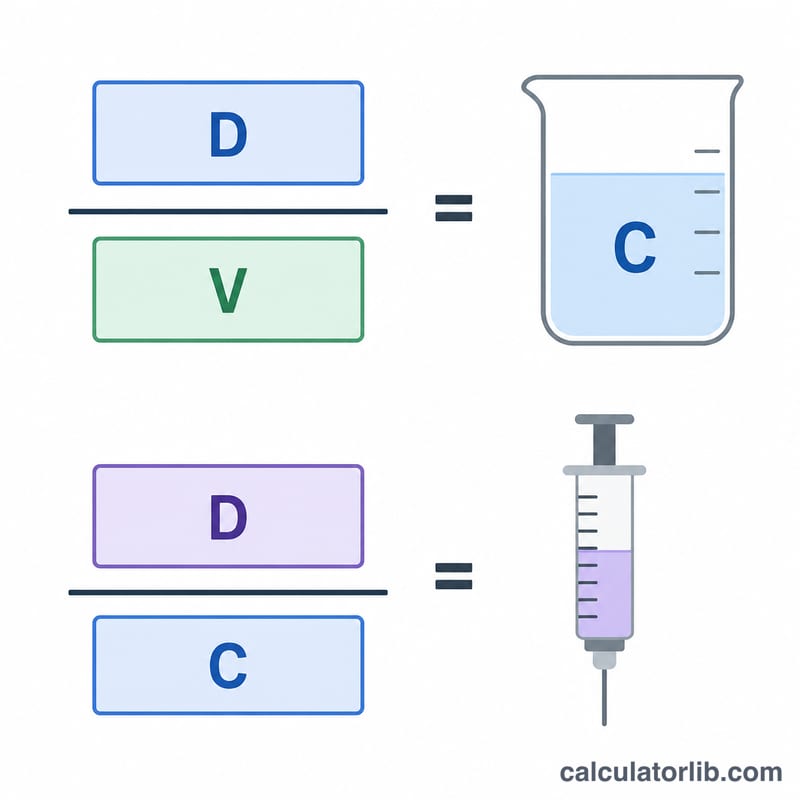
Worked example
A vial holds 1000 mg of powder. You add 10 mL of diluent, giving a concentration of \(1000 \div 10 = 100\) mg/mL. To deliver a 250 mg dose, draw up \(250 \div 100 = 2.5\) mL.
FAQ
Does the powder change the final volume? Some drugs have a "displacement value." Always follow the package insert; if a final volume is given, enter that as the diluent volume.
What units should I use? Keep drug amounts in the same unit (mg here). The concentration will be in mg/mL and the dose volume in mL.
Can I use units or mcg instead of mg? Yes — as long as the drug amount and desired dose share the same unit, the dose volume in mL is correct.
This tool is for educational support only and does not replace clinical judgment or pharmacy verification.