
What is the Acid Dilution Preparation Calculator?
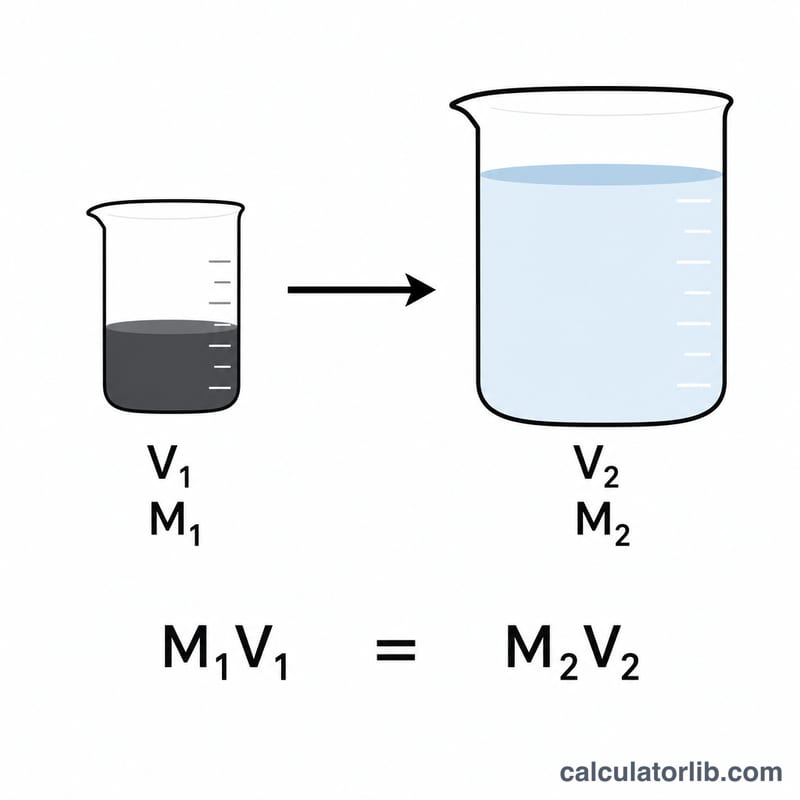
This tool tells you exactly how much concentrated stock acid and how much water (diluent) you need to prepare a dilute acid solution at a chosen molarity and final volume. It is based on the dilution principle that the moles of solute stay constant: \(M_1 V_1 = M_2 V_2\). It is a universal chemistry calculation and applies in any laboratory worldwide.
How to use it
Enter the concentration of your concentrated stock acid (for example 12 M hydrochloric acid), the target concentration you want to end up with, and the final volume of solution you need. The calculator returns the volume of stock acid to measure out and the volume of water to add to reach the final volume.
The formula explained
The rearranged dilution equation is $$V_{stock} = \frac{\text{Target (M)} \times \text{Final Volume (mL)}}{\text{Stock (M)}}$$ Because concentration multiplied by volume equals moles of solute, the moles delivered by the small portion of stock must equal the moles present in the final diluted solution. The water needed is simply the final volume minus the stock volume: $$V_{water} = \text{Final Volume (mL)} - V_{stock}$$
Worked example
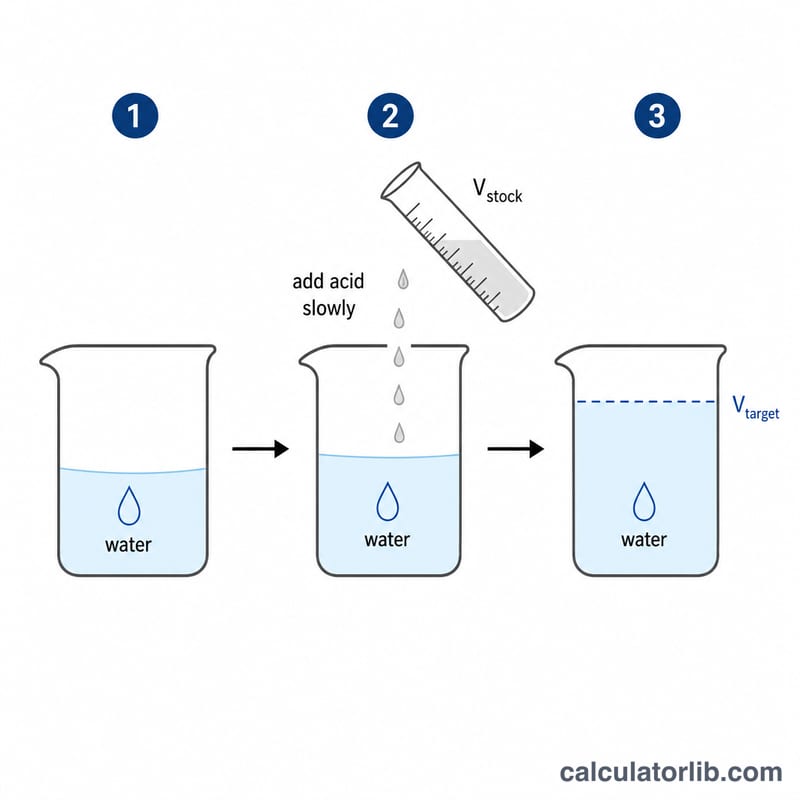
To make 1000 mL of 1 M HCl from 12 M stock: $$V_{stock} = \frac{1 \times 1000}{12} = 83.33 \text{ mL}$$ Add about 83.33 mL of concentrated acid to roughly 900 mL of water, then top up to 1000 mL. Water to add \(\approx 916.67\) mL.
FAQ
Do the volume units matter? Use the same unit for target volume and the answer; this tool uses mL. The concentrations must use the same unit (molarity).
Why add acid to water? Diluting concentrated acid releases heat. Adding acid slowly to water disperses that heat safely; the reverse can cause violent spattering.
What if the target concentration exceeds the stock? That is impossible by dilution — you cannot concentrate by adding water. Check your inputs.