
What is the Buffer Dilution Calculator?
Lab buffers are often supplied or stored as concentrated stocks (such as 10X TBE, 5X loading dye, or 50X TAE) to save space and improve stability. Before use they must be diluted to a 1X working concentration. This calculator tells you exactly how much concentrated stock and how much diluent (water or solvent) to combine to reach any final volume you need.
How to use it
Enter the total final volume you want to prepare and the fold concentration of your stock (10 for a 10X stock, 50 for a 50X stock, and so on). The calculator returns the volume of concentrated stock to measure out and the volume of diluent to add. The two volumes always sum to your final volume.
The formula explained
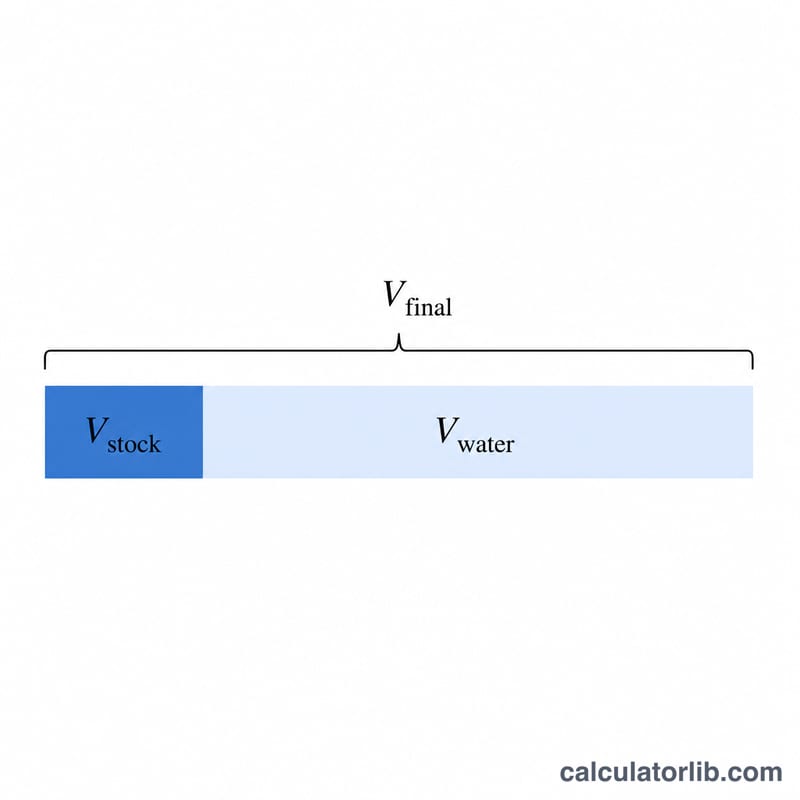
The dilution follows the simple relationship $$V_{stock} = \frac{V_{final}}{\text{fold}}.$$ The remaining volume is diluent: $$V_{water} = V_{final} - V_{stock}.$$ This is a direct application of \(C_1 V_1 = C_2 V_2\), where the concentration ratio equals the fold factor.
Worked example
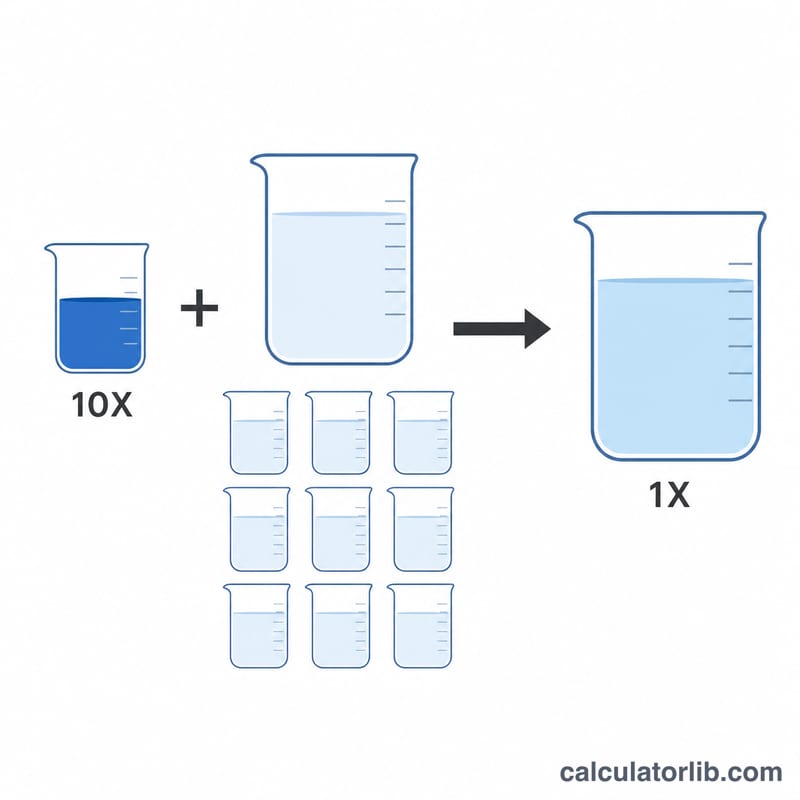
To make 100 mL of 1X buffer from a 10X stock: $$V_{stock} = \frac{100}{10} = 10 \text{ mL of stock},$$ and $$V_{water} = 100 - 10 = 90 \text{ mL of water}.$$ Mix 10 mL of 10X stock with 90 mL of water.
Standard Lab Buffer Stock Concentrations
Most molecular-biology buffers are stored as concentrated stocks to save space and improve shelf life, then diluted to a 1X working concentration immediately before use. The table below lists common buffers, the fold at which their stocks are typically supplied or prepared, and their usual 1X application.
| Buffer | Typical Stock Fold | 1X Working Use |
|---|---|---|
| TBE (Tris-Borate-EDTA) | 10X (or 5X) | Agarose & polyacrylamide gel electrophoresis running buffer for DNA/RNA |
| TAE (Tris-Acetate-EDTA) | 50X | Agarose gel electrophoresis running buffer; preferred for large DNA fragments & downstream extraction |
| PBS (Phosphate-Buffered Saline) | 10X | Cell washing, dilutions, and isotonic buffer for biological assays |
| TE (Tris-EDTA) | 10X (often 100X) | Resuspension and storage of DNA/RNA (1X = 10 mM Tris, 1 mM EDTA) |
| SDS-PAGE Loading Dye (Laemmli) | 5X (or 4X, 6X) | Sample loading buffer for denaturing protein gels |
| Gel Loading Buffer (DNA) | 5X / 6X | Loading dye to track migration and add density when loading DNA samples |
Exact stock recipes vary by supplier and protocol; always confirm the fold printed on the bottle before diluting. To prepare a 1X solution, divide the desired final volume by the stock fold to find the volume of concentrate, then add diluent to the final volume.
FAQ
Does the unit matter? No — the result is in whatever volume unit you enter (mL, µL, L), as long as you stay consistent.
Can I dilute to something other than 1X? This tool assumes a 1X target. To dilute 10X to 2X, divide the fold by your target first (use 5 as the fold).
Why is the diluent slightly less than the final volume? Because the concentrated stock already contributes volume, so the diluent equals final volume minus stock volume.