
What This Calculator Does
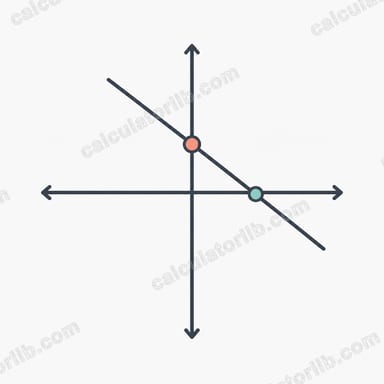
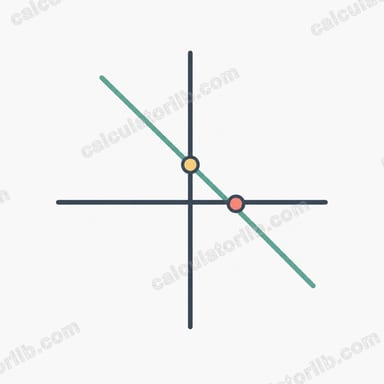
This tool finds the x-intercept and y-intercept of a straight line written in standard form, Ax + By = C. The x-intercept is the point where the line crosses the x-axis (where y = 0), and the y-intercept is where it crosses the y-axis (where x = 0). It also reports the slope of the line as a bonus.
How to Use It
Enter the three coefficients A, B, and C from your equation in standard form. If your line is given as 2x + 3y = 6, then A = 2, B = 3, and C = 6. Click calculate and the tool returns both intercept points and the slope.
The Formula Explained
To find the x-intercept, set y = 0 in the equation. This leaves Ax = C, so \(x = \frac{C}{A}\). To find the y-intercept, set x = 0, leaving By = C, so \(y = \frac{C}{B}\). The slope from standard form is \(m = -\frac{A}{B}\). Note that if A = 0 the line is horizontal and has no x-intercept; if B = 0 it is vertical and has no y-intercept.
Worked Example
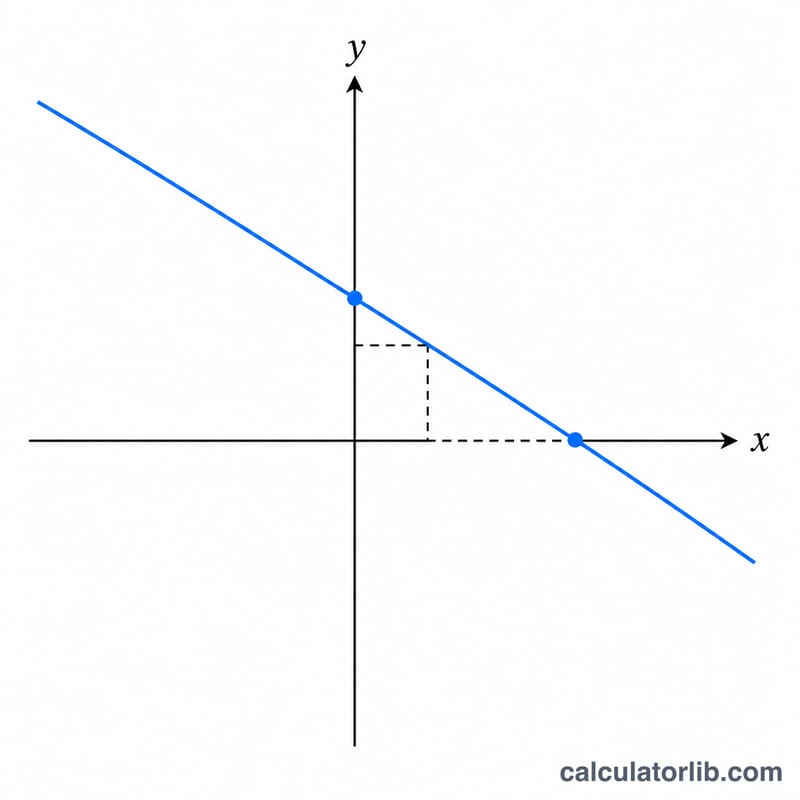
Take the line 2x + 3y = 6. The x-intercept is
giving the point (3, 0). The y-intercept is
$$y = \frac{C}{B} = \frac{6}{3} = 2$$giving the point (0, 2). The slope is
$$m = -\frac{A}{B} = -\frac{2}{3} \approx -0.667$$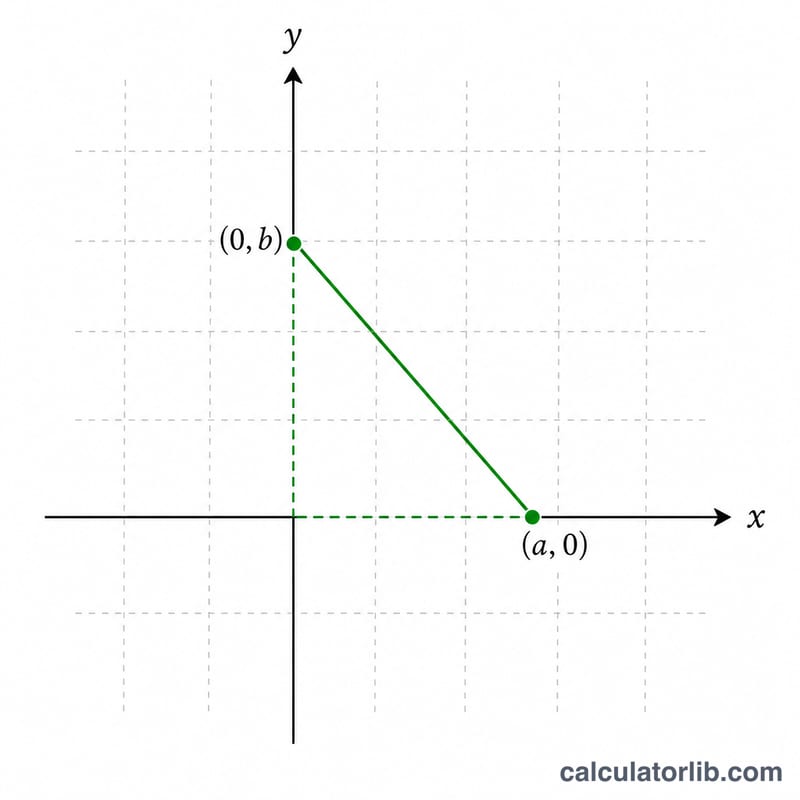
FAQ
What if A or B is zero? A zero denominator means that intercept does not exist. A horizontal line (A = 0) never crosses the x-axis except trivially, and a vertical line (B = 0) never crosses the y-axis.
Can I use decimals or negatives? Yes. Enter any real numbers for A, B, and C; the calculator handles negatives and decimals.
How do I convert slope-intercept form to standard form? Rearrange y = mx + b into -mx + y = b, then scale so coefficients are convenient integers if desired.