
What Is a Parallel Line?
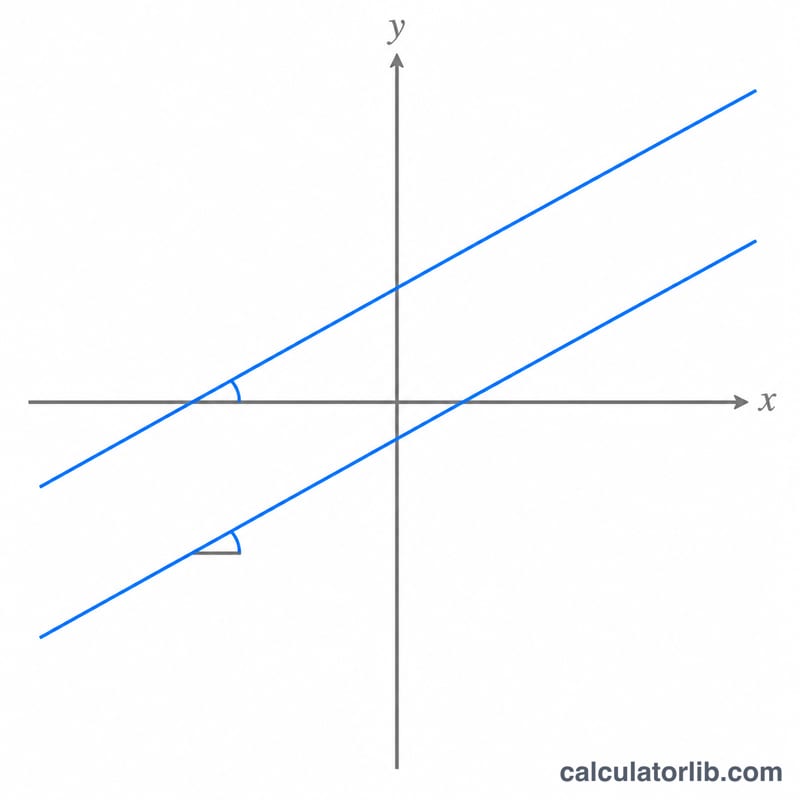
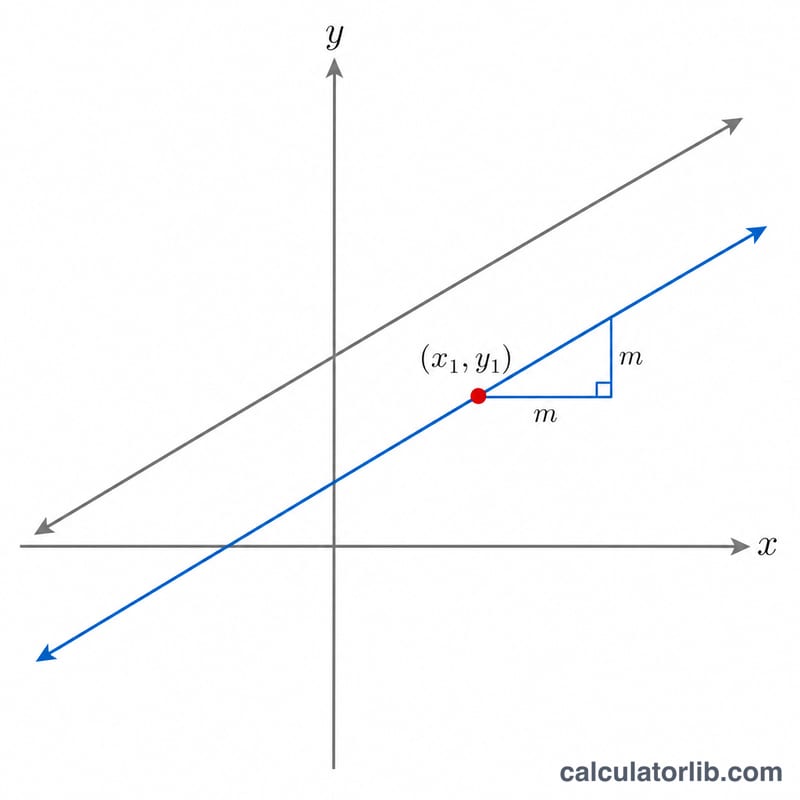
Two lines are parallel when they have the exact same slope but never intersect. This calculator takes the slope m of an original line and a point (x₀, y₀) that a new line must pass through, then builds the equation of the line that is parallel to the original and runs through your point.
How to Use It
Enter the slope of the original line and the coordinates of the point your parallel line should pass through. The calculator returns the equation in both slope-intercept form \(y = mx + b\) and point-slope form. Because parallel lines share an identical slope, the new line keeps the same m — only the y-intercept changes.
The Formula Explained
Start from the point-slope equation: \(y - y_0 = m(x - x_0)\). Expanding and solving for y gives $$y = m\,x + \left(y_0 - m\cdot x_0\right)$$ so the y-intercept is \(b = y_0 - m\cdot x_0\). The slope of the parallel line equals the original slope m exactly.
Worked Example
Suppose the original line has slope \(m = 2\) and the new parallel line must pass through the point (3, 4). Then $$b = 4 - 2\cdot 3 = 4 - 6 = -2$$ The parallel line is \(y = 2x - 2\), written in point-slope form as \(y - 4 = 2(x - 3)\).
FAQ
Do parallel lines always have the same slope? Yes. On a flat plane, any two distinct lines with equal slopes are parallel.
What about vertical lines? Vertical lines have an undefined slope (x = constant). This calculator works with numeric slopes only; for a vertical line, the parallel line is simply \(x = x_0\).
Can the y-intercept be negative? Absolutely. The intercept \(b = y_0 - m\cdot x_0\) can be positive, negative, or zero depending on your inputs.