
What Is Slope-Intercept Form?
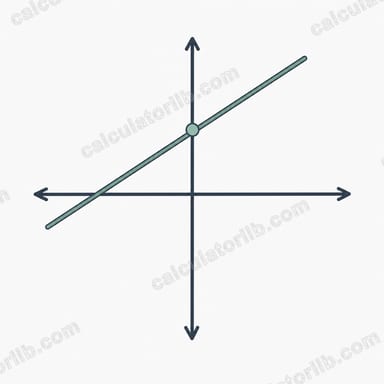
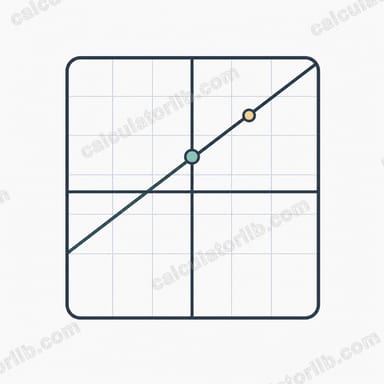
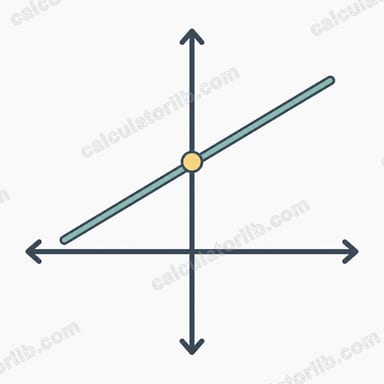
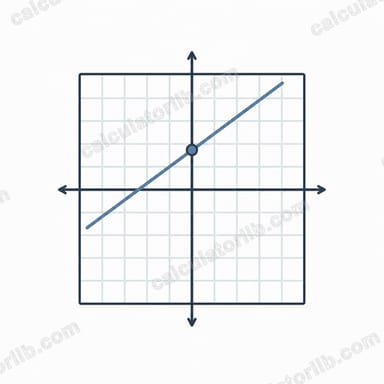
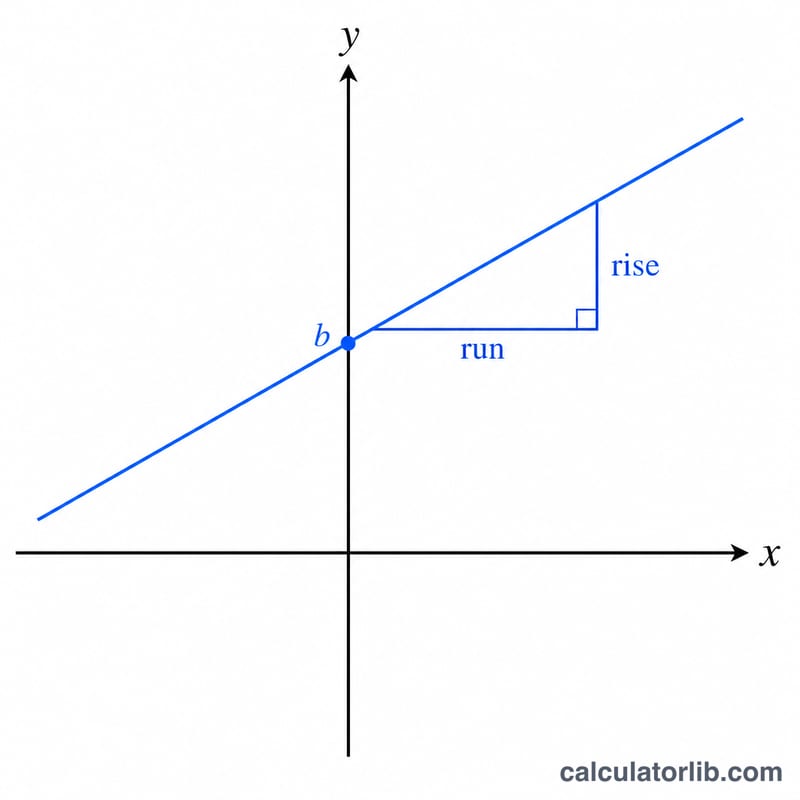
Slope-intercept form is the most common way to write the equation of a straight line: \(y = mx + b\), where \(m\) is the slope (how steep the line is) and \(b\) is the y-intercept (where the line crosses the vertical axis). This calculator takes any two points on the line and instantly returns m, b, and the full equation.
How to Use It
Enter the coordinates of two distinct points, \((x_1, y_1)\) and \((x_2, y_2)\). The calculator computes the slope and then the intercept. Make sure x₁ and x₂ are different — if they are equal the line is vertical and cannot be written in slope-intercept form.
The Formula Explained
The slope is the change in y divided by the change in x: \(m = \dfrac{y_2 - y_1}{x_2 - x_1}\). Once you have m, substitute one point back into \(y = mx + b\) and solve for the intercept: \(b = y_1 - m \cdot x_1\).
$$y = m\,x + b$$$$\text{where}\quad \left\{ \begin{aligned} m &= \dfrac{y_2 - y_1}{x_2 - x_1} \\ b &= y_1 - m \cdot x_1 \end{aligned} \right.$$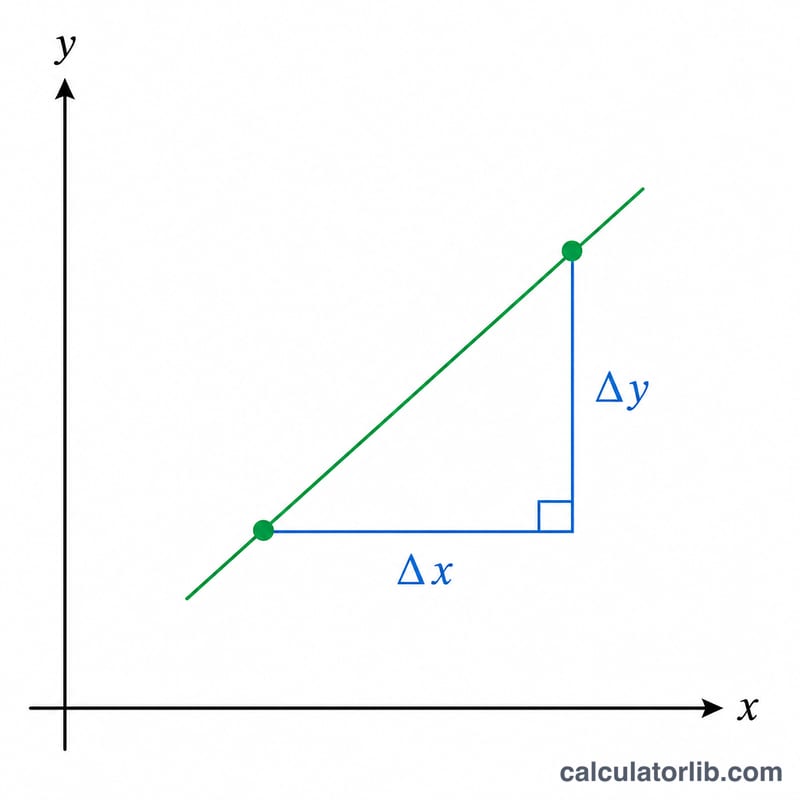
Worked Example
Take the points \((1, 2)\) and \((3, 8)\). Slope $$m = \frac{8 - 2}{3 - 1} = \frac{6}{2} = 3.$$ Intercept $$b = 2 - 3 \cdot 1 = -1.$$ So the equation is \(y = 3x - 1\).
FAQ
What if the two points are the same? You need two different points to define a unique line.
What does a slope of 0 mean? A horizontal line; the equation becomes \(y = b\).
Why can't a vertical line use this form? Its slope is undefined (division by zero), so it is written as \(x = \text{constant}\) instead.