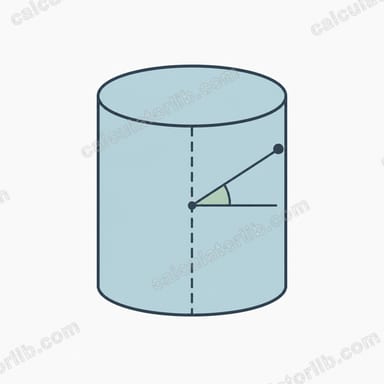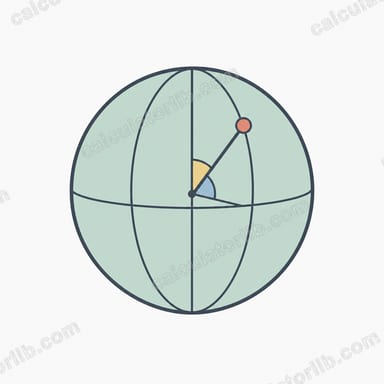

What Are Spherical Coordinates?
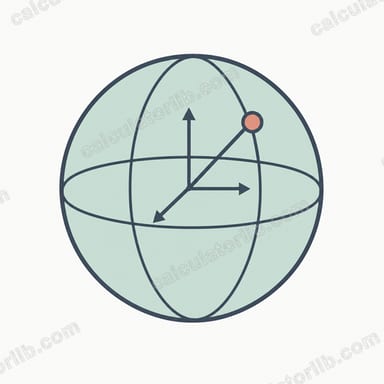
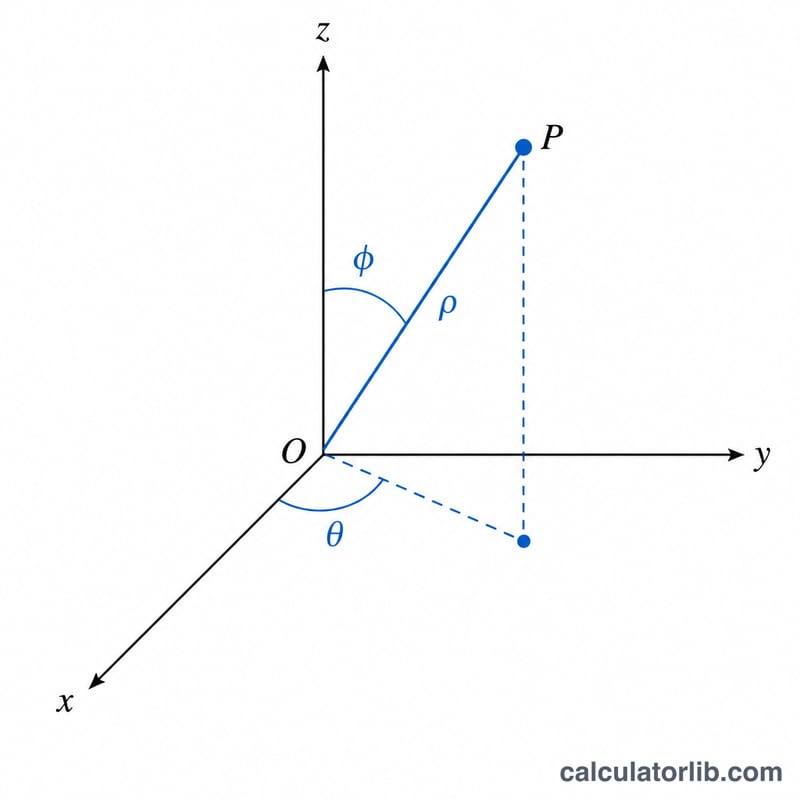
Spherical coordinates describe a point in 3D space using three values: the radial distance \(\rho\) (rho) from the origin, the azimuthal angle \(\theta\) (theta) measured in the xy-plane from the positive x-axis, and the polar angle \(\varphi\) (phi) measured down from the positive z-axis. This calculator converts ordinary Cartesian coordinates (x, y, z) into the spherical system (\(\rho\), \(\theta\), \(\varphi\)), which is widely used in physics, astronomy, computer graphics, and engineering.
How to Use It
Enter the three Cartesian components x, y, and z of your point, then read off \(\rho\), \(\theta\), and \(\varphi\). Angles are reported in both radians and degrees. The azimuthal angle uses the atan2 function, so it correctly resolves the quadrant and ranges over (−180°, 180°]; the polar angle ranges from 0° to 180°.
The Formula Explained
The radial distance is the 3D Pythagorean length, \(\rho = \sqrt{\text{x}^{2} + \text{y}^{2} + \text{z}^{2}}\). The azimuthal angle \(\theta = \operatorname{atan2}(\text{y}, \text{x})\) gives the rotation around the z-axis. The polar angle \(\varphi = \arccos(\text{z} / \rho)\) gives the tilt away from the vertical axis. When \(\rho = 0\) (the origin) the angles are undefined, so \(\varphi\) defaults to 0.
$$\begin{gathered} \rho = \sqrt{\text{x}^{2} + \text{y}^{2} + \text{z}^{2}} \\[1em] \theta = \operatorname{atan2}\!\left(\text{y},\, \text{x}\right) \\[1em] \varphi = \arccos\!\left(\frac{\text{z}}{\rho}\right) \end{gathered}$$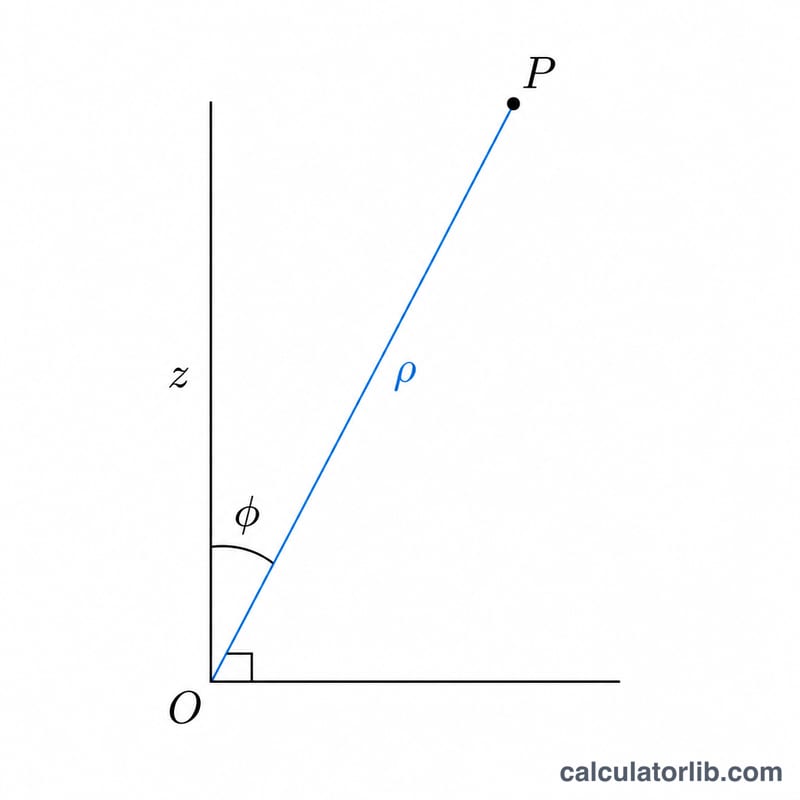
Worked Example
For the point (1, 1, 1):
$$\rho = \sqrt{1+1+1} = \sqrt{3} \approx 1.7320508$$$$\theta = \operatorname{atan2}(1, 1) = 45° = 0.7853982 \text{ rad}$$$$\varphi = \arccos\!\left(\frac{1}{\sqrt{3}}\right) = \arccos(0.5773503) \approx 0.9553166 \text{ rad} \approx 54.7356°$$FAQ
Which angle convention is used? The physics/ISO convention: \(\theta\) is the azimuth and \(\varphi\) is the polar (inclination) angle from the z-axis.
Why atan2 instead of arctan? \(\operatorname{atan2}(\text{y}, \text{x})\) returns the correct quadrant for any sign of x and y, unlike a plain \(\arctan(\text{y}/\text{x})\).
What if all inputs are zero? \(\rho\) is 0 and the angles are mathematically undefined; the tool returns \(\theta = 0\) and \(\varphi = 0\).