
What is the Spherical to Cylindrical Coordinates Converter?
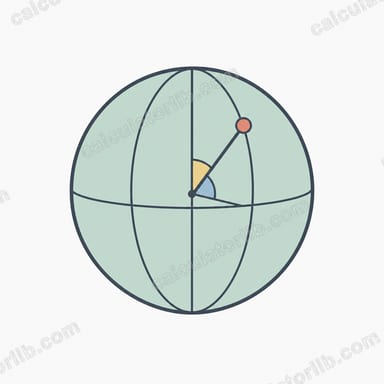
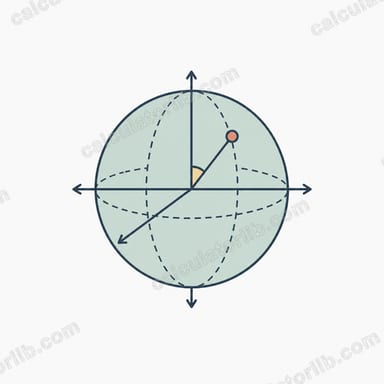
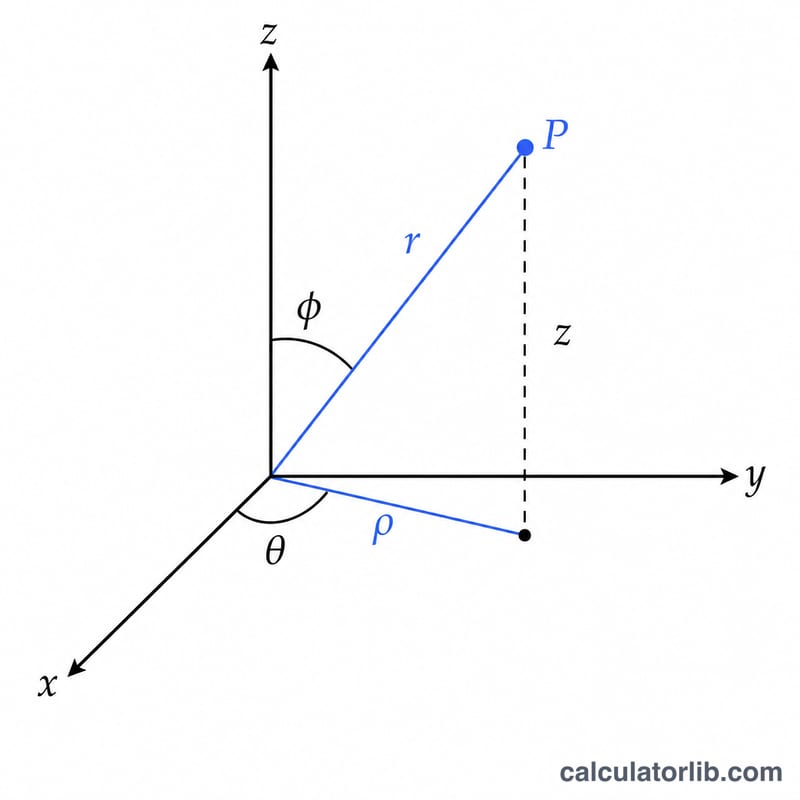
This tool converts a 3D point given in spherical coordinates into cylindrical coordinates. It uses the common physics/ISO convention where r is the radial distance from the origin, theta is the azimuthal angle measured in the x-y plane, and phi is the polar (zenith) angle measured down from the positive z-axis. Note that some math textbooks swap the roles of theta and phi, so always confirm which convention your source uses.
How to use it
Enter the radial distance r, the azimuthal angle theta, and the polar angle phi. Pick whether your angles are in degrees or radians using the angle-unit selector (it applies to both angles). Optionally choose a display precision. The calculator returns the cylindrical radius rho, the azimuthal angle theta (unchanged), and the height z along the axis.
The formula explained
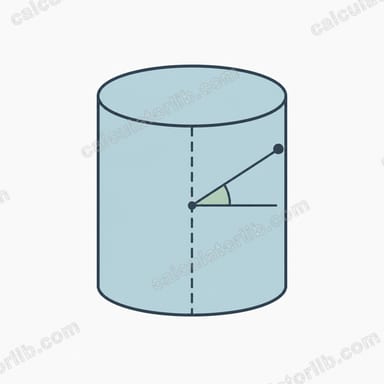
The azimuthal angle theta is identical in both systems, so it simply carries through. The other two coordinates come from projecting the radial distance onto and along the z-axis:
$$\rho = r\cdot\sin(\phi)$$$$\theta = \theta \;\text{(unchanged)}$$$$z = r\cdot\cos(\phi)$$Internally the angle is first converted to radians (multiply degrees by \(\pi/180\)), because the trigonometric functions expect radians.
Worked example
Take r = 5, theta = 60°, phi = 30°. Convert phi to radians: \(30 \times \pi/180 = 0.5236\) rad. Then \(\rho = 5 \times \sin(30°) = 5 \times 0.5 = 2.5\), the azimuthal angle stays at 60°, and \(z = 5 \times \cos(30°) = 5 \times 0.8660254 = 4.330127\). So the point in cylindrical coordinates is (2.5, 60°, 4.330127).
FAQ
Why does theta not change? Both spherical and cylindrical systems share the same azimuthal angle in the x-y plane, so theta is identical and is passed through unchanged.
What if phi = 0? The point lies on the positive z-axis: \(\rho = 0\) and \(z = r\). At phi = 90° the point is in the x-y plane (\(\rho = r\), \(z = 0\)); at phi = 180° it is on the negative z-axis (\(\rho = 0\), \(z = -r\)).
Can rho be negative? For \(0 \le \phi \le 180°\), \(\sin(\phi)\) is non-negative so rho is always ≥ 0. Standard practice keeps phi within [0, 180°].