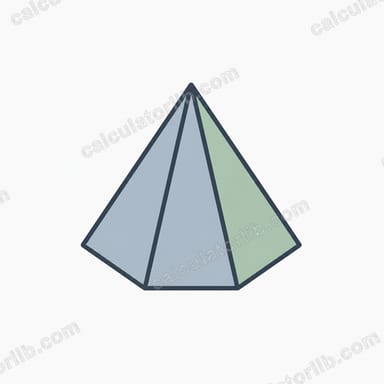

What is a hexagonal pyramid?
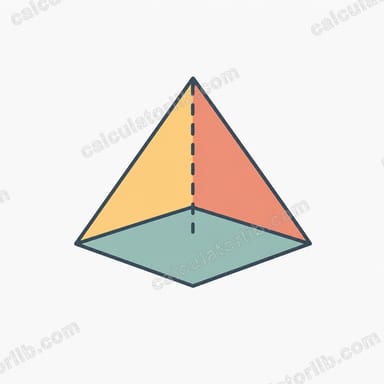
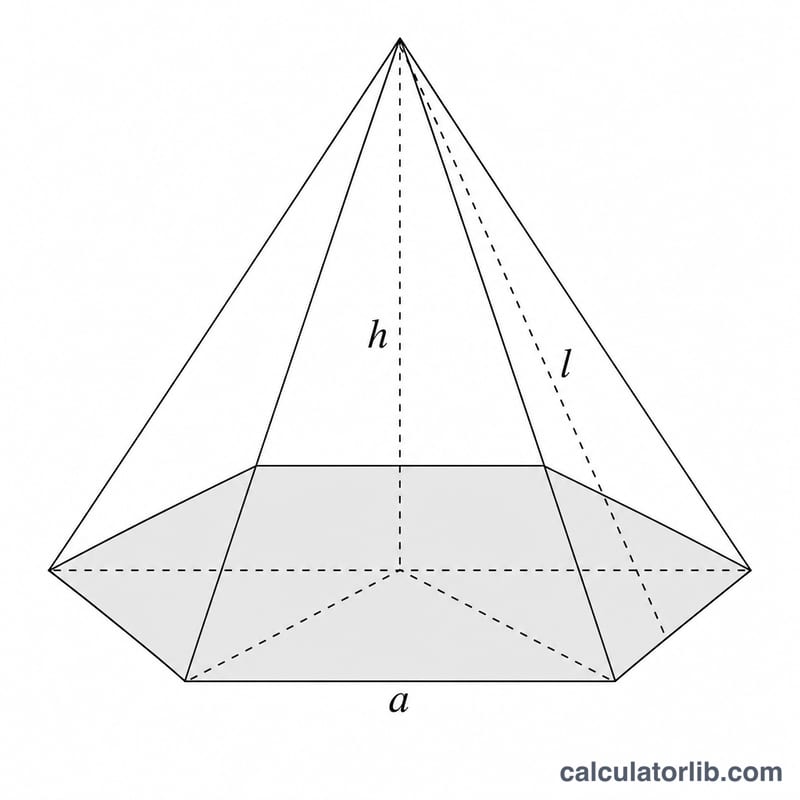
A regular hexagonal pyramid is a three-dimensional solid with a regular six-sided polygon as its base and six triangular faces that meet at a single apex directly above the center of the base. It is fully described by two measurements: the base edge length a (the length of one side of the hexagon) and the perpendicular height h from the base to the apex.
How to use this calculator
Enter the base edge length and the pyramid height in any consistent unit (cm, m, in, etc.). The calculator instantly returns the volume, the area of the hexagonal base, the lateral surface area, the total surface area, the slant height of the triangular faces, and the base perimeter.
The formulas explained
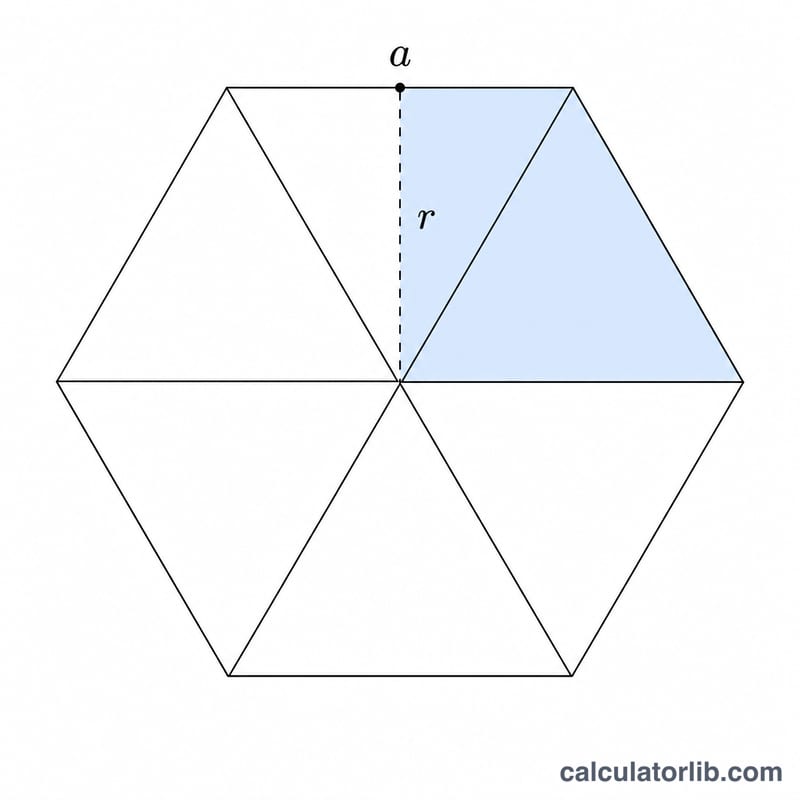
The hexagonal base has area \( A = \frac{3\sqrt{3}}{2}\,a^{2} \). The volume of any pyramid is one third of the base area times the height, which simplifies for a hexagon to
$$V = \frac{\sqrt{3}}{2}\,a^{2}\,h$$The slant height is found with the Pythagorean theorem using the height and the base apothem \( \frac{a\sqrt{3}}{2} \):
$$l = \sqrt{h^{2} + \left(\frac{a\sqrt{3}}{2}\right)^{2}}$$The lateral area is \( 3\,a\,l \) (six triangles), and the total surface area adds the base.
Worked example
For a base edge a = 6 and height h = 10: base area
$$A = \frac{3\sqrt{3}}{2}\cdot 36 \approx 93.53$$volume
$$V = \frac{\sqrt{3}}{2}\cdot 36 \cdot 10 \approx 311.77$$The apothem is \( 6\cdot\frac{\sqrt{3}}{2} \approx 5.196 \), so the slant height is
$$l = \sqrt{100 + 27} \approx 11.27$$Lateral area
$$A_{lat} = 3\cdot 6 \cdot 11.27 \approx 202.83$$and total surface area \( \approx 296.36 \).
FAQ
What units does it use? Any unit, as long as you use the same one for edge and height; volume comes out cubed and areas squared.
Is the height the slant height? No — enter the vertical (perpendicular) height. The calculator computes the slant height for you.
Does it work for irregular hexagonal pyramids? No, these formulas assume a regular hexagon base and an apex centered above it.