

What is the Imaginary Number Calculator?
The imaginary unit i is defined by \(i^2 = -1\). Whenever you raise i to an integer power, the result always simplifies to one of just four values: 1, i, -1, or -i. This calculator takes any exponent n — positive, negative, or zero — and returns \(i^n\) in its simplest form, along with its real and imaginary parts.
How to use it
Type the exponent n (the power you want to raise i to) and submit. The calculator reduces n modulo 4 and reports the matching value. Negative exponents are handled correctly because the modulo result is normalized into the range 0–3.
The formula explained
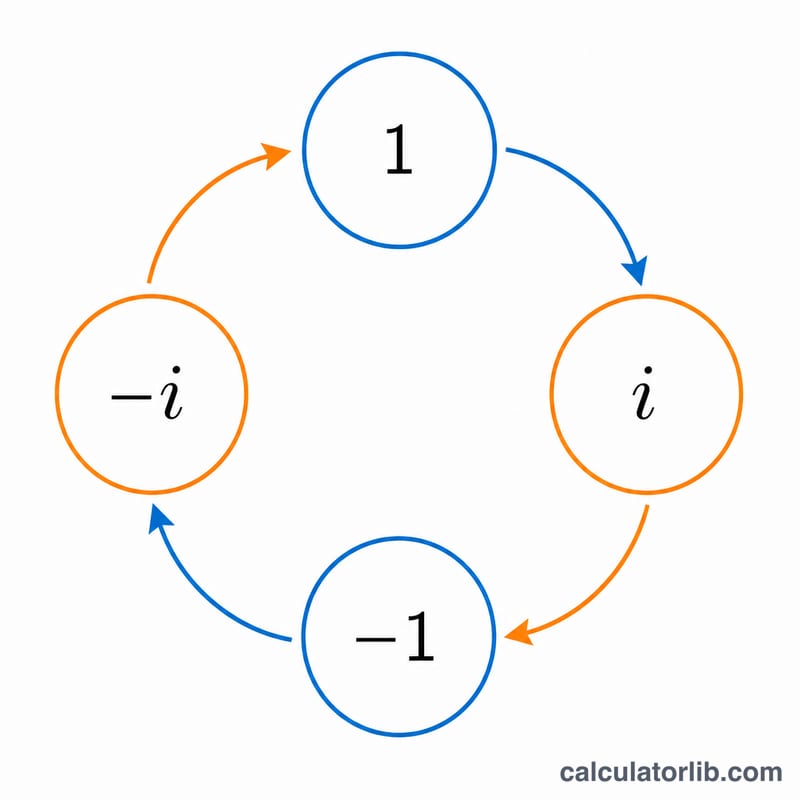
The powers of i form a repeating cycle of length four:
\(i^0 = 1\), \(i^1 = i\), \(i^2 = -1\), \(i^3 = -i\), and then \(i^4 = 1\) again. Because of this, \(i^n\) equals i raised to the remainder of n divided by 4. We compute $$i^{\,n} = i^{\,m}, \quad m = ((n \bmod 4) + 4) \bmod 4 = \begin{cases} 1 & m = 0 \\ i & m = 1 \\ -1 & m = 2 \\ -i & m = 3 \end{cases}$$ so the index is always 0, 1, 2, or 3 — even for negative n — then map it to the value.
Worked example
Find \(i^{30}\). Divide 30 by 4: $$30 = 4 \times 7 + 2, \quad \text{so } 30 \bmod 4 = 2.$$ Therefore \(i^{30} = i^2 = -1\). The real part is -1 and the imaginary part is 0.
FAQ
What is \(i^0\)? Any nonzero base to the power 0 is 1, so \(i^0 = 1\).
How are negative powers handled? \(i^{-1} = 1/i = -i\). The modulo math normalizes -1 to index 3, which correctly returns -i.
Why only four possible answers? Multiplying by i rotates a number 90° in the complex plane; four rotations return you to the start, creating the 4-step cycle.