
What this calculator does
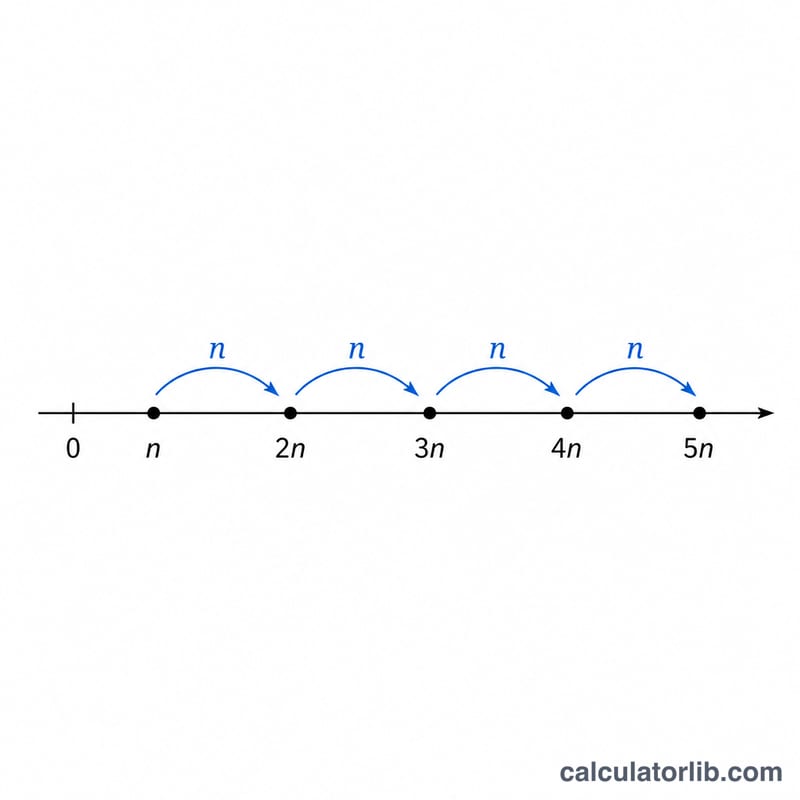
This tool lists the first 100 multiples of a positive whole number. A multiple of a number \(n\) is any value \(n\) times a positive whole number: \(n\), \(2n\), \(3n\), and so on. You can also set a minimum value so that only multiples strictly greater than that minimum are shown, which is handy when you only care about larger members of the sequence.
How to use it
Enter the number whose multiples you want in the first box. In the second box, enter a minimum value: only multiples that are strictly greater than this number will be listed. To start from the very first multiple, set the minimum to 0. Press calculate and you will get exactly 100 multiples in ascending order, plus a plain-English answer sentence you can copy.
The formula explained
To find where the list should start, compute the starting index $$k_0 = \left\lfloor \frac{m}{n} \right\rfloor + 1,$$ where \(m\) is the minimum and \(n\) is the number. Multiplying gives the first term \(n \times k_0\), which is guaranteed to be the smallest multiple strictly greater than the minimum. Because the rule is strict, if the minimum is itself a multiple of \(n\) it is skipped. The list is then $$\text{term}_i = n \times (k_0 + i), \quad i = 0 \text{ to } 99.$$

Worked example
Suppose \(n = 5\) and \(m = 100\). Then $$k_0 = \left\lfloor \frac{100}{5} \right\rfloor + 1 = 20 + 1 = 21,$$ so the first listed multiple is \(5 \times 21 = 105\). Note 100 is excluded because the rule is strictly greater. The 100 terms run 105, 110, 115, … up to \(5 \times 120 = 600\).
FAQ
Why is 100 not in the list when I enter 5 and 100? Because "greater than" is strict; 100 equals the minimum, so it is excluded and the list begins at 105. Lower the minimum to 99 to include 100.
How do I see the standard first 100 multiples? Set the minimum to 0. Then the list is simply \(n \times 1\) through \(n \times 100\).
Does it always return exactly 100 values? Yes. Regardless of the inputs, the calculator always produces 100 multiples.