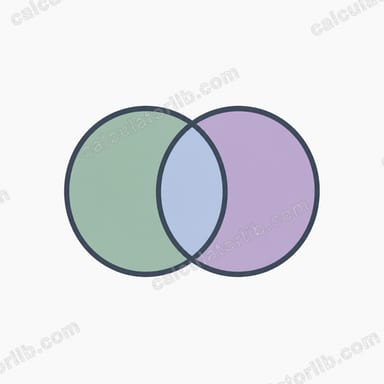

What is a common multiple?
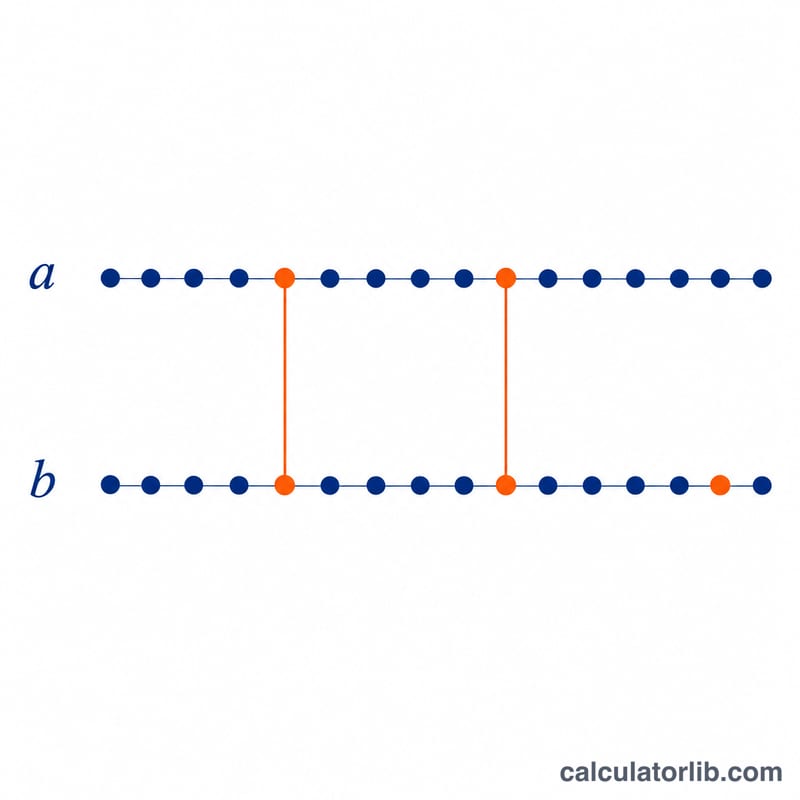
A common multiple of two whole numbers is a number that both of them divide into evenly. For example, 12 is a common multiple of 4 and 6 because \(4 \times 3 = 12\) and \(6 \times 2 = 12\). Since every number has infinitely many multiples, two numbers share infinitely many common multiples — but they all follow a simple pattern built on a single value: the least common multiple (LCM).
How to use this calculator
Enter your two numbers, choose how many common multiples you want to see, and the calculator returns the LCM, the greatest common divisor (GCD), and an ordered list of the first shared multiples. Because every common multiple is a multiple of the LCM, the list is simply LCM, 2×LCM, 3×LCM, and so on.
The formula explained
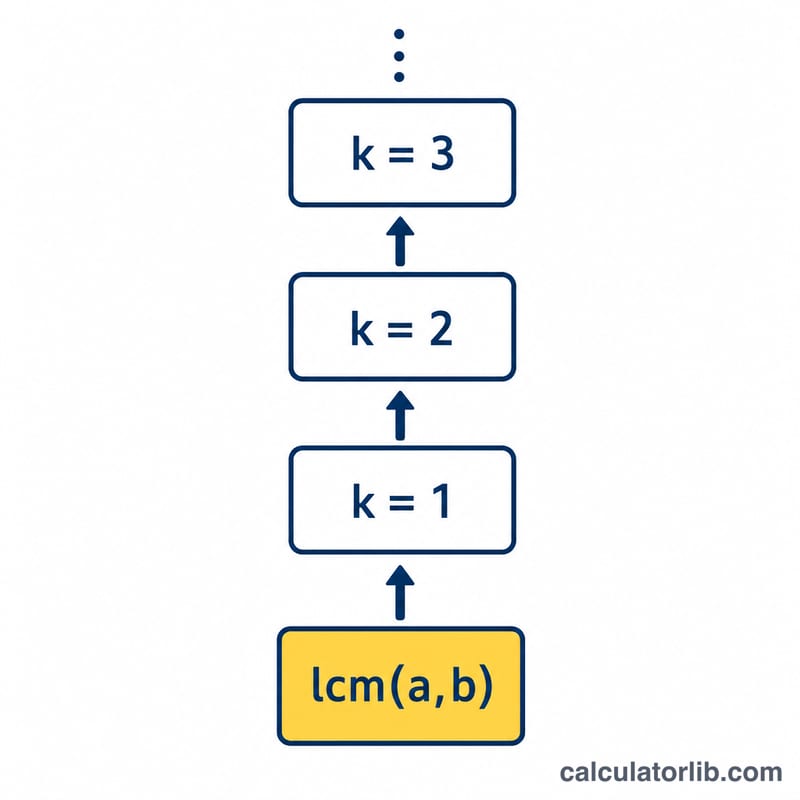
The fastest route to common multiples is through the LCM. The LCM is found from the GCD: $$\operatorname{lcm}(\text{a},\, \text{b}) = \frac{\text{a} \times \text{b}}{\gcd(\text{a},\, \text{b})}$$ The GCD is computed with the Euclidean algorithm (repeatedly replace the larger number with the remainder of dividing it by the smaller). Once you have the LCM, every common multiple is \(k \times \operatorname{lcm}\) for \(k = 1, 2, 3, \ldots\)
Worked example
Take \(a = 4\) and \(b = 6\). Their GCD is 2, so $$\operatorname{lcm} = \frac{4 \times 6}{2} = \frac{24}{2} = 12$$ The first five common multiples are therefore 12, 24, 36, 48 and 60 — each divisible by both 4 and 6.
FAQ
Is there a largest common multiple? No. Because you can keep multiplying the LCM, the common multiples go on forever. There is only a smallest one, the LCM.
What if the two numbers are the same? Then the LCM equals that number, and the common multiples are just its ordinary multiples.
What if one number is 1? Every multiple of the other number is then a common multiple, since 1 divides everything.