
What it is
The Early Retirement Savings Calculator estimates how many years of consistent annual investing it will take to accumulate your target nest egg. It is a planning tool for anyone pursuing financial independence (FI) or early retirement, and it works with any currency since the math is universal.
How to use it
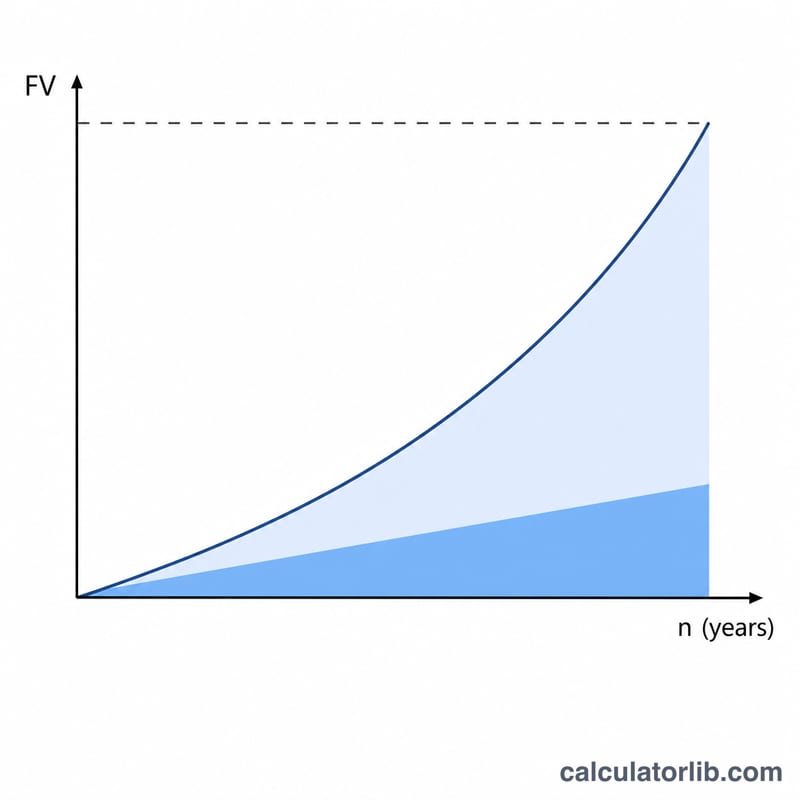
Enter your target nest egg, the amount you contribute each year, and the average annual return you expect from your investments. The calculator returns the number of years until you hit the goal, along with how much of that comes from your own contributions versus investment growth.
The formula explained
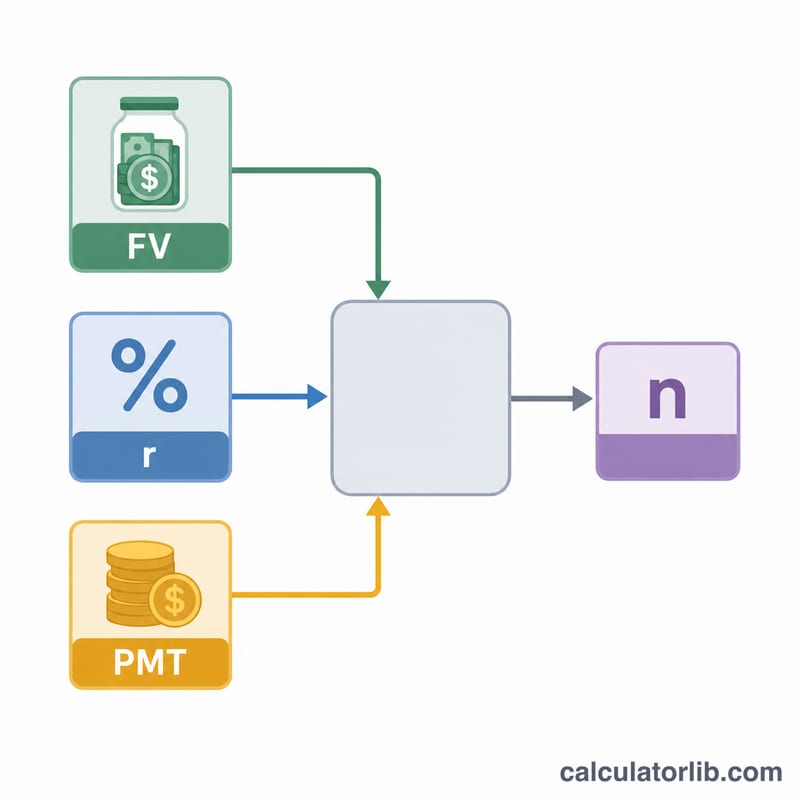
The tool solves the future-value-of-an-annuity equation for time. Given a future value FV, an annual contribution PMT, and a decimal annual return \(r\), the number of years is $$n = \frac{\ln\!\left(\dfrac{\text{FV} \cdot r}{\text{PMT}} + 1\right)}{\ln(1 + r)}.$$ When \(r\) is 0 the equation simplifies to \(\text{FV} / \text{PMT}\), which the calculator handles separately to avoid dividing by zero.
Worked example
Suppose you want a $1,000,000 nest egg, contribute $30,000 per year, and expect a 7% return. Then \(r = 0.07\), $$\frac{\text{FV} \cdot r}{\text{PMT}} = \frac{1{,}000{,}000 \times 0.07}{30{,}000} = 2.3333,$$ plus 1 gives 3.3333. \(\ln(3.3333) \approx 1.20397\) and \(\ln(1.07) \approx 0.06766\), so \(n \approx 17.8\) years. Your contributions over that time total about $533,800 and the rest, roughly $466,200, is investment growth.
FAQ
Are contributions made at year-end? Yes, this model assumes an ordinary annuity with contributions at the end of each period.
Does it account for inflation or taxes? No. Use a real (inflation-adjusted) return and after-tax figures if you want results in today's dollars.
What if I already have savings? Treat your target as the remaining gap, or subtract the future value of existing savings from the target before entering it.