
What This Calculator Does
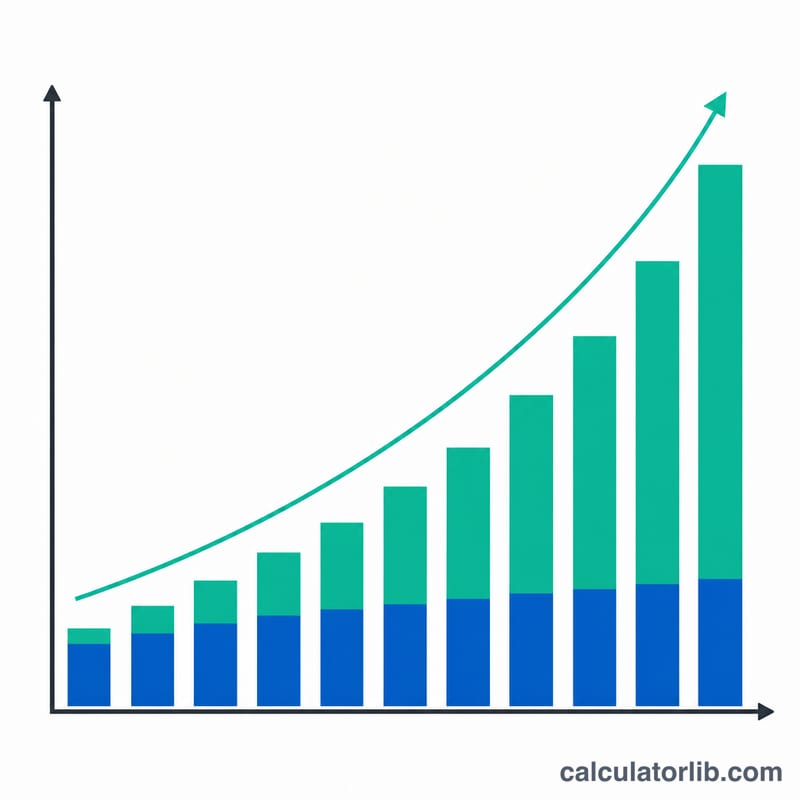
The Monthly Investment Growth Calculator for Retirement projects how much your regular monthly contributions could grow into by the time you retire. It uses compound interest with monthly compounding, so each contribution earns returns and those returns earn returns too. This is a universal compound-growth tool and is not tied to any specific country or tax-advantaged account — enter any monthly amount, expected rate, and time horizon.
How to Use It
Enter three values: your monthly contribution (the amount you invest every month), your annual interest rate (a long-term expected return, e.g. 7%), and the number of years until retirement. The calculator returns your estimated retirement balance, the total amount you personally contributed, and how much of the balance came from compound interest.
The Formula Explained
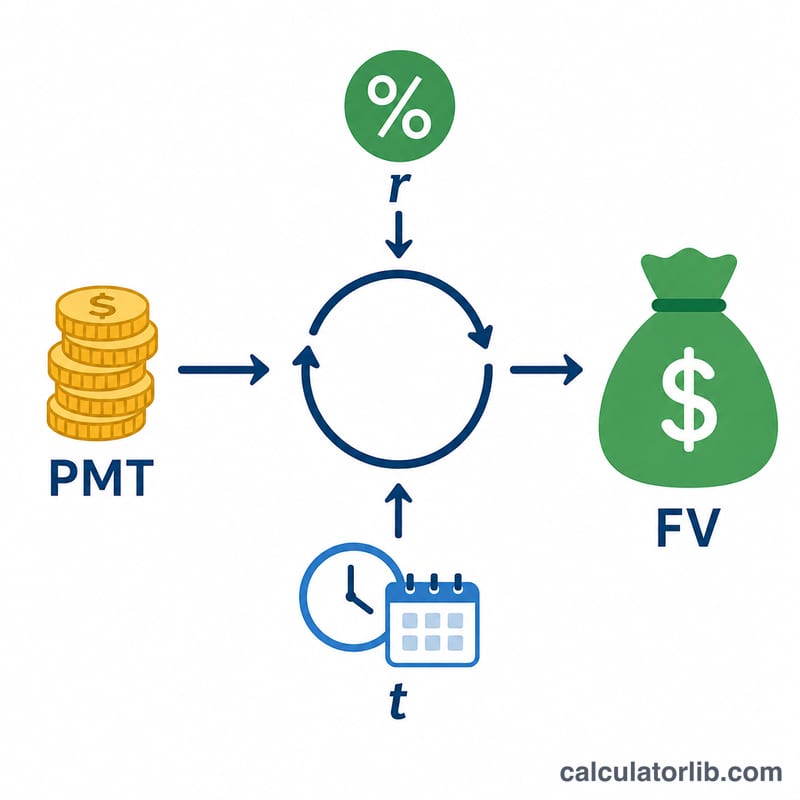
The future value of a series of equal monthly deposits is calculated as:
$$FV = PMT \times \left[\frac{(1 + r/12)^{12t} - 1}{r/12}\right] \times (1 + r/12)$$
Here r is the annual rate as a decimal and t is years. The bracketed term is the standard annuity factor, and the final \((1 + r/12)\) treats each deposit as made at the start of the month (an "annuity due"), giving each contribution one extra month of growth.
Worked Example
Suppose you invest $500 per month at a 7% annual return for 30 years. The monthly rate is \(0.07/12 \approx 0.0058333\), and there are 360 months. Plugging in: $$FV \approx 500 \times 1219.97 \times 1.0058333 \approx \mathbf{613{,}544}$$ You contributed $180,000 of your own money, so roughly $433,544 came from compound growth.
FAQ
Are contributions added at the start or end of the month? This model assumes the start of each month, which gives slightly higher results than an end-of-month model.
What rate should I use? A diversified long-term portfolio has historically returned roughly 6–8% before inflation. Use a conservative figure to avoid overestimating.
Does this account for inflation or taxes? No. The result is a nominal pre-tax figure. Subtract expected inflation to estimate purchasing power.