

What Is the Savings Multiple by Age Calculator?
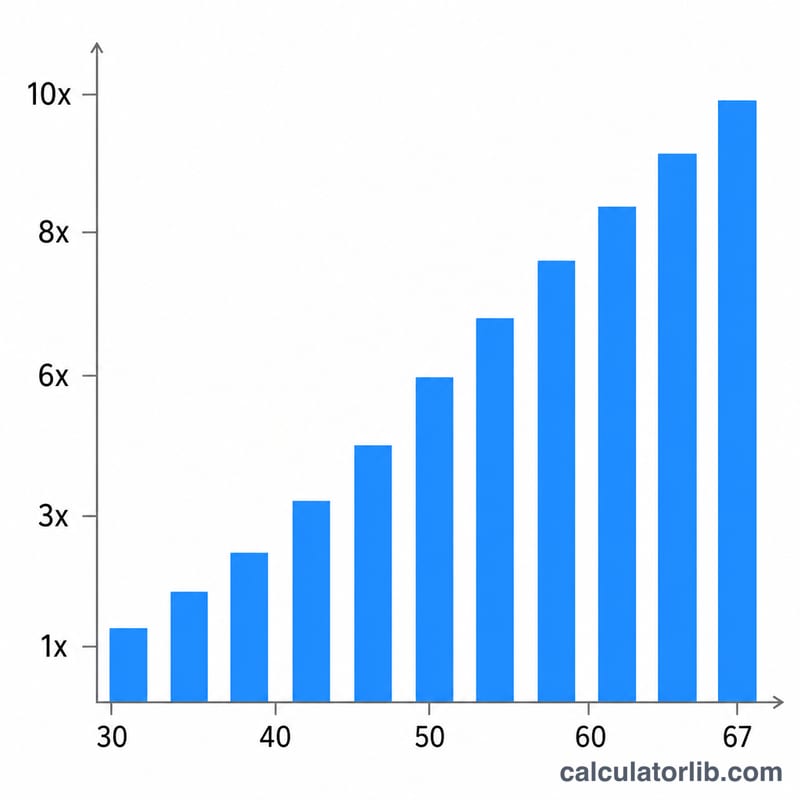
This calculator (based on widely used US retirement guidelines, e.g. Fidelity's benchmarks) estimates how much you should have saved for retirement at your current age, expressed as a multiple of your annual salary. The popular milestones are 1× your salary by age 30, 3× by 40, 6× by 50, 8× by 60, and 10× by 67. It is intended as a US-oriented rule of thumb and assumes a typical retirement around age 67.
How to Use It
Enter your current annual gross salary and your current age. The calculator finds the appropriate savings multiple for your age (interpolating smoothly between the published milestones) and multiplies it by your salary to give a target savings figure. Compare that target with your actual retirement balances to see whether you are on track.
The Formula Explained
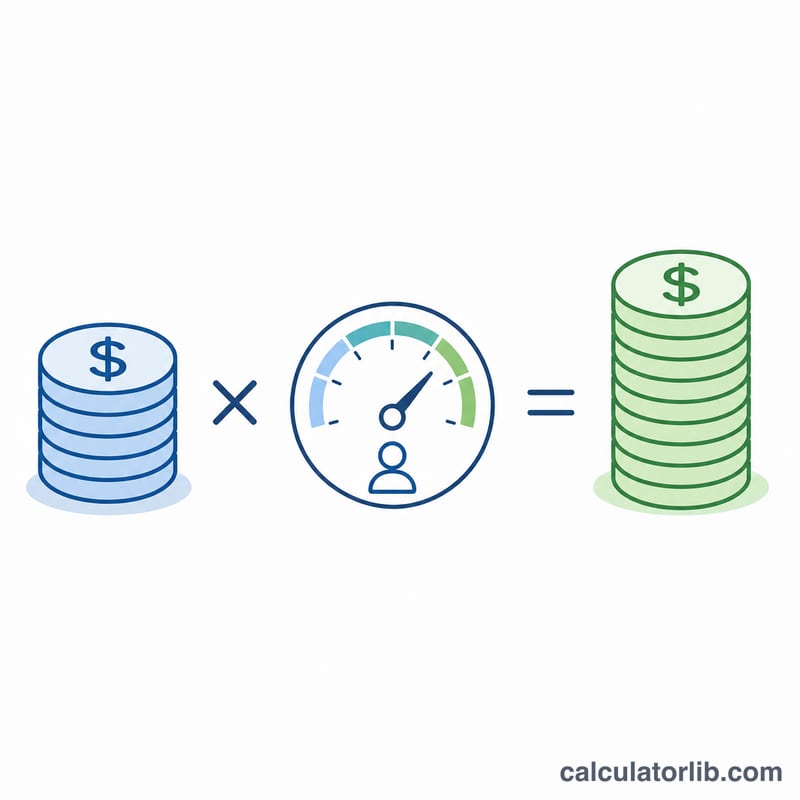
The core equation is $$\text{Target} = \text{Annual Salary} \times m(\text{age})$$ where \(m(\text{age})\) is the savings multiple. At the milestone ages the multiple equals the published value (1, 3, 6, 8, 10). Between milestones the calculator linearly interpolates — for example at age 45, halfway between 40 (3×) and 50 (6×), the multiple is 4.5×.
Worked Example
Suppose you earn $60,000 and are 40 years old. The multiple at 40 is exactly 3×, so your target savings $$= 60{,}000 \times 3 = \textbf{\$180{,}000}$$ At age 50 the same salary would target \(6\times = \$360{,}000\).
FAQ
Is this a guarantee? No. These are rough benchmarks; your real needs depend on lifestyle, longevity, Social Security, and investment returns.
Does it apply outside the US? The multiples are based on US savings guidance and assume retirement near 67; other countries have different systems.
What counts as savings? Generally retirement accounts such as 401(k), IRA, and other long-term investments — not your emergency fund or home equity.