
What is DMS to Decimal Degrees Conversion?
Geographic coordinates are often written in the sexagesimal degrees-minutes-seconds (DMS) format, such as 40°26′46″ N. Many mapping tools, GPS devices, and programming libraries instead expect decimal degrees, like 40.446111. This calculator converts any DMS angle into its decimal degrees equivalent so you can paste it directly into Google Maps, GIS software, or your own code.
How to Use It
Choose whether the coordinate is positive (North latitude or East longitude) or negative (South or West). Enter the whole degrees, the minutes (0–59), and the seconds (0–59.999). The calculator returns the single decimal degree value along with a breakdown of each component.
The Formula Explained
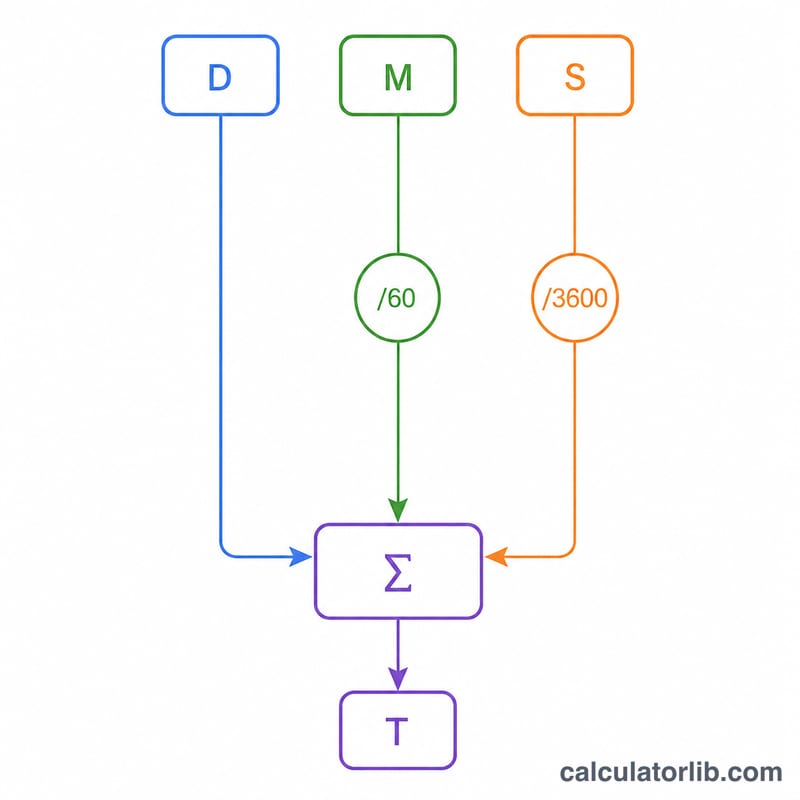
One full degree contains 60 minutes, and one minute contains 60 seconds, so one degree equals 3600 seconds. To combine the parts into a decimal you divide minutes by 60 and seconds by 3600, then add them to the whole degrees:
$$\text{Decimal} = \text{D} + \frac{\text{M}}{60} + \frac{\text{S}}{3600}$$
If the location is South or West, multiply the entire result by \(-1\).
Worked Example
Convert 40° 26′ 46″ N to decimal degrees. Minutes: \(26 \div 60 = 0.433333\). Seconds: \(46 \div 3600 = 0.012778\). Sum: $$40 + 0.433333 + 0.012778 = 40.446111°$$ Because it is North, the value stays positive: 40.446111°.
FAQ
Why are some coordinates negative? Southern latitudes and Western longitudes are conventionally expressed as negative decimal degrees.
How many decimals should I keep? Six decimal places of latitude/longitude pinpoint a location to roughly 0.11 meters, which is plenty for most uses.
Can minutes or seconds exceed 60? No. Valid minutes and seconds range from 0 up to (but not including) 60; otherwise they would roll into the next larger unit.