
What is the DMS to Decimal Degrees Converter?
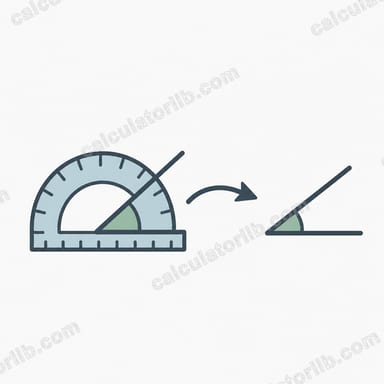
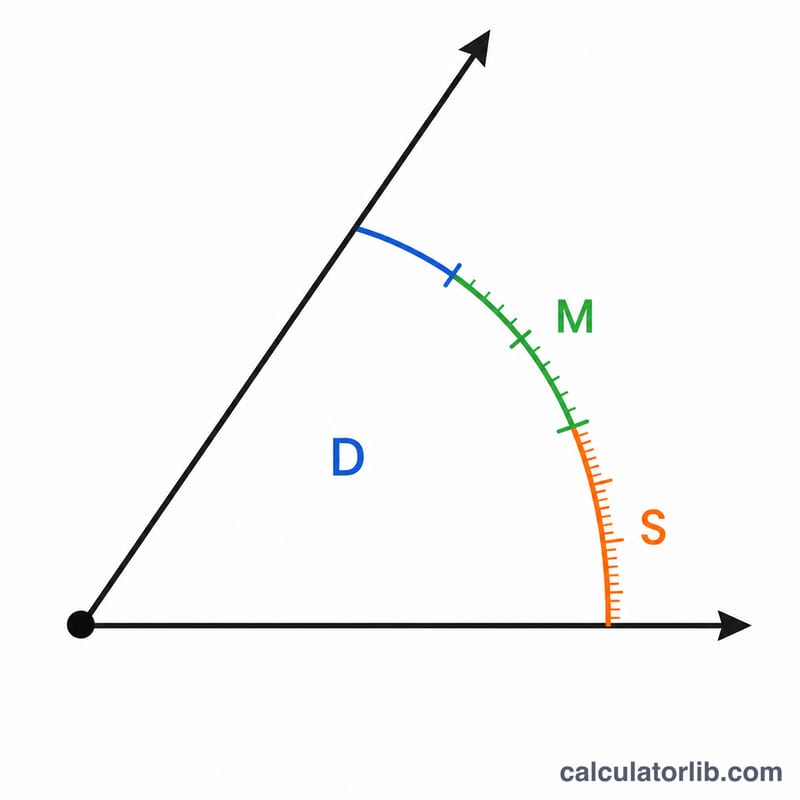
Angles are often written in degrees, minutes and seconds (DMS) — a sexagesimal (base-60) notation inherited from ancient astronomy. This tool turns that DMS value into a single decimal-degrees number, which is the format computers, spreadsheets and GPS systems usually need. It is widely used in land surveying, engineering drawings, dimensional inspection on measuring machines, and in navigation and astronomy.
How to use it
Pick the sign (+ for north/east or positive angles, − for south/west or negative angles), then enter the whole degrees, the minutes and the seconds. Leave a field blank and it is treated as zero. The result is the combined decimal-degrees value. The sign is applied to the whole DMS group, so you only set direction once — do not negate the individual components yourself.
The formula explained
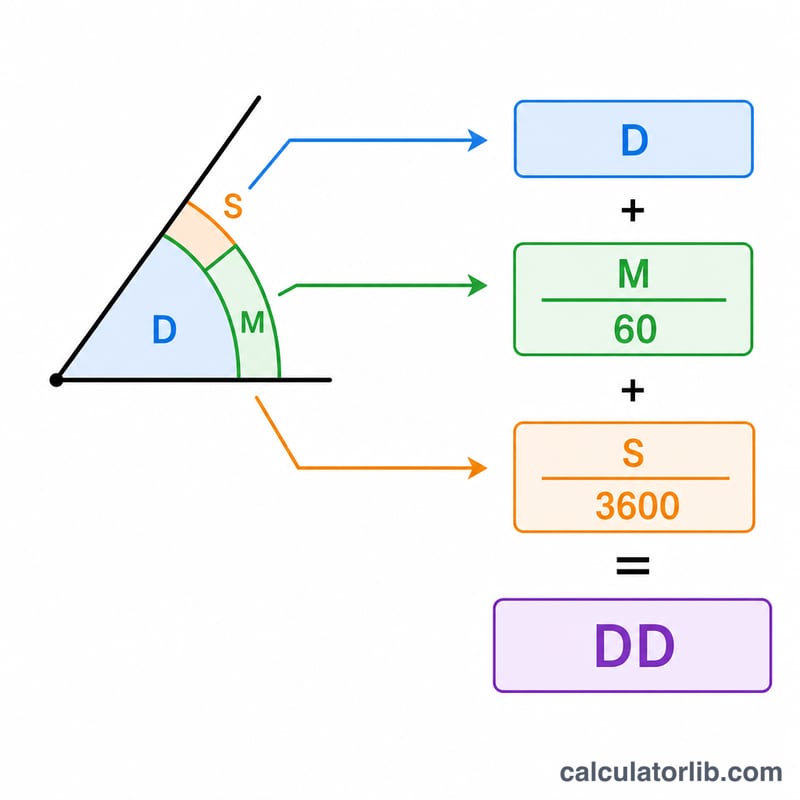
One arcminute equals 1/60 of a degree and one arcsecond equals 1/3600 of a degree, so:
$$\text{DD} = \text{Sign} \times \left( \text{Degrees} + \frac{\text{Minutes}}{60} + \frac{\text{Seconds}}{3600} \right)$$Because the divisors are fixed constants (60 and 3600) there is never a divide-by-zero risk. Un-normalized inputs still work: 90 minutes simply adds 1.5°, so you can convert raw measurements without first reducing them to the 0–59 range.
Worked example
Convert +30° 31′ 12″:
$$\text{DD} = +1 \times \left( 30 + \frac{31}{60} + \frac{12}{3600} \right) = 30 + 0.51666\ldots + 0.00333\ldots = 30.52\degree$$For a negative bearing −12° 30′ 00″:
$$\text{DD} = -1 \times \left( 12 + 0.5 + 0 \right) = -12.5\degree$$FAQ
Why use the sign selector instead of a negative degree value? A negative degree with positive minutes is ambiguous. Using one sign for the whole group matches surveying convention and avoids errors.
Can minutes or seconds exceed 59? Yes. The math still works — the surplus just rolls into the decimal total — though normalized DMS keeps minutes and seconds in the 0–59 range.
How precise is the result? The converter rounds for everyday display. For high-precision survey work keep extra decimal places, since one arcsecond is about 0.000278°.