
What this calculator does
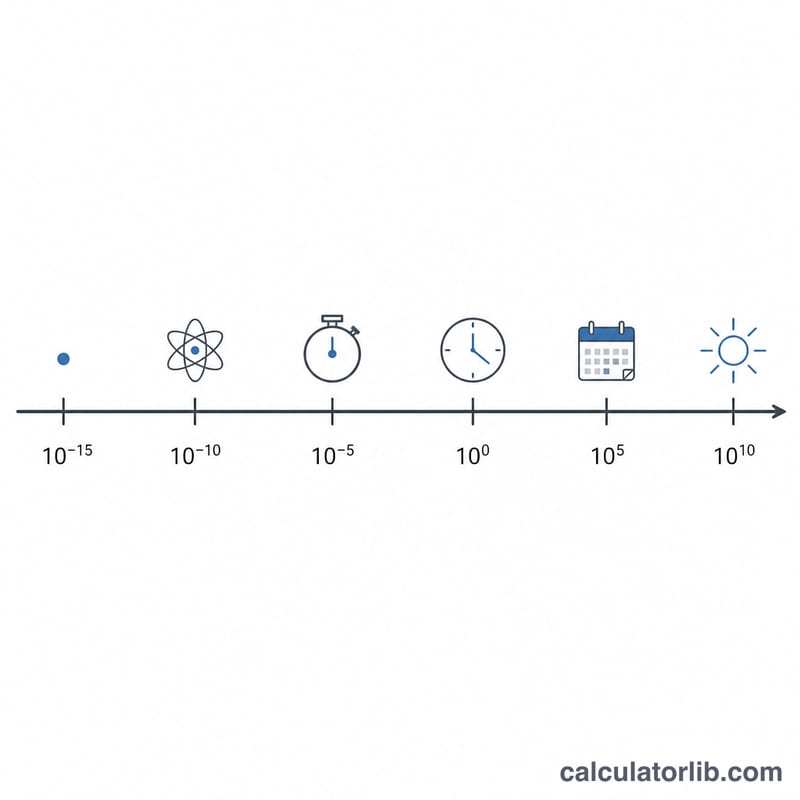
The Time Unit Conversion Calculator turns a single quantity of time, expressed in one unit, into its equivalent across sixteen different time units at the same time. It spans an extraordinary range, from the unimaginably small Planck time and the atomic unit of time used in physics, through metric units like nanoseconds and milliseconds, up to everyday minutes, hours and days, and on to several definitions of the year and the Julian century. The tool is universal and uses pure mathematical constants, so it applies identically anywhere in the world.
How to use it
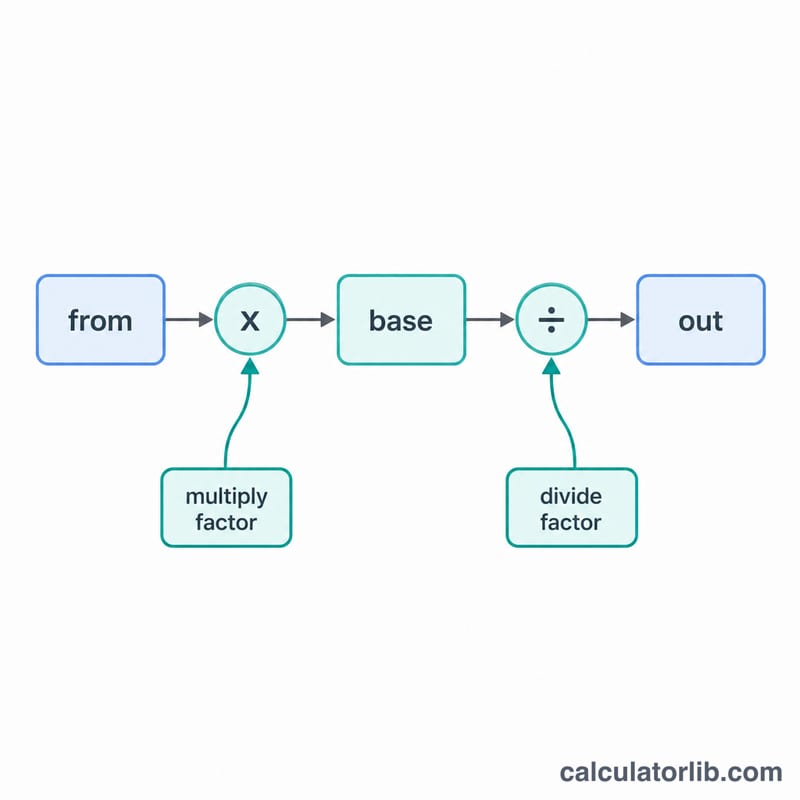
Enter a number in the "Time value" field, pick the unit that value is currently expressed in from the "Input unit" dropdown, and choose how many significant digits you want displayed. The calculator first converts your value to SI seconds, then divides that by each unit's scale factor to fill the whole results table at once.
The formula explained
Every unit is defined by its size in seconds, called its scale factor. To convert, the calculator computes \(\text{seconds} = \text{value} \times \text{factor[input unit]}\), then for every target unit it computes \(\text{out} = \text{seconds} \div \text{factor[unit]}\). For example one minute is 60 s, one hour is 3600 s, one day is 86400 s, and a Gregorian year is $$365.2425 \times 86400 = 31{,}556{,}952 \text{ s}.$$ Because all scale factors are strictly positive, no division by zero can ever occur, and negative or zero input values are handled cleanly.
Worked example
Suppose value = 90 and the input unit is Minute. First, $$\text{seconds} = 90 \times 60 = 5400 \text{ s}.$$ Then $$\text{hours} = 5400 \div 3600 = 1.5 \text{ hour},$$ and $$\text{days} = 5400 \div 86400 = 0.0625 \text{ day}.$$ For value = 1 second, $$\text{Planck time} = 1 \div 5.39124760 \times 10^{-44} = 1.8548608483392 \times 10^{43} \text{ tp}.$$
FAQ
Why are there several "year" options? Different fields use different year lengths: a calendar year is 365 days, the Gregorian year averages 365.2425 days, the Julian year is exactly 365.25 days, and the sidereal year (one full orbit relative to the stars) is about 365.256363 days.
What is Planck time? It is the smallest meaningful unit of time in physics, roughly \(5.39 \times 10^{-44}\) seconds, derived from fundamental constants.
Does the significant-digits setting change the answer? No. It only controls how many digits are shown; the underlying converted values are always computed at full precision.