
What is the Density Unit Conversion Calculator?
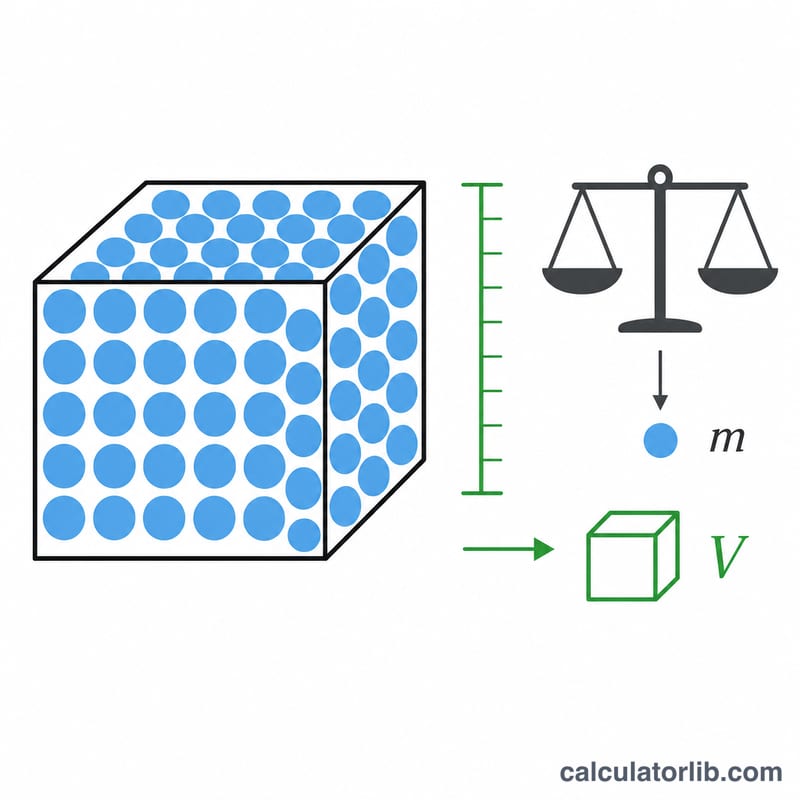
This tool converts a single density value into 15 commonly used density units at the same time. Density is mass per unit volume, and it appears in countless metric and imperial units depending on the field of work. Whether you have a value in grams per cubic centimetre, kilograms per cubic metre, metric tonnes per cubic metre, or pounds per cubic foot, this calculator shows every equivalent instantly. It is a pure physics/units tool and works identically everywhere in the world.
How to use it
Enter your density value, choose the unit that the value is expressed in from the dropdown, and pick how many display digits you want. The results table then lists the same value expressed in all 15 supported units. The "Display digits" option only changes the precision shown; it never alters the underlying math.
The formula explained
Every unit has a fixed factor that converts it to the SI base unit, kilogram per cubic metre (\(\text{kg/m}^3\)). First the entered value is normalized to SI: \(\rho_{\text{SI}} = \text{value} \times f_{in}\). Then it is converted to each target unit by dividing by that unit's factor: \(\text{out} = \rho_{\text{SI}} / f_{out}\). Combined, the direct conversion is \(\text{out} = \text{value} \times f_{in} / f_{out}\). Because the factors are fixed nonzero constants, there is never a division by your input, so a value of zero simply produces zero everywhere.
$$\text{Output} = \text{Density} \times \frac{f_{\text{Input Unit}}}{f_{\text{Output Unit}}}$$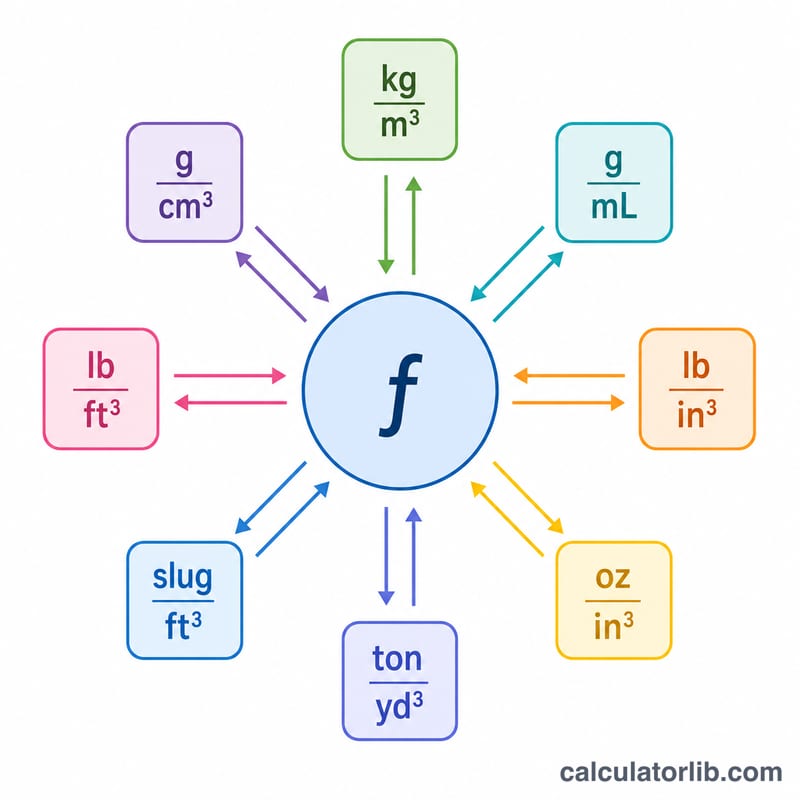
Worked example
Suppose you enter 1 \(\text{kg/m}^3\). The SI value is 1. Converting: grams per cubic metre = \(1 / 0.001 = 1000\); grams per cubic centimetre = \(1 / 1000 = 0.001\); pounds per cubic foot = \(1 / 16.0184\ldots = 0.06243\). For water at 1000 \(\text{kg/m}^3\) the calculator returns 1 \(\text{g/cm}^3\) and about 62.43 \(\text{lb/ft}^3\), both of which match the known density of water.
FAQ
Which "tonne" is used? The metric tonne (1000 kg), not the US or UK ton.
Which gallon? Both are supported: the US liquid gallon (3.785411784 L) and the UK imperial gallon (4.54609 L).
Does the display-digits setting affect accuracy? No. The computation always uses full double precision; the setting only controls how many digits are shown.