
What this calculator does
The Length Unit Conversion Calculator takes a single length you enter in one unit and instantly expresses it in 36 different units of length. It covers four families: the metric SI scale (picometer up to yottameter), the imperial/US customary units (mil, inch, hand, foot, yard, chain, furlong, mile), the traditional Japanese shakkanho units (rin, sun, shaku, kujira-jaku or whale shaku, jo, ken, cho, ri), and astronomical and nautical units (astronomical unit, light-year, parsec, nautical mile, fathom). It is a universal tool with no jurisdictional rules; the Japanese units simply have fixed metric definitions and are labelled in romanized English.
How to use it
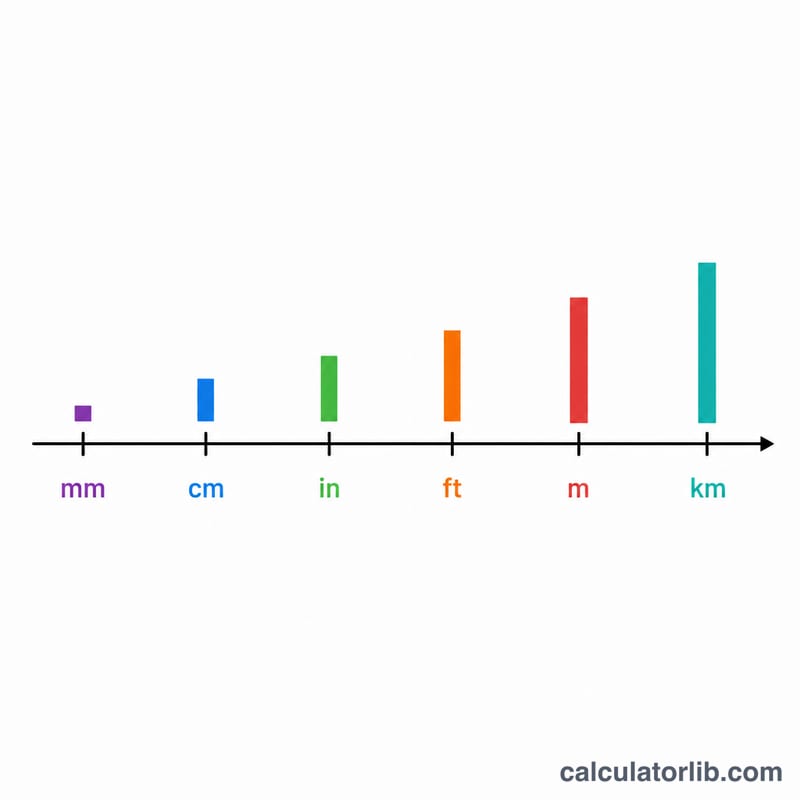
Type the numeric value into Length, choose the Unit it is measured in from the dropdown, and submit. The result page shows the length in meters at the top, followed by a grouped table giving the converted value for every supported unit. Negative numbers are accepted and scale linearly, and an input of 0 returns 0 everywhere.
The formula
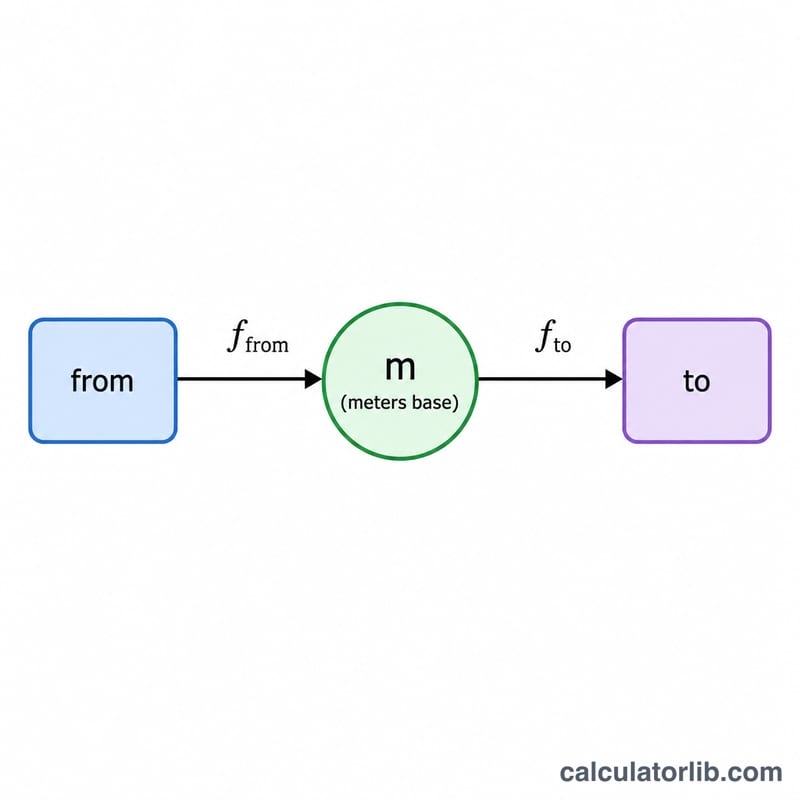
Each unit has a fixed conversion factor \(f\) equal to how many meters one of that unit represents (the meter is the SI base). The calculator first normalises your input to meters with \(L_m = \text{length} \times f_{\text{from}}\), then divides by each target factor: \(\text{value}_t = L_m / f_t\). Equivalently $$\text{value}_t = \text{length} \times \frac{f_{\text{from}}}{f_t}.$$ The Japanese shaku-based units are built from the exact rational base \(\frac{10}{33}\ \text{m}\) to avoid rounding drift; the light-year uses the Julian year (365.25 days) times the speed of light \(299792458\ \text{m/s}\).
Worked example
Enter length = 1 with unit Meter. \(L_m = 1\ \text{m}\), so picometer = \(1\mathrm{e}{12}\), centimeter = \(100\), millimeter = \(1000\), inch = $$\frac{1}{0.0254} = 39.370078740157,$$ foot = \(3.280839895013\), yard = \(1.093613298338\), mile = \(0.000621371192237\), shaku = \(3.3\), sun = \(33\), ken = \(0.55\), nautical mile = \(0.000539956803456\), and light-year approximately \(1.0570008340246\mathrm{e}{-16}\). A quick sanity check: \(2.54\ \text{cm}\) converts to exactly \(1\) inch.
FAQ
Why include Japanese units? The shakkanho system is still used in carpentry, kimono tailoring (kujira-jaku) and land measurement; its units have precise metric definitions, so they convert exactly like any other unit.
Which light-year definition is used? The Julian-year light-year, \(9.4607304725808\mathrm{e}{15}\ \text{m}\), the value adopted by the IAU.
Can I convert tiny atomic or huge cosmic lengths? Yes — from picometers and angstroms up to parsecs and yottameters, all in one pass, with about 14 significant figures of precision.