
What this calculator does
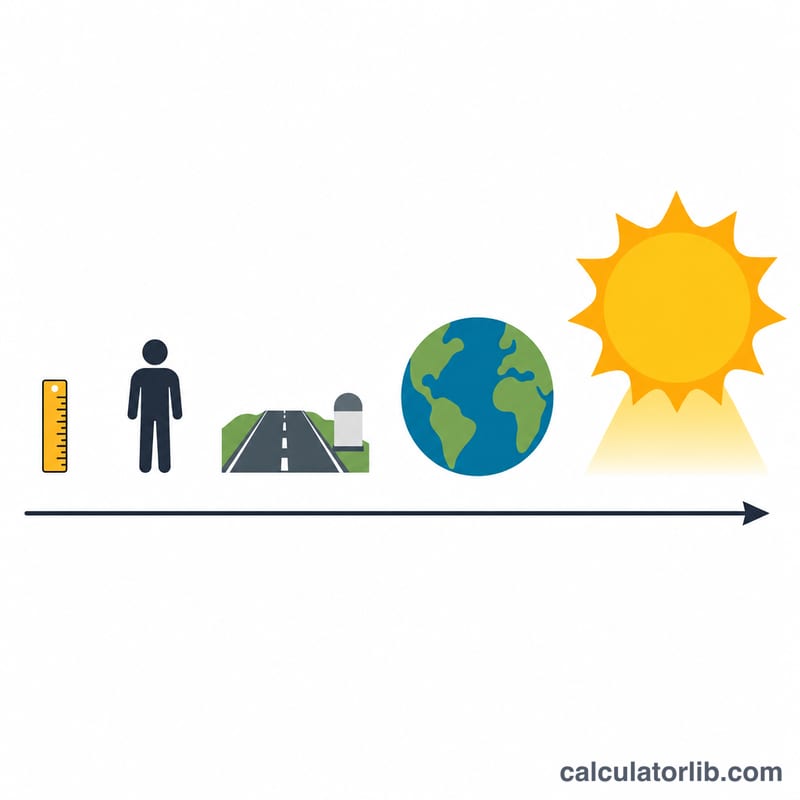
This tool converts a distance or length from one unit to another, such as meters to feet or kilometers to miles. It supports 19 units ranging from the astronomical (light-year, light-day) down to the microscopic (angstrom, nanometer), plus everyday and historical units like the inch, foot, yard, mile, rod and the Cape foot. Every conversion is exact and linear because length units differ only by a fixed scale factor.
How to use it
Enter the value you want to convert, pick the unit you are converting from, and the unit you want the answer to. Press calculate. You get the answer in the target unit, the precise conversion factor, a rounded "quick multiplier" for mental math, and a written step-by-step solution. Negative and decimal values are allowed.
The formula explained
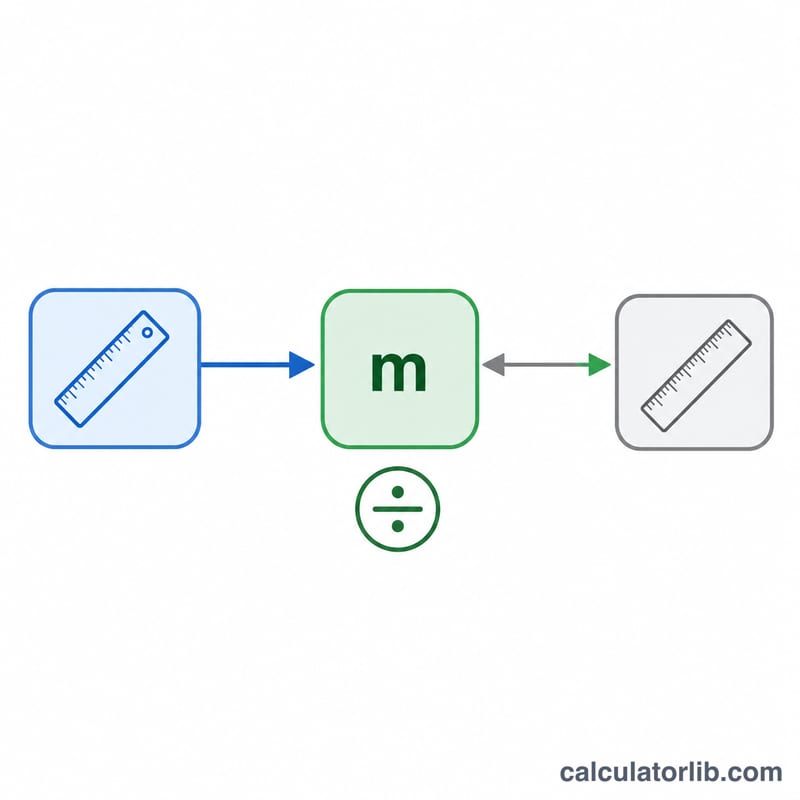
Each unit is stored as its length in meters, the SI base unit. To convert, the value is first imagined in meters and then re-expressed in the target unit: $$\text{result} = \text{value} \times \dfrac{\text{metersPerFromUnit}}{\text{metersPerToUnit}}$$ Because no unit has an offset (unlike temperature), a single multiplication is exact. The ratio in the middle is the conversion factor.
Worked example
Convert 1 meter to feet. A meter is 1 m and a foot is 0.3048 m, so the factor is \(1 / 0.3048 = 3.280839895\). Multiply by the value 1 to get $$1 \times \dfrac{1}{0.3048} = 3.2808399 \text{ ft}$$ with a handy quick multiplier of about 3.281.
FAQ
What does "mil" mean here? A mil is one thousandth of an inch (0.0000254 m), used in engineering. It is not a millimeter.
What is a Cape foot? A historical South African unit equal to about 0.314858 m, slightly longer than the international foot.
Why do huge or tiny answers use many digits? Units like the light-year (about \(9.46 \times 10^{15}\) m) and angstrom (\(10^{-10}\) m) span enormous scales, so the result is shown to high precision to stay accurate.