What is the Harry Potter Currency Calculator?
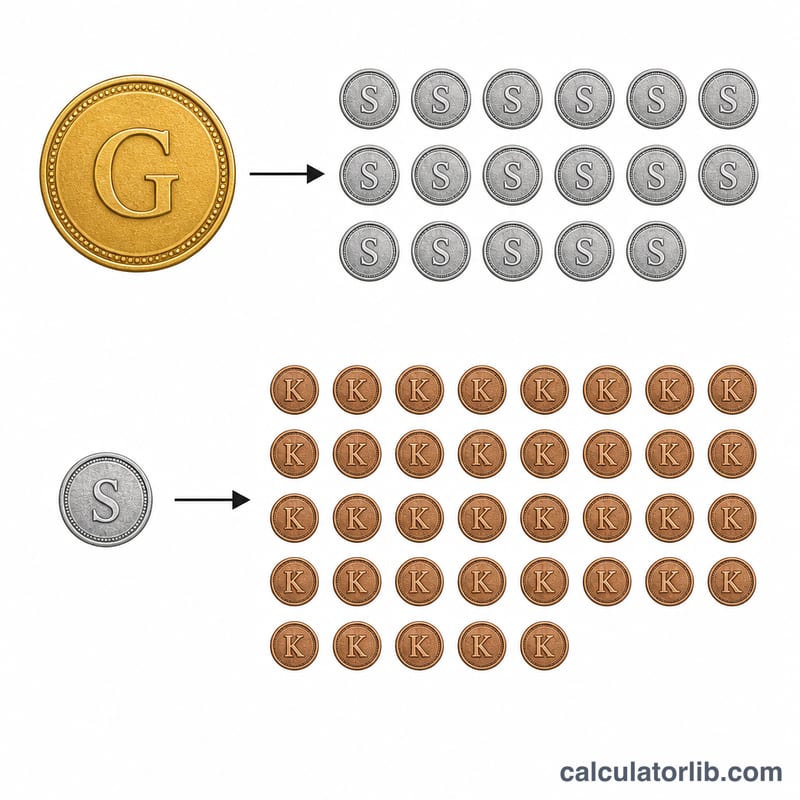
In J.K. Rowling's wizarding world, money comes in three coins: gold Galleons, silver Sickles, and bronze Knuts. The exchange isn't decimal — there are 17 Sickles to a Galleon and 29 Knuts to a Sickle. That makes 1 Galleon worth 493 Knuts. This calculator adds up any mix of coins and tells you the total value in Knuts, Sickles, and Galleons, then neatly repacks it into the fewest coins.
How to use it
Enter how many Galleons, Sickles, and Knuts you have, then read the results. The main figure is the total in Knuts (the smallest unit), which is the easiest way to compare two piles of wizarding money. The table also shows the equivalent in Sickles and Galleons, plus a clean "normalized" breakdown using the fewest coins possible.
The formula explained
Because the system is fixed, every coin has a value in Knuts: a Sickle is 29 Knuts and a Galleon is \(17 \times 29 = 493\) Knuts. So:
$$\text{Total Knuts} = \text{Galleons} \times 493 + \text{Sickles} \times 29 + \text{Knuts}$$
To repack into the fewest coins, divide the total by 493 for Galleons, take the remainder and divide by 29 for Sickles, and the final remainder is the leftover Knuts.
Worked example
Suppose you have 2 Galleons, 5 Sickles, and 10 Knuts. That's $$(2 \times 493) + (5 \times 29) + 10 = 986 + 145 + 10 = 1{,}141 \text{ Knuts}$$ Dividing 1,141 by 493 gives 2 Galleons (986), leaving 155 Knuts; \(155 \div 29 = 5\) Sickles (145), leaving 10 Knuts — so it normalizes back to 2 Galleons, 5 Sickles, 10 Knuts.
Wizarding Currency Conversion Table
The wizarding money system in the Harry Potter books uses three fixed rates: 17 Sickles = 1 Galleon and 29 Knuts = 1 Sickle, which makes 493 Knuts = 1 Galleon (\(17 \times 29 = 493\)). Because these rates never change, every conversion is exact arithmetic — there is no fluctuating exchange rate to look up.
| 1 unit of… | in Galleons | in Sickles | in Knuts |
|---|---|---|---|
| 1 Galleon | 1 | 17 | 493 |
| 1 Sickle | 1/17 Galleon | 1 | 29 |
| 1 Knut | 1/493 Galleon | 1/29 Sickle | 1 |
To convert any pile, first reduce everything to Knuts — the base unit of the system:
$$\text{Total Knuts} = 493 \times G + 29 \times S + K$$| Galleons | Sickles | Knuts |
|---|---|---|
| 1 | 17 | 493 |
| 5 | 85 | 2,465 |
| 10 | 170 | 4,930 |
| 17 | 289 | 8,381 |
| 50 | 850 | 24,650 |
| 100 | 1,700 | 49,300 |
| Knuts | In Sickles + Knuts | In Galleons + Sickles + Knuts |
|---|---|---|
| 29 | 1 Sickle | 1 Sickle |
| 58 | 2 Sickles | 2 Sickles |
| 100 | 3 Sickles 13 Knuts | 3 Sickles 13 Knuts |
| 232 | 8 Sickles | 8 Sickles |
| 493 | 17 Sickles | 1 Galleon |
| 500 | 17 Sickles 7 Knuts | 1 Galleon 7 Knuts |
Remainders are kept whole because coins cannot be split: 100 Knuts is \(3 \times 29 = 87\) Knuts' worth of Sickles with 13 Knuts left over, written 3 Sickles 13 Knuts rather than 3.45 Sickles.
Example Coin Piles Compared
Each row below is computed strictly with the canonical constants 493 (Knuts per Galleon) and 29 (Knuts per Sickle). The "normalized" column shows the fewest-coin form: take the total in Knuts, divide by 493 for Galleons, divide the remainder by 29 for Sickles, and whatever is left stays as Knuts.
| Input (G / S / K) | Total in Knuts | Total in Sickles | Total in Galleons (with remainder) | Normalized fewest-coin form | Note |
|---|---|---|---|---|---|
| 0 / 0 / 493 | 493 | 17 Sickles | 1 Galleon, no remainder | 1 G | Exactly one Galleon |
| 0 / 20 / 0 | 580 | 20 Sickles | 1 Galleon + 87 Knuts remainder | 1 G 3 S | More than 17 Sickles, so it rolls up |
| 1 / 16 / 28 | 985 | 33 Sickles 28 Knuts | 1 Galleon + 492 Knuts remainder | 1 G 16 S 28 K | Exactly one Knut short of 2 Galleons (986) |
| 0 / 0 / 1,000 | 1,000 | 34 Sickles 14 Knuts | 2 Galleons + 14 Knuts remainder | 2 G 0 S 14 K | A sack of bronze is worth surprisingly little |
| 10 / 0 / 0 | 4,930 | 170 Sickles | 10 Galleons, no remainder | 10 G | Round Galleon amount |
| 0 / 7 / 0 | 203 | 7 Sickles | 0 Galleons + 203 Knuts remainder | 7 S | A small shop purchase, well under a Galleon |
Worked check on the third row, with every substitution shown:
$$493 \times 1 + 29 \times 16 + 28 = 493 + 464 + 28 = 985 \text{ Knuts}$$Converting 985 back up again: \(985 \div 493 = 1\) with remainder \(985 - 493 = 492\); then \(492 \div 29 = 16\) with remainder \(492 - 464 = 28\). So 985 Knuts is 1 Galleon, 16 Sickles and 28 Knuts — and since 2 Galleons is \(2 \times 493 = 986\) Knuts, the pile is exactly one Knut short.
The same round trip on the 1,000-Knut row: \(1000 \div 493 = 2\) remainder \(1000 - 986 = 14\), and 14 is smaller than 29, so no Sickles can be formed — the answer is 2 Galleons and 14 Knuts.
Key Terms Explained
- Galleon
- The gold coin and largest denomination: 1 Galleon = 17 Sickles = 493 Knuts.
- Sickle
- The silver middle coin: 1 Sickle = 29 Knuts = 1/17 of a Galleon.
- Knut
- The bronze coin and smallest unit — the base of the whole system. Every other amount can be written as a whole number of Knuts.
- Total in Knuts
- The common base used to compare two piles of mixed coins. Reduce both to Knuts with \(493G + 29S + K\) and the larger number is simply the larger amount of money.
- Normalized breakdown
- The fewest-coin representation of a total, found by successive division: divide the total Knuts by 493 for the Galleon count, divide what is left by 29 for the Sickle count, and keep the final leftover as Knuts.
- Remainder
- The leftover value after extracting as many of a larger denomination as possible. For example, 580 Knuts contains 1 Galleon with a remainder of 87 Knuts, and that 87 becomes 3 Sickles.
- Non-decimal currency
- A money system whose units are not powers of ten. A dollar splits into 100 cents, so decimal notation works directly; the wizarding system splits 1 → 17 → 29, so amounts are written as whole coins plus remainders instead of decimals. Pre-1971 British currency (12 pence to a shilling, 20 shillings to a pound) worked the same way.
Note: Galleons, Sickles and Knuts are fictional currency from the Harry Potter books by J. K. Rowling. The 17-and-29 rates are canon within those stories, but the coins have no fixed or official exchange value against any real-world currency — any dollar, euro or pound figure you see quoted for a Galleon is somebody's estimate, not a published rate. This calculator converts only between the three wizarding units.
FAQ
How many Knuts in a Galleon? Exactly 493 (\(17 \text{ Sickles} \times 29 \text{ Knuts}\)).
Is this an official exchange rate? Yes, these are the canonical rates from the Harry Potter books — 17 Sickles per Galleon and 29 Knuts per Sickle.
Can I convert to real-world money? No fixed real-world rate exists; this tool only converts within the wizarding currency.