
What is the Bacon Curing Calculator?
This tool tells you exactly how much salt, curing salt (Prague Powder #1, also called Pink Cure #1 or Insta Cure #1) and sugar you need to dry-cure a piece of pork belly into bacon. Curing by percentage of meat weight — known as Equilibrium Curing (EQ) — is the most reliable method because the meat can never over-salt or take in too much nitrite, no matter how long it cures.
How to use it
Weigh your pork belly in grams and enter the weight. Choose your salt percentage (2% is a typical balanced bacon, 1.5–3% is common) and your sugar percentage (often 0.5–1.5% for flavour and balance). The calculator returns the three weights to mix into your cure rub. Coat the meat evenly, vacuum-seal or bag it, and refrigerate for about 7 days per 25 mm of thickness, flipping daily.
The formula explained
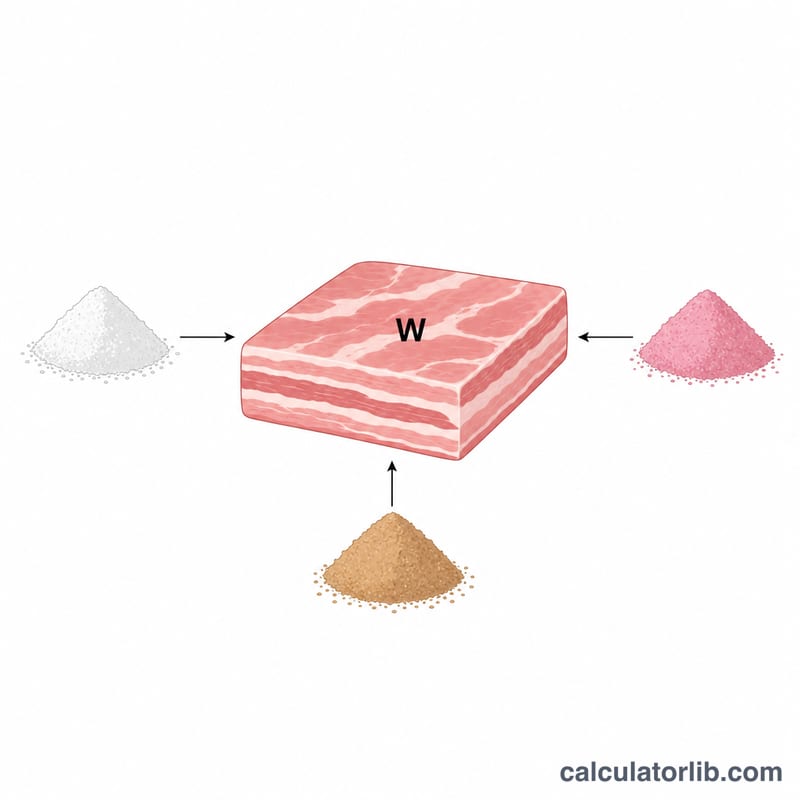
Salt and sugar are simple percentages of the meat weight: $$\text{salt}_g = W \times \frac{s}{100}$$ The curing salt is fixed at 0.25% of meat weight (\(W \times 0.0025\)). Prague Powder #1 is 6.25% sodium nitrite, so 2.5 g per kg delivers roughly 156 ppm nitrite — the maximum allowed for cured meats and the standard for safe bacon.
Worked example
For a 1000 g pork belly at 2% salt and 1% sugar:
$$\text{salt} = 1000 \times 2 \div 100 = 20\ \text{g}$$ $$\text{cure \#1} = 1000 \times 0.0025 = 2.5\ \text{g}$$ $$\text{sugar} = 1000 \times 1 \div 100 = 10\ \text{g}$$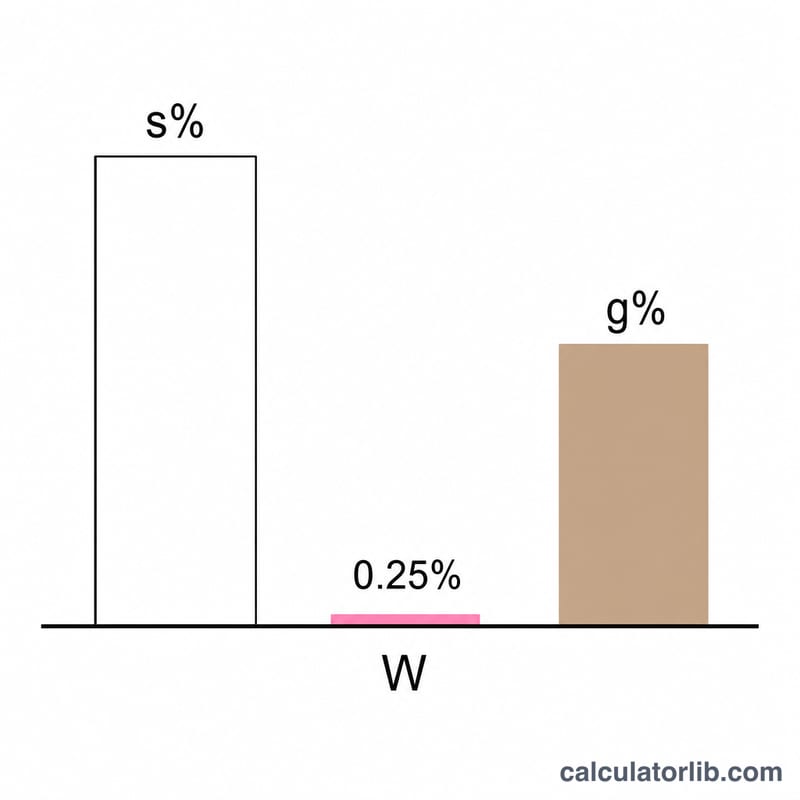
Recommended Salt, Sugar & Cure Percentages
The percentages below reflect standard charcuterie practice for equilibrium dry-curing, where every ingredient is calculated as a percentage of the raw meat weight. The cure #1 figure is anchored to the USDA/industry maximum for ingoing sodium nitrite.
| Ingredient | Typical range | Common default | Notes |
|---|---|---|---|
| Salt | 1.5–3% | 2% | Below ~1.5% flavor and preservation suffer; above ~3% the bacon tastes overly salty. |
| Sugar | 0–1.5% | 1% | Optional; balances salt and aids browning. Brown sugar, maple, or honey can substitute by weight. |
| Cure #1 (Prague Powder #1) | 0.25% (fixed) | 0.25% | 0.25% (2.5 g/kg) delivers ~156 ppm ingoing sodium nitrite — the USDA limit for dry cure. Do not exceed. |
Prague Powder #1 is 6.25% sodium nitrite and 93.75% salt. At 0.25% of the meat weight, the ingoing nitrite works out to \(0.0025 \times 0.0625 = 0.000156\), i.e. 156 parts per million — the maximum permitted ingoing nitrite for dry-cured products under USDA rules. These ranges are based on established charcuterie references and USDA nitrite limits; do not substitute cure #1 for table salt or vice versa.
Practical Curing Tips
- Weigh cure #1 on a precise gram scale. Use a scale accurate to 0.1 g for the cure #1, since the safe quantity is small (2.5 g per kg of meat). Eyeballing it risks both under- and over-curing.
- Mix the rub thoroughly. Combine the salt, cure #1 and sugar completely before applying, so the nitrite is evenly distributed across the whole belly rather than concentrated in spots.
- Bag, refrigerate and flip. Vacuum-seal (or use a zip bag) and refrigerate at 2–4 °C for roughly 7 days per 25 mm (1 inch) of thickness, flipping the bag daily and redistributing the liquid that forms so the cure penetrates evenly.
- Rinse, dry and form a pellicle. After curing, rinse off surface cure, pat dry, and rest the belly uncovered in the fridge for several hours to a day to develop a tacky pellicle that smoke adheres to.
- Always cook bacon made with cure #1. Cure #1 is intended for products that will be cooked. Hot-smoke or pan-cook the bacon to a safe internal temperature before eating — it is not a ready-to-eat product.
This is general food-preparation information, not professional food-safety advice. When curing meat at home, follow a trusted, tested recipe and your local food-safety guidance, and discard any product that smells or looks off.
FAQ
Is curing salt necessary? For bacon that is cooked, cure #1 protects against botulism and gives the classic pink colour and flavour. Do not exceed the calculated amount.
Can I skip the sugar? Yes — set sugar to 0%. Sugar balances the salt and aids browning but is optional.
What salt percentage should I pick? 2% is a safe, well-seasoned starting point. Lower to 1.5% for milder bacon.