
What Is the Salt to Sodium Converter?
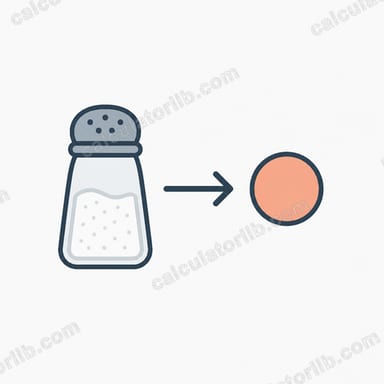
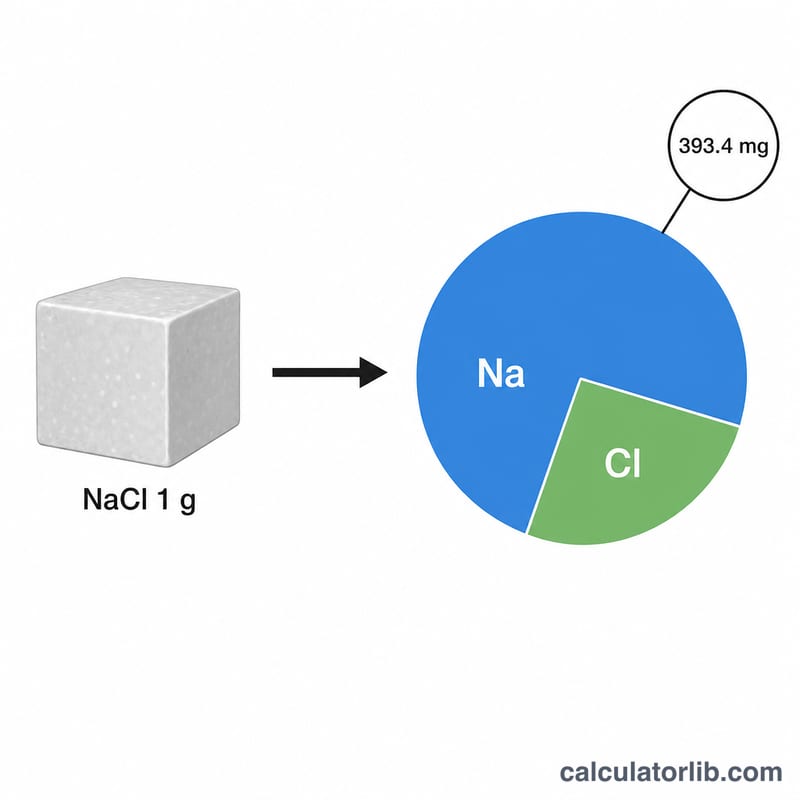
Table salt (sodium chloride) is only about 40% sodium by weight — the rest is chloride. Nutrition labels and dietary guidelines often report sodium, while recipes, salt packets and many food products list salt. This calculator converts a quantity of salt in grams into the equivalent amount of sodium in milligrams so you can accurately track your intake.
How to Use It
Enter the amount of salt in grams and the calculator returns the corresponding sodium content in milligrams. For example, the World Health Organization recommends less than 5 g of salt per day, which equals just under 2,000 mg of sodium.
The Formula Explained
The conversion uses the molar mass ratio of sodium within sodium chloride:
$$\text{Sodium (mg)} = \text{Salt (g)} \times 393.4$$
This comes from the fact that 1 gram of salt contains about 0.3934 grams (393.4 mg) of sodium. To go the other way: $$\text{Salt (g)} = \text{Sodium (mg)} \times 2.5 \div 1000$$ since multiplying sodium by 2.5 reverses the 0.4 fraction.
Worked Example
Suppose a meal contains 5 g of salt. Multiply: $$5 \times 393.4 = 1{,}967 \text{ mg of sodium}$$ That single meal already uses nearly the whole recommended daily limit of sodium.
FAQ
Why isn't salt 100% sodium? Salt is sodium chloride (NaCl). Sodium makes up roughly 40% of its weight; chloride makes up the other 60%.
How do I convert sodium back to salt? Multiply the sodium amount in milligrams by 2.5 and divide by 1000 to get salt in grams.
How much salt should I eat per day? Major health bodies suggest under 5–6 g of salt (about 2,000–2,400 mg sodium) daily, but check guidance for your situation.