
What Is the FENa Calculator?
The Fractional Excretion of Sodium (FENa) is a clinical index used to evaluate acute kidney injury (AKI). It expresses the percentage of sodium filtered by the kidneys that ends up being excreted in the urine. Because the kidneys reabsorb sodium avidly when perfusion is low, FENa helps clinicians distinguish a prerenal cause (poor blood flow) from intrinsic renal damage such as acute tubular necrosis.
How to Use It
Obtain simultaneous serum (plasma) and spot urine measurements of sodium and creatinine. Enter the urine sodium and urine creatinine, then the plasma sodium and plasma creatinine. Sodium values are typically in mEq/L and creatinine in mg/dL — the units cancel out, so consistent units are all that matters. The calculator returns FENa as a percentage.
The Formula Explained
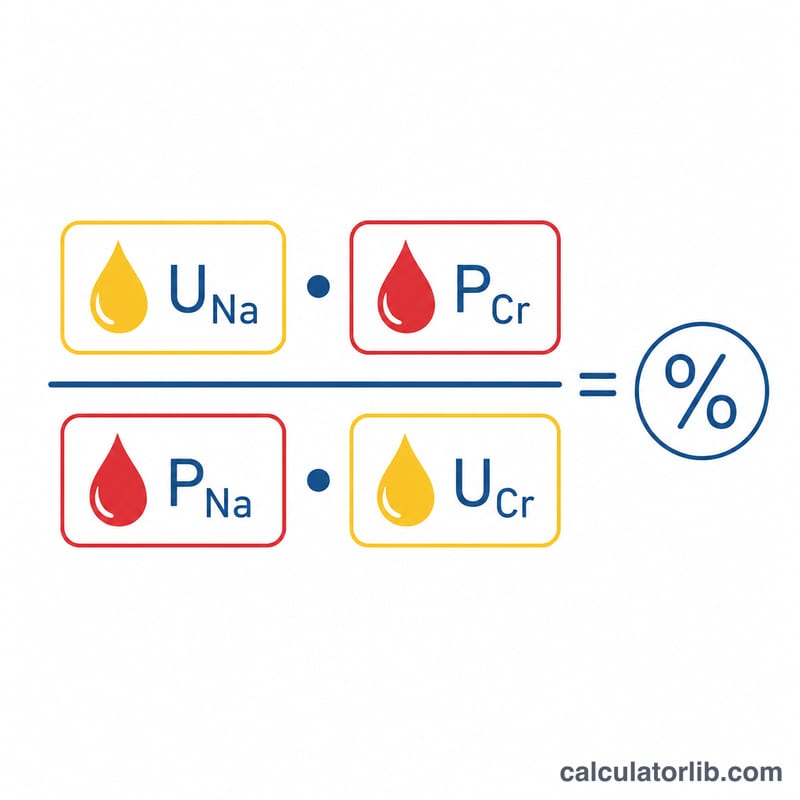
$$\text{FENa} = \frac{\text{Urine Na} \times \text{Plasma Cr}}{\text{Plasma Na} \times \text{Urine Cr}} \times 100\%$$ The numerator reflects sodium being excreted relative to creatinine, while the denominator normalizes against filtered load. Multiplying by 100 converts the fraction into a readable percentage.
Worked Example
Suppose Urine Na = 20 mEq/L, Plasma Cr = 4 mg/dL, Plasma Na = 140 mEq/L, Urine Cr = 50 mg/dL. $$\text{FENa} = \frac{20 \times 4}{140 \times 50} \times 100 = \frac{80}{7000} \times 100 = 1.14\%$$ A value near 1% is suggestive of a prerenal cause.
FAQ
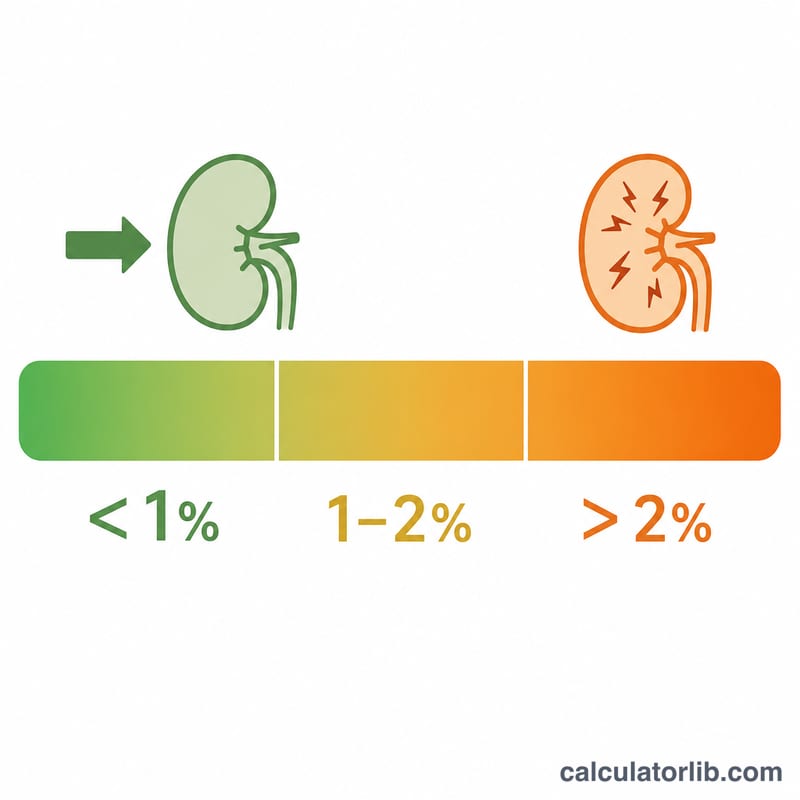
What FENa value indicates prerenal AKI? A FENa below 1% generally points to a prerenal cause, while above 2% suggests intrinsic renal injury such as acute tubular necrosis.
When is FENa unreliable? FENa can be misleading in patients taking diuretics, with chronic kidney disease, or with conditions like contrast nephropathy. In diuretic use, the fractional excretion of urea (FEUrea) may be more reliable.
Does the unit choice matter? No, as long as sodium uses the same units for urine and plasma, and creatinine uses the same units for both — the ratio cancels the units.