
What this calculator does
The Dog Age in Dog Years by Breed Size Calculator converts your dog's chronological age into an equivalent human age. The classic "multiply by 7" rule is misleading because dogs mature very fast in their first two years and then age at a pace that depends on their body size. Smaller dogs tend to live longer and age more slowly than large breeds, so this tool lets you pick small, medium, or large to get a closer estimate.
How to use it
Enter your dog's age in years (decimals are fine — a 6-month-old puppy is \(0.5\)). Choose the breed size that best matches your dog: small (up to about 9 kg / 20 lb), medium (10–22 kg / 21–50 lb), or large (23 kg / 50 lb and up). The result shows the equivalent human age along with the per-year rate used.
The formula explained
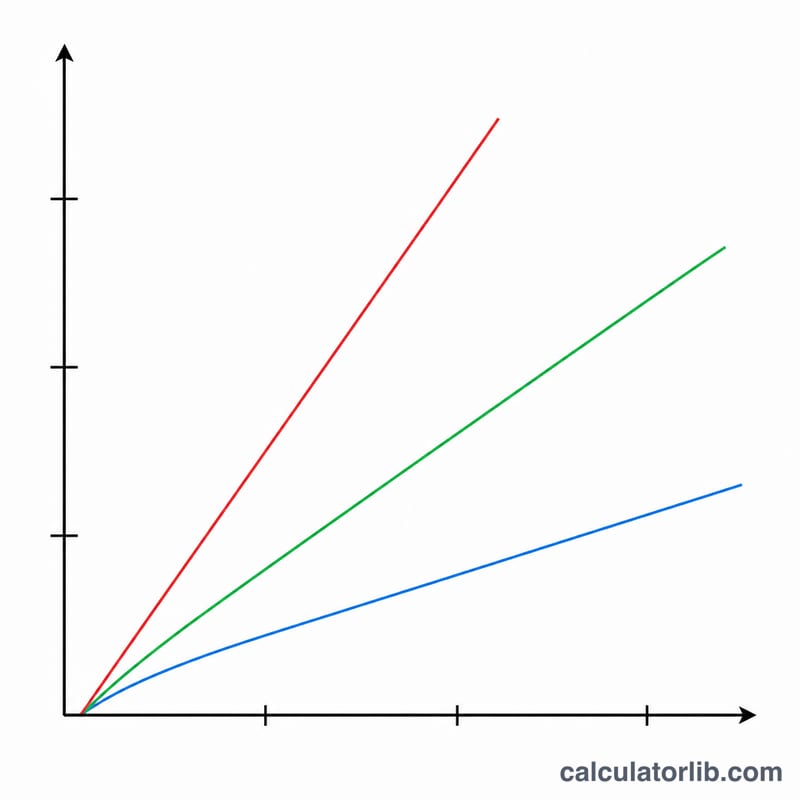
This model follows the widely used AKC-style approach. The first year of a dog's life counts as 15 human years. The second year adds another 9 human years, bringing a 2-year-old dog to 24 human years. After that, each additional dog year adds a size-dependent amount: 4 human years for small breeds, 5 for medium, and 6 for large breeds. So large dogs "catch up" and overtake small dogs in human-age terms.
$$H = \begin{cases} 15\,\text{Age}, & \text{Age} \le 1 \\[4pt] 15 + 9\left(\text{Age} - 1\right), & 1 < \text{Age} \le 2 \\[4pt] 24 + 5\left(\text{Age} - 2\right), & \text{Age} > 2 \end{cases}$$
Worked example
A 5-year-old large-breed dog: the first two years equal 24 human years. The remaining 3 years (\(5 - 2\)) each add 6, giving \(3 \times 6 = 18\). Total = \(24 + 18 = \mathbf{42}\) human years. The same 5-year-old as a small breed would be $$24 + 3 \times 4 = 36$$ human years.
FAQ
Is the "multiply by 7" rule accurate? No. It overstates a puppy's maturity and ignores breed size. This calculator is a better approximation.
Why do large dogs age faster? Larger breeds reach old age sooner and generally have shorter lifespans, so each calendar year represents more human years.
What about giant breeds? Very large breeds (e.g. Great Danes) age even faster than the "large" setting; treat the large-breed result as a conservative minimum.