What This Converter Does
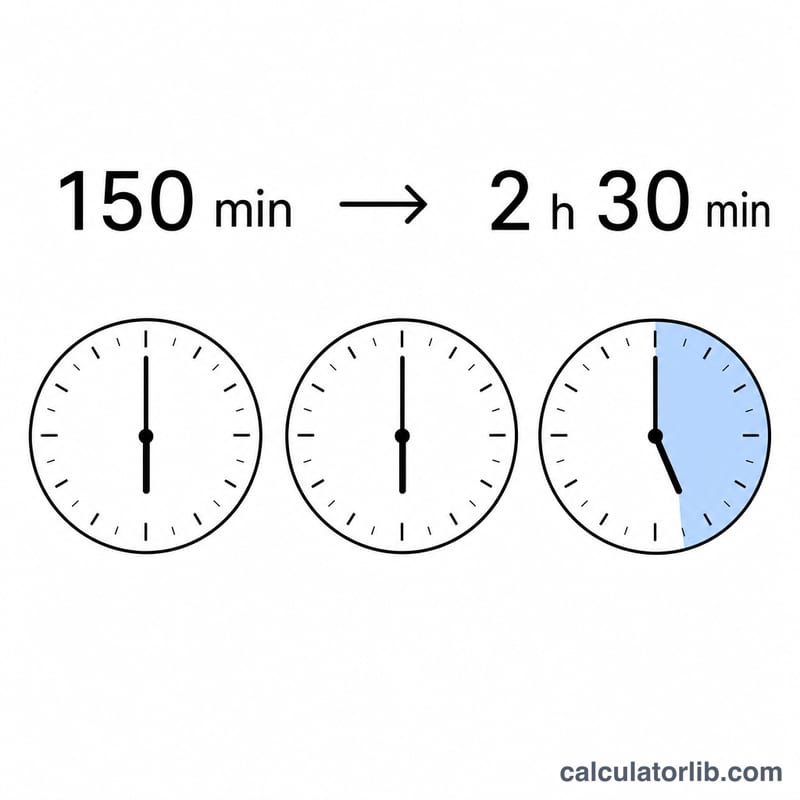
The Minutes to Hours and Minutes Converter takes any whole number of minutes and breaks it down into full hours plus the leftover minutes. For example, 150 minutes becomes 2 hours and 30 minutes. It also shows the equivalent value in decimal hours (2.5), which is handy for timesheets, billing, and spreadsheets that expect a decimal format.
How to Use It
Type the total number of minutes into the input box and the calculator instantly returns three values: the whole hours, the remaining minutes, and the decimal-hour equivalent. There are no units to choose and no other settings — it works for any positive number of minutes.
The Formula Explained
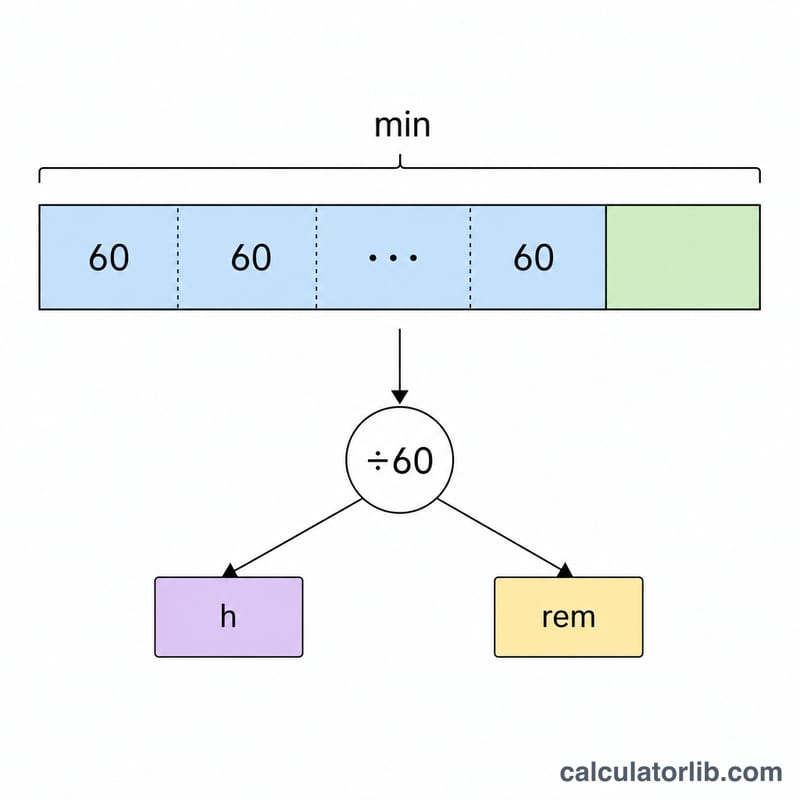
The conversion relies on two simple operations. The number of whole hours is the floor (round-down) of the minutes divided by 60: \(\text{hours} = \left\lfloor \text{min} / 60 \right\rfloor\). The leftover minutes are what remains after removing those whole hours: \(\text{remMin} = \text{min} \bmod 60\). The decimal-hour value is simply \(\text{min} / 60\) without rounding down.
$$\text{hours} = \left\lfloor \frac{\text{min}}{60} \right\rfloor \qquad \text{remMin} = \text{min} - 60 \times \text{hours}$$$$\text{Decimal Hours} = \frac{\text{min}}{60}$$
Worked Example
Suppose you have 200 minutes. Dividing by 60 gives 3.33, and the floor is 3, so there are 3 whole hours. The remainder is $$200 - (3 \times 60) = 200 - 180 = 20$$ minutes. So 200 minutes equals 3 hours and 20 minutes, or about 3.33 decimal hours.
Common Minutes to Hours and Minutes Conversions
To convert minutes to hours and minutes, divide by 60. The whole number is the hours, and the remainder is the leftover minutes. Decimal hours are simply \(\text{minutes} \div 60\).
| Minutes | Hours and Minutes (h:mm) | Decimal Hours |
|---|---|---|
| 15 | 0:15 | 0.25 |
| 30 | 0:30 | 0.5 |
| 45 | 0:45 | 0.75 |
| 60 | 1:00 | 1 |
| 75 | 1:15 | 1.25 |
| 90 | 1:30 | 1.5 |
| 120 | 2:00 | 2 |
| 180 | 3:00 | 3 |
| 240 | 4:00 | 4 |
| 300 | 5:00 | 5 |
| 480 | 8:00 | 8 |
| 600 | 10:00 | 10 |
| 720 | 12:00 | 12 |
| 1440 | 24:00 | 24 |
Worked example: convert 135 minutes.
$$\text{Hours} = \left\lfloor \frac{135}{60} \right\rfloor = 2$$
$$\text{Minutes} = 135 - 60 \times 2 = 15$$
So 135 minutes = 2 hours 15 minutes (2:15), which is \(135 \div 60 = 2.25\) decimal hours.
Minutes to Decimal Hours for Timesheets
Many payroll and billing systems want time in decimal hours rather than h:mm. Divide the minutes by 60. Because most fractions repeat, they are usually rounded to two decimals.
| Minutes | Decimal Hours (exact, 3 d.p.) | Rounded to 2 Decimals |
|---|---|---|
| 5 | 0.083 | 0.08 |
| 10 | 0.167 | 0.17 |
| 15 | 0.25 | 0.25 |
| 20 | 0.333 | 0.33 |
| 25 | 0.417 | 0.42 |
| 40 | 0.667 | 0.67 |
| 50 | 0.833 | 0.83 |
How rounding affects totals
Rounding each entry separately can make the total drift from the true time. Compare six identical entries:
| Six entries of | True total | 2-decimal rounding | 6-minute (0.1 h) increments | 15-minute (0.25 h) increments |
|---|---|---|---|---|
| 20 minutes | 2.00 h (120 min) | 6 × 0.33 = 1.98 h | 20 → 0.3 h; 6 × 0.3 = 1.8 h | 20 → 0.25 h; 6 × 0.25 = 1.5 h |
| 10 minutes | 1.00 h (60 min) | 6 × 0.17 = 1.02 h | 10 → 0.2 h (12 min) or 0.1 h (6 min), depending on the rule; 0.2 h gives 1.2 h | 10 → 0.25 h; 6 × 0.25 = 1.5 h |
Two-decimal rounding is off by only about a minute here, while 15-minute rounding can be off by 30 minutes. For the most accurate result, add up all the minutes first, then convert the total to hours once. Rounding rules for paid time vary by employer and by local labor law, so check the policy that applies to you.
FAQ
How many hours is 90 minutes? 90 minutes is 1 hour and 30 minutes (1.5 decimal hours).
What is the difference between "2:30" and "2.5 hours"? "2:30" means 2 hours and 30 minutes (hours and minutes format), while "2.5 hours" is the same duration written in decimal form. This tool gives you both.
Can I enter a large number like 1000 minutes? Yes. 1000 minutes converts to 16 hours and 40 minutes (about 16.67 decimal hours).