
What Is Maximum Static Friction?
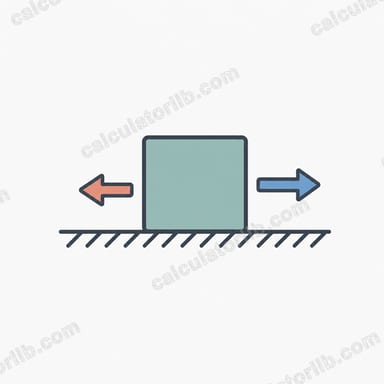
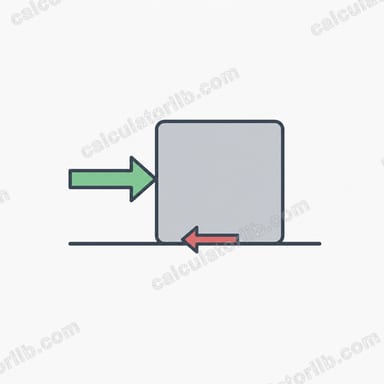
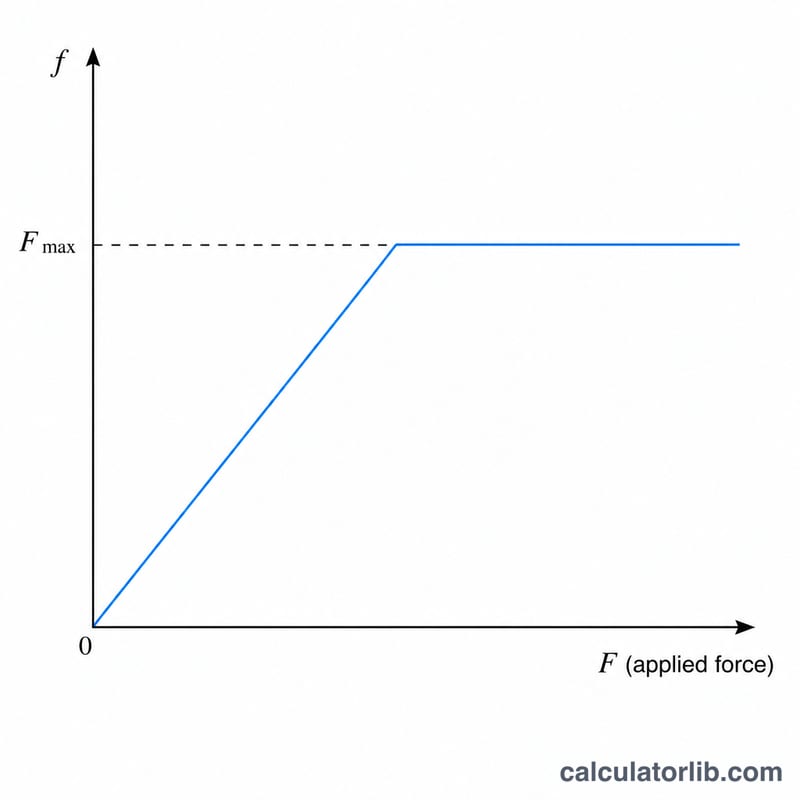
Static friction is the force that resists the start of motion between two surfaces that are in contact but not sliding. Before an object begins to move, the static friction force can take any value up to a maximum limit. That limit is the maximum static friction force, written \(F_{s,\max}\). Once an applied force exceeds this value, the object breaks free and begins to slide. This calculator computes \(F_{s,\max}\) from the coefficient of static friction and the normal force.
The Formula
The maximum static friction force is given by:
$$F_{s,\max} = \mu_s \cdot \text{N}$$
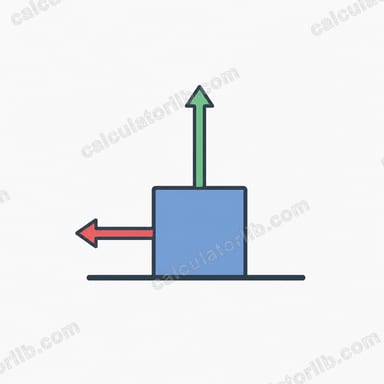
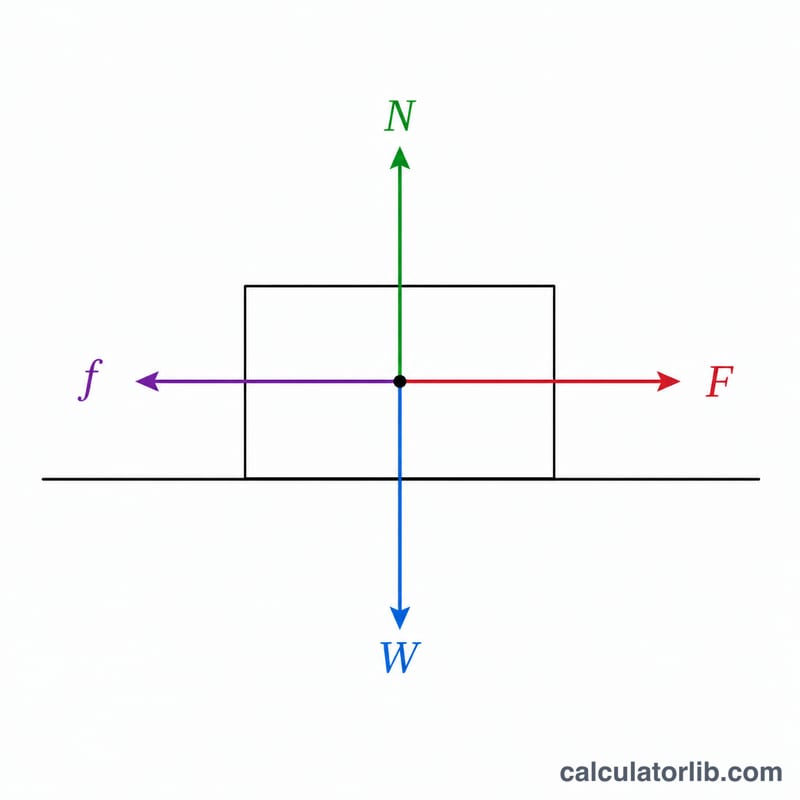
where \(\mu_s\) is the dimensionless coefficient of static friction (which depends on the two materials in contact) and \(\text{N}\) is the normal force in newtons. The normal force is the perpendicular contact force; on a flat horizontal surface it equals the object's weight, \(\text{N} = m \cdot g\). The result \(F_{s,\max}\) is in newtons.
How to Use It
Enter the coefficient of static friction (for example 0.6 for rubber on dry concrete) and the normal force in newtons. The calculator multiplies them to give the maximum friction force that must be overcome to start sliding.
Worked Example
A 10 kg box sits on a floor with \(\mu_s = 0.4\). Its weight gives a normal force of $$\text{N} = 10 \times 9.81 \approx 98.1 \text{ N}.$$ Then $$F_{s,\max} = 0.4 \times 98.1 = 39.24 \text{ N}.$$ You must push with more than 39.24 N to start the box moving.
FAQ
Is static friction always equal to \(F_{s,\max}\)? No. Static friction adjusts to match the applied force up to the maximum. \(F_{s,\max}\) is only the upper limit.
Why is kinetic friction usually smaller? The coefficient of kinetic friction is typically less than \(\mu_s\), so once an object moves it takes less force to keep it moving.
Can \(\mu_s\) be greater than 1? Yes. Some very grippy or sticky surface pairs have coefficients above 1.