
What This Calculator Does
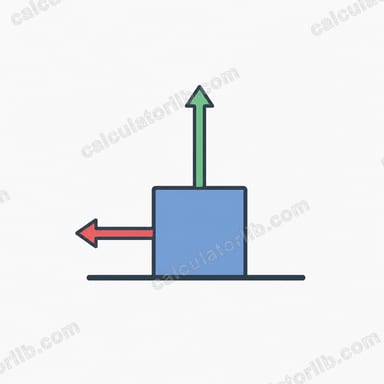
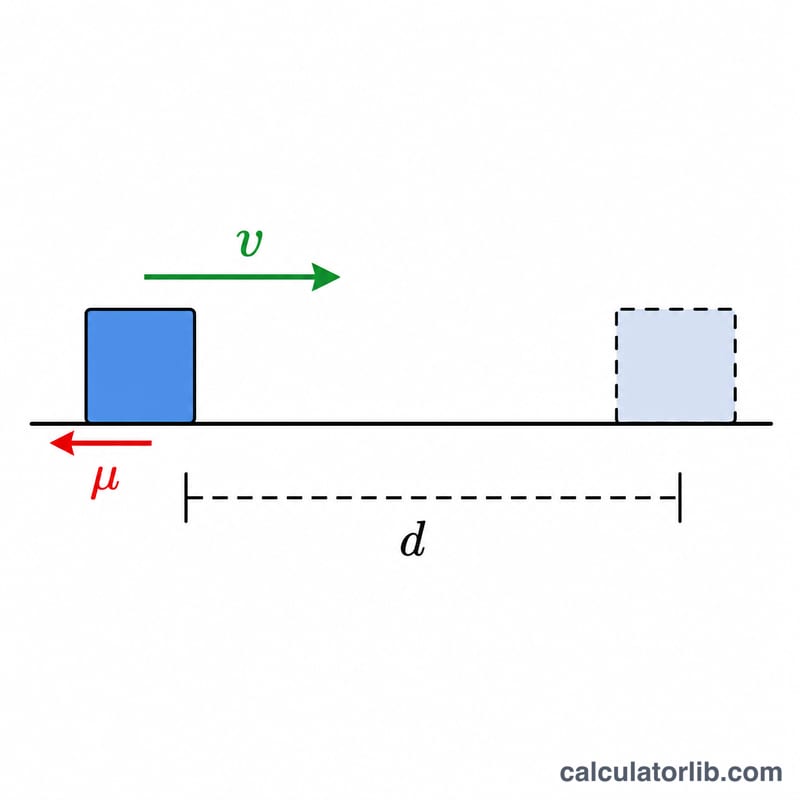
This tool estimates how far an object will slide before coming to a complete stop once friction is the only horizontal force acting on it. Given an initial speed, the coefficient of friction between the object and the surface, and gravitational acceleration, it returns the stopping distance, the deceleration, and the time required to stop.
How to Use It
Enter the initial speed in metres per second, the dimensionless coefficient of friction (\(\mu\)) for the contact surfaces, and the local value of gravity (9.81 m/s² on Earth). Press calculate to see the sliding distance immediately. Lower friction values produce longer stopping distances, which is why icy roads dramatically increase braking distances.
The Formula Explained
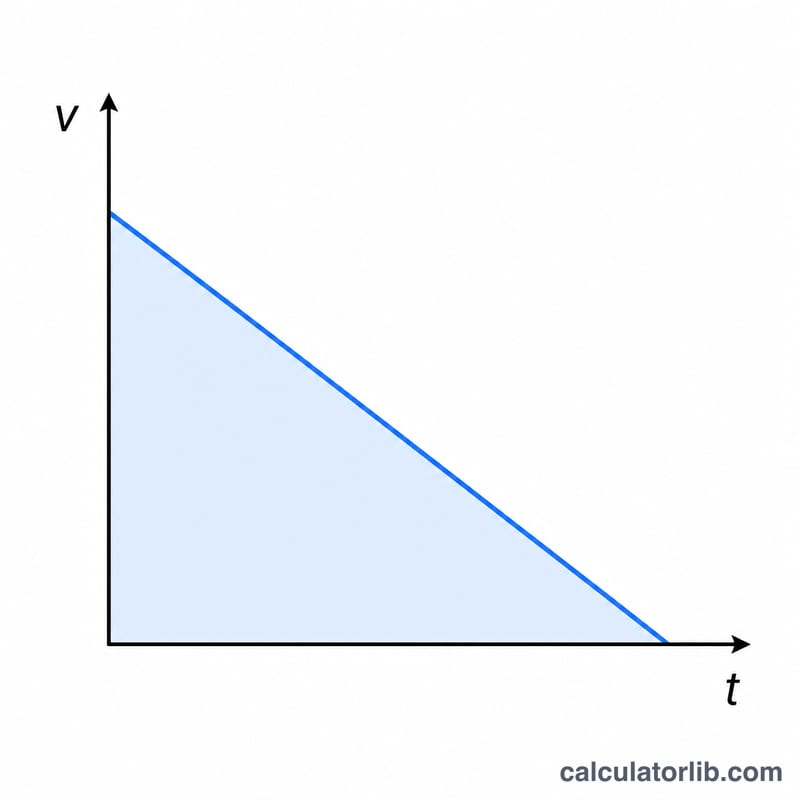
Friction provides a deceleration of \(a = \mu g\). Using the kinematic relation \(v^2 = 2 \cdot a \cdot d\) for an object decelerating to rest, we solve for distance:
$$d = \frac{v^2}{2 \cdot \mu \cdot g}$$
The mass of the object cancels out, so stopping distance does not depend on weight — only on speed and friction. Notice distance grows with the square of speed: doubling speed quadruples the stopping distance.
Worked Example
A car slides at 20 m/s on dry asphalt with \(\mu = 0.7\) and \(g = 9.81\) m/s². The deceleration is \(0.7 \times 9.81 = 6.867\) m/s². The stopping distance is $$\frac{20^2}{2 \times 0.7 \times 9.81} = \frac{400}{13.734} \approx 29.13 \text{ m},$$ and the time to stop is \(20 / 6.867 \approx 2.91\) s.
FAQ
Does mass affect stopping distance? No. Mass cancels in the equation, so a heavy and a light object slide the same distance under identical friction and speed.
Which coefficient of friction should I use? Use the kinetic (sliding) coefficient. Typical values: dry asphalt 0.7, wet road 0.4, ice 0.1.
Does this include reaction time? No. It models only the sliding/braking phase, not the driver's reaction distance before braking begins.