
What is the Parallax Distance Calculator?
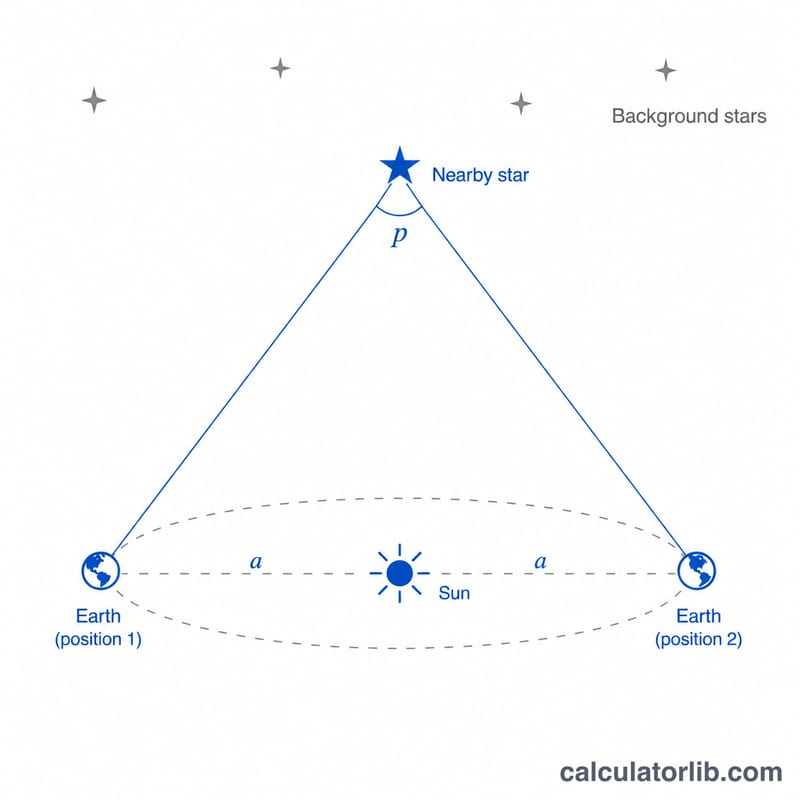
Stellar parallax is the apparent shift of a nearby star against the distant background as the Earth orbits the Sun. By measuring this tiny angular shift, astronomers can directly determine how far away a star lies. This calculator converts a measured parallax angle (in arcseconds) into a distance expressed in parsecs, light-years, and astronomical units (AU). The method is geometry-based and is the foundational rung of the cosmic distance ladder.
How to use it
Enter the parallax angle of the star in arcseconds. The angle is half of the total apparent shift observed over six months (a baseline of two AU). Click calculate to see the distance. Smaller angles correspond to larger distances — a star with a parallax of one arcsecond sits at exactly one parsec.
The formula explained
The definition of the parsec gives the elegant relationship $$d = \frac{1}{p}$$ where d is in parsecs and p is in arcseconds. One parsec is the distance at which one AU subtends an angle of one arcsecond. We then convert: 1 parsec \(\approx 3.26156\) light-years and 1 parsec \(\approx 206{,}264.806\) AU.
Worked example
The nearest star system, Proxima Centauri, has a parallax of about \(0.7687\) arcseconds. The distance is $$d = \frac{1}{0.7687} \approx 1.301 \text{ parsecs}$$ or roughly 4.24 light-years — consistent with the known value.
FAQ
Why are the angles so small? Even the nearest stars are vastly far away, so their parallax shifts are well under one arcsecond, requiring space telescopes like Gaia to measure precisely.
What if I enter zero? A parallax of zero implies an infinite distance, so the calculator requires a positive value.
Does this work for distant galaxies? No — parallax is only practical for relatively nearby stars. Beyond a few thousand parsecs the angle is too small, and astronomers switch to other methods such as standard candles.