What is the Speed, Distance & Time Calculator?
This calculator solves the classic motion relationship between speed, distance, and time. Given any two of the three quantities, it instantly computes the third. It is useful for trip planning, running and cycling pace estimates, physics homework, and logistics. The tool accepts mixed units — kilometers, miles, or meters for distance, and hours, minutes, or seconds for time — and normalizes everything to kilometers and hours internally.
How to use it
Choose what you want to solve for: Speed, Distance, or Time. Then enter the two known values and pick their units. For example, to find your average speed, enter the distance traveled and the time taken, then read the result in km/h. The calculator outputs distance in kilometers, time in hours, and speed in kilometers per hour.
The formula explained
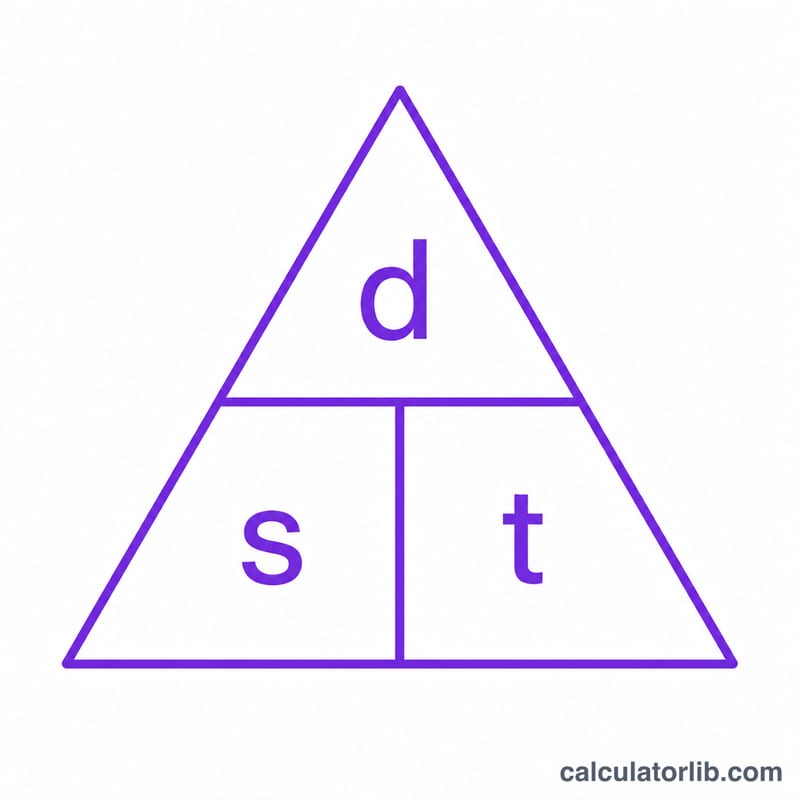
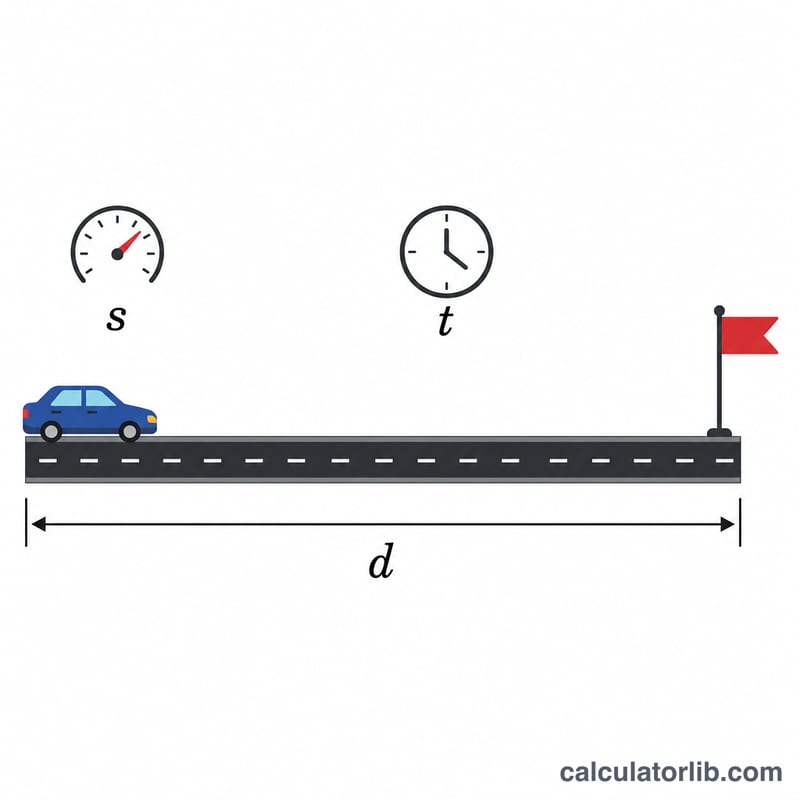
The three relationships all stem from one equation: $$\text{distance} = \text{speed} \times \text{time}$$ Rearranging gives \(\text{speed} = \text{distance} \div \text{time}\) and \(\text{time} = \text{distance} \div \text{speed}\). Consistent units are essential — that is why this tool converts your inputs to a common base (kilometers and hours) before computing.
Worked example
Suppose you drive 150 km in 2 hours. $$\text{Speed} = 150 \div 2 = 75\ \text{km/h}$$ Now suppose you travel at 60 km/h for 30 minutes (0.5 h): $$\text{distance} = 60 \times 0.5 = 30\ \text{km}$$ To cover 100 km at 50 km/h, $$\text{time} = 100 \div 50 = 2\ \text{hours}$$
Speed and Unit Conversion Table
Use these exact factors to convert speed, distance and time units before or after using the calculator. Values are rounded to 5-6 significant digits.
Speed conversions
| From | km/h | mph | m/s | knots |
|---|---|---|---|---|
| 1 km/h | 1 | 0.621371 | 0.277778 | 0.539957 |
| 1 mph | 1.609344 | 1 | 0.44704 | 0.868976 |
| 1 m/s | 3.6 | 2.23694 | 1 | 1.94384 |
| 1 knot | 1.852 | 1.15078 | 0.514444 | 1 |
Distance factors
| Unit | Equivalent |
|---|---|
| 1 km | 1000 m = 0.621371 mi |
| 1 mile (international) | 1.609344 km = 1609.344 m |
| 1 m | 0.001 km = 0.000621371 mi |
Time factors
| Unit | Equivalent |
|---|---|
| 1 h | 60 min = 3600 s |
| 1 min | 60 s = 1/60 h |
| 1 s | 1/60 min = 1/3600 h |
To convert m/s to km/h, multiply by 3.6; to convert km/h to m/s, divide by 3.6. A knot is defined as exactly one nautical mile per hour (1.852 km/h).
Typical Speeds Reference Table
The values below are approximate, rounded typical figures for orientation only. Real speeds vary with conditions, person, vehicle and regulations.
| Activity / object | km/h | mph | m/s |
|---|---|---|---|
| Walking | ~5 | ~3.1 | ~1.4 |
| Jogging | ~10 | ~6.2 | ~2.8 |
| Cycling | ~15–25 | ~9.3–15.5 | ~4.2–6.9 |
| Urban car driving | ~50 | ~31 | ~13.9 |
| Highway driving | ~100–120 | ~62–75 | ~27.8–33.3 |
| High-speed train | ~300 | ~186 | ~83.3 |
| Commercial jet (cruise) | ~900 | ~559 | ~250 |
| Speed of sound in air (at 20°C) | ~1235 | ~767 | ~343 |
Posted speed limits differ by country, and some countries use km/h while others (such as the United States and the United Kingdom) use mph on road signs.
Key Terms: Speed, Velocity, Distance and Time
- Speed: how fast an object covers distance, a scalar quantity (magnitude only). SI unit: metres per second (m/s).
- Average speed: total distance travelled divided by total time taken, \(\bar{v} = \frac{d}{t}\). It ignores any speeding up, slowing down or stops within the trip, apart from the time they take. This calculator computes average speed (and the matching distance or time) using \(d = s \times t\).
- Instantaneous speed: the speed at one particular moment, like the reading on a car speedometer. It can differ from the average speed over the whole trip.
- Velocity: speed together with direction, so it is a vector quantity. Two objects with the same speed but moving in different directions have different velocities. SI unit: m/s, with a direction.
- Distance: the total length of the path travelled, a scalar that never decreases. SI unit: metre (m).
- Displacement: the straight-line change in position from start to end, a vector with direction. If you run one full lap of a track, your distance is the lap length but your displacement is zero.
- Time (duration): how long the movement lasts. SI unit: second (s); hours and minutes are common in everyday use.
The three quantities are linked by \(\text{speed} = \frac{\text{distance}}{\text{time}}\), \(\text{distance} = \text{speed} \times \text{time}\) and \(\text{time} = \frac{\text{distance}}{\text{speed}}\). Keep units consistent (for example km with h for km/h) or convert first.
FAQ
Does it handle miles? Yes. Select miles as the distance unit; the result is converted to km/h using \(1\ \text{mile} = 1.609344\ \text{km}\).
What units is the answer in? Speed is shown in km/h, distance in km, and time in hours, regardless of your input units.
How do I convert hours to minutes? Multiply the hour result by 60. For example, 0.5 hours equals 30 minutes.