What Is the Speed Calculator?
The Speed Calculator is a simple online tool that works out how fast you are travelling based on the distance you covered and the time it took. You enter the distance in kilometres and the time in hours and minutes, and the calculator instantly returns your average speed in kilometres per hour (km/h). It works for any kind of movement — running, cycling, driving, walking, or even rowing — making it useful for athletes, commuters, students, and anyone curious about their pace.
How to Use It
Getting your result takes just a few seconds:
- Enter the total distance you travelled, in kilometres.
- Enter the time it took, split into hours and minutes.
- Read your average speed in km/h from the result.
For example, if you cycled 30 km in 1 hour and 30 minutes, the calculator divides 30 km by 1.5 hours to give 20 km/h.
The Formula Explained
Speed is one of the most fundamental measurements in physics, and the formula is straightforward:
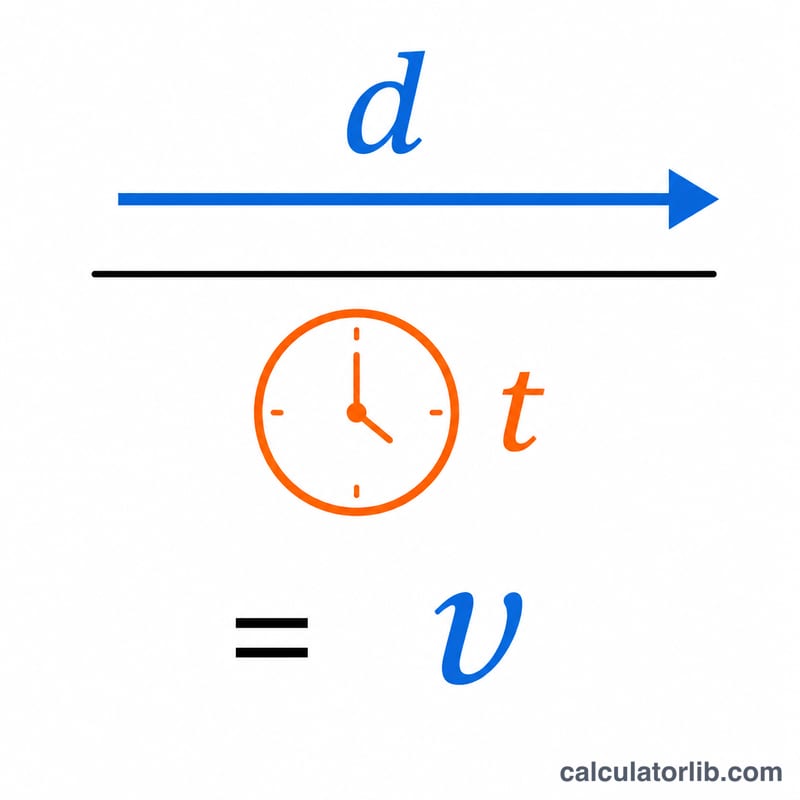
- Speed = Distance ÷ Time
$$\text{Speed (km/h)} = \dfrac{\text{Distance (km)}}{\text{Hours} + \dfrac{\text{Minutes}}{60}}$$
The only thing to watch is your units. Because the answer is in km/h, the distance must be in kilometres and the time must be converted into hours. To convert minutes into hours, divide the minutes by 60. So 45 minutes becomes 0.75 hours.
Worked Example
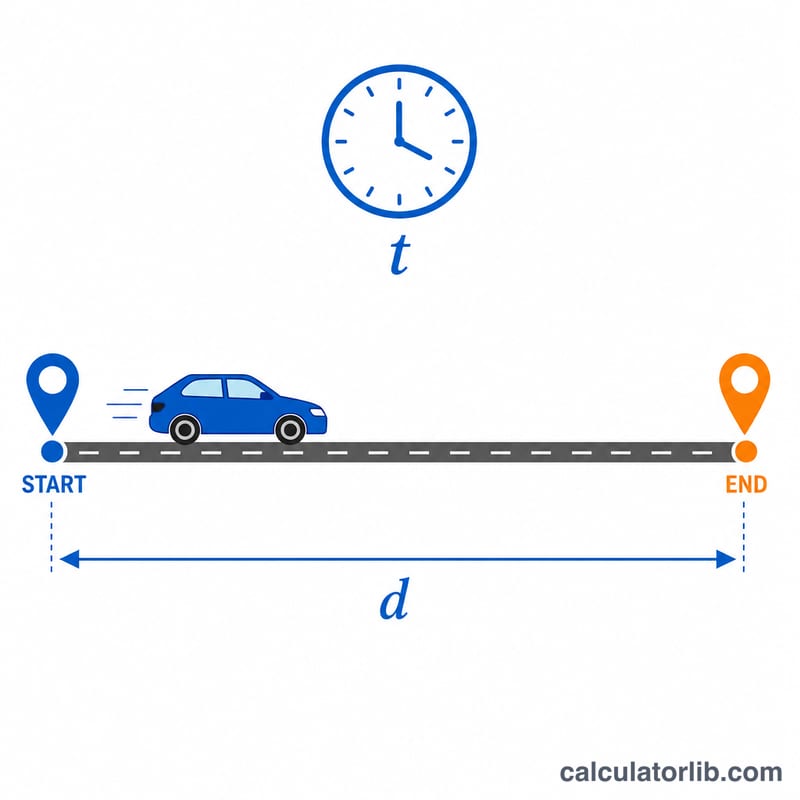
Suppose you drove 120 km and it took you 2 hours and 24 minutes. First convert the time to hours: \(24 \div 60 = 0.4\), so the total time is 2.4 hours. Then apply the formula:
- Speed = 120 km ÷ 2.4 hours = 50 km/h
$$\text{Speed} = \frac{120\ \text{km}}{2.4\ \text{hours}} = 50\ \text{km/h}$$
This is your average speed across the whole trip — it does not show moments where you sped up or slowed down.
Speed and Distance Unit Conversions
This calculator works in kilometres and hours, so its result is always in kilometres per hour (km/h). The factors below convert that result into other speed units, and convert other distance or time units into the kilometres and hours the form expects. Each row states the direction explicitly: multiply to go one way, divide to go back.
Speed units
| From | To | Operation | Reverse |
|---|---|---|---|
| 1 km/h | mph | × 0.6214 | mph → km/h: ÷ 0.6214 |
| 1 km/h | m/s | × 0.2778 | m/s → km/h: ÷ 0.2778 |
| 1 km/h | knots | × 0.5400 | knots → km/h: ÷ 0.5400 |
| 1 mph | km/h | × 1.6093 | km/h → mph: ÷ 1.6093 |
| 1 m/s | km/h | × 3.600 | km/h → m/s: ÷ 3.600 |
| 1 knot | km/h | × 1.852 | km/h → knots: ÷ 1.852 |
The exact relations behind these rounded factors are \(1\ \text{m/s} = 3.6\ \text{km/h}\) (since 1 m/s covers 3600 m in an hour) and \(1\ \text{knot} = 1\ \text{nautical mile per hour} = 1.852\ \text{km/h}\) exactly, by international definition of the nautical mile. The mile-based factor derives from the international yard and pound agreement of 1959, which fixes 1 international mile at exactly 1609.344 m — so \(1\ \text{mph} = 1.609344\ \text{km/h}\) exactly. Knots and nautical miles are used in marine and aviation practice worldwide; miles per hour is the everyday road unit in the United States and the United Kingdom.
Distance units (convert to km before entering)
| From | To km | Operation | Reverse |
|---|---|---|---|
| 1 mile | 1.6093 km | × 1.6093 | km → miles: ÷ 1.6093 |
| 1 nautical mile | 1.852 km | × 1.852 | km → NM: ÷ 1.852 |
| 1 metre | 0.001 km | × 0.001 (÷ 1000) | km → m: × 1000 |
| 1 foot | 0.0003048 km | × 0.0003048 | km → ft: ÷ 0.0003048 |
Time units
| From | To hours | Operation | Reverse |
|---|---|---|---|
| 1 minute | 1/60 h ≈ 0.01667 h | ÷ 60 | h → min: × 60 |
| 1 second | 1/3600 h ≈ 0.0002778 h | ÷ 3600 | h → s: × 3600 |
The calculator accepts hours and minutes separately, so minutes need no manual conversion — it applies \(\text{minutes} \div 60\) internally. Seconds, however, must be folded into the minutes field: 45 s = 0.75 min.
Speed Across Common Scenarios
The table below shows realistic distance-and-time combinations, the km/h the calculator returns, and the mph equivalent (km/h × 0.6214). The formula applied in every row is
$$\text{Speed (km/h)} = \frac{\text{Distance (km)}}{\text{Hours} + \dfrac{\text{Minutes}}{60}}$$| Activity | Distance | Time | Speed (km/h) | Speed (mph) |
|---|---|---|---|---|
| Steady jogging | 5 km | 25 min | 12.0 | 7.5 |
| Easy 10 km run | 10 km | 1 h 0 min | 10.0 | 6.2 |
| Half marathon | 21.1 km | 1 h 45 min | 12.1 | 7.5 |
| Road cycling | 40 km | 1 h 20 min | 30.0 | 18.6 |
| Urban / mixed driving | 120 km | 2 h 24 min | 50.0 | 31.1 |
| Airliner cruise leg | 900 km | 1 h 15 min | 720 | 447.4 |
Two rows worked through in full. The jog: \(25\ \text{min} \div 60 = 0.41667\ \text{h}\), so \(5 \div 0.41667 = 12.0\ \text{km/h}\). The drive: \(2 + (24 \div 60) = 2.4\ \text{h}\), so \(120 \div 2.4 = 50.0\ \text{km/h}\). The half marathon rounds slightly: \(21.1 \div 1.75 = 12.057\), displayed as 12.1 km/h.
These are illustrative values chosen to show the arithmetic across a wide range of speeds — they are not benchmarks, targets or norms. Actual figures vary enormously with fitness, terrain, traffic, weather, vehicle and aircraft type. The airliner row is ground speed over a single cruise segment, which differs from airspeed whenever there is a headwind or tailwind; the driving row is an average over a whole trip including stops, which is typically well below the posted limit on any individual road.
Key Terms Explained
- Speed
- A scalar quantity: how much distance is covered per unit of time, with no direction attached. This calculator reports it in kilometres per hour (km/h); other common units are m/s, mph and knots. Because it is scalar, speed is never negative.
- Velocity
- A vector quantity: speed plus a direction, e.g. 50 km/h due north. Two objects can share a speed of 50 km/h and have different velocities if they travel different ways. In SI the unit is m/s; km/h is also used.
- Average speed
- Total distance divided by total elapsed time, including every stop and slowdown: $$v_{\text{avg}} = \frac{\text{total distance}}{\text{total elapsed time}}$$ This is exactly what this calculator computes. It is not the average of the speeds you held along the way — a 10 km leg at 20 km/h followed by a 10 km leg at 60 km/h gives \(20 \div (0.5 + 0.1667) = 30\ \text{km/h}\), not 40 km/h.
- Instantaneous speed
- The speed at one specific instant — what a speedometer displays. Formally it is the derivative of distance with respect to time, \(v = \dfrac{ {\mathrm{d}s}}{\mathrm{d}t}\), i.e. the limit of average speed as the time interval shrinks toward zero. Units are the same (km/h or m/s).
- Pace
- The reciprocal view of speed: time taken per unit distance, usually minutes per kilometre (min/km) in running and swimming, or minutes per mile where miles are the standard. Convert from a km/h result with $$\text{Pace (min/km)} = \frac{60}{\text{Speed (km/h)}}$$ So 12.0 km/h is a pace of \(60 \div 12.0 = 5.00\) min/km, i.e. 5 minutes per kilometre. Going the other way, a 6:00 min/km pace is \(60 \div 6 = 10.0\) km/h.
- Distance
- The length of path actually travelled, entered here in kilometres (km). Distinct from displacement, which is the straight-line separation between start and finish — a 400 m lap of a track is 400 m of distance but zero displacement.
- Elapsed time
- The total clock time from start to finish, entered here as hours plus minutes. In sport this is sometimes called gross or elapsed time, as opposed to moving time, which excludes pauses; using moving time instead gives a higher, different figure.
- Acceleration
- The rate at which velocity changes, in metres per second squared (m/s²): \(a = \Delta v / \Delta t\). An object moving at constant speed in a straight line has zero acceleration; one moving at constant speed around a curve is still accelerating, because its direction — and therefore its velocity — is changing.
Conventions and edge cases
Each case below was run through this calculator; the result column is what it actually returns.
| Case | Input | Result |
|---|---|---|
| Negative distance | -100, 2, 0 | The time must be greater than 0, and the distance cannot be negative. |
| 100 in 2 hours | 100, 2, 0 | Average Speed: 50.00 km/h |
| Zero time | 100, 0, 0 | The time must be greater than 0, and the distance cannot be negative. |
Checked on 2026-11-08
Frequently Asked Questions
Is this average or instantaneous speed? It calculates average speed over the entire journey, not your speed at any single moment.
Can I get the answer in mph? This calculator displays km/h. To convert to miles per hour, multiply the result by 0.6214.
What if my time is only minutes? Leave the hours field at zero and enter your minutes — the calculator handles the conversion automatically.