
What Is Mean Piston Speed?
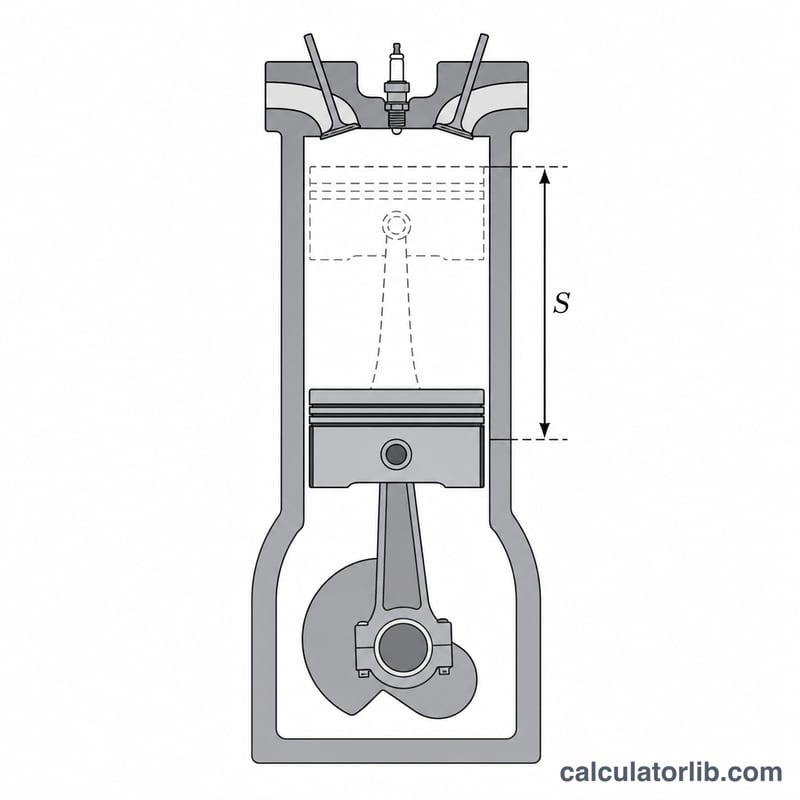
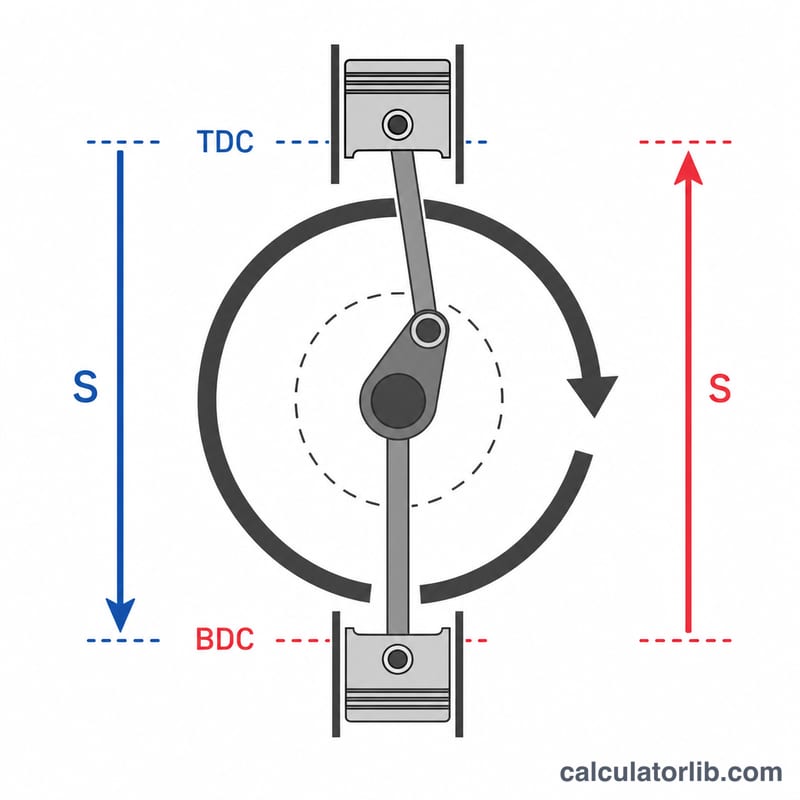
Mean piston speed (MPS) is the average linear speed of an engine's piston as it travels up and down the cylinder bore. During one full crankshaft revolution the piston covers twice the stroke length (down then up), so the average speed depends only on the stroke and the engine speed — not on bore, displacement or peak velocity. It is one of the most important figures for judging how hard an engine is working and its mechanical durability.
How to Use This Calculator
Enter the engine's stroke in millimetres and the engine speed in RPM, then read off the mean piston speed in metres per second. A ft/min equivalent is shown for reference, which is the unit traditionally used in engineering tables.
The Formula Explained
The equation is:
$$\overline{v}_p = \frac{2 \times \dfrac{\text{Stroke (mm)}}{1000} \times \text{RPM}}{60}\ \text{m/s}$$
The factor of 2 accounts for the piston moving the stroke distance twice per revolution. Dividing RPM by 60 converts revolutions per minute into revolutions per second. To get a result in m/s, the stroke is converted from mm to metres (divide by 1000) inside the calculation.
Worked Example
Consider an engine with a 86 mm stroke running at 6000 RPM:
$$\overline{v}_p = \frac{2 \times 0.086\ \text{m} \times 6000}{60} = 17.2\ \text{m/s}$$
That equates to roughly 3,386 ft/min — typical for a healthy production engine. Most road-car engines stay below about 20–23 m/s, while race engines push toward 25 m/s or higher.
FAQ
Why does mean piston speed matter? High piston speeds increase inertial loads on the connecting rod and bearings, accelerate ring and bore wear, and raise the risk of mechanical failure. It is a better cross-engine durability indicator than RPM alone.
What is a safe mean piston speed? Production engines commonly run 15–20 m/s, performance engines 20–23 m/s, and purpose-built race engines can exceed 25 m/s with specialised components.
Does bore size affect MPS? No. Mean piston speed depends only on stroke and RPM. Bore affects displacement and breathing, but not piston travel distance.