
What this calculator does
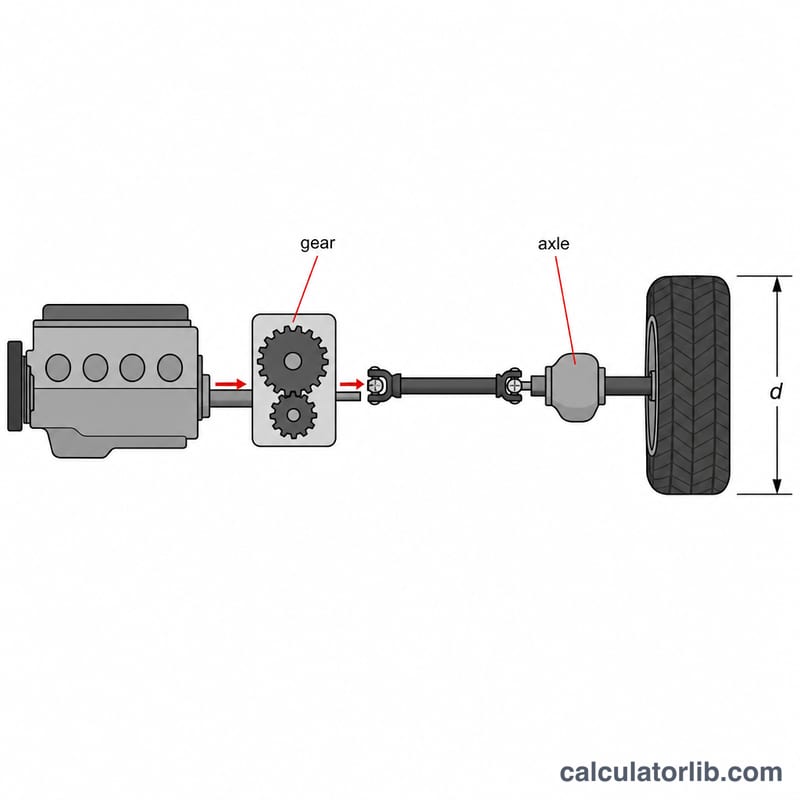
The RPM from Speed Calculator estimates how fast your engine is turning (revolutions per minute) at a given road speed. It uses your transmission gear ratio, axle (final drive) ratio, and tire diameter to convert miles per hour into engine RPM. It's handy for choosing gearing, picking a cruising overdrive ratio, or checking that your tachometer reads sensibly.
How to use it
Enter your speed in mph, the transmission gear ratio you're in (1.00 is typical for a direct top gear, 0.70 for an overdrive), the axle/final drive ratio (commonly 3.08–4.10), and the overall tire diameter in inches. Press calculate to see engine RPM and the total drive ratio.
The formula explained
The widely used shortcut is $$\text{RPM} = \frac{\text{Speed (mph)} \times \text{Gear Ratio} \times \text{Axle Ratio} \times 336}{\text{Tire Diameter (in)}}$$ The magic number 336 bundles together the conversions from miles per hour to inches per minute and the \(\pi\) factor for tire circumference, so you can feed tire diameter directly without computing circumference yourself.
Worked example
At 70 mph in a 0.70 overdrive gear, with a 3.08 axle ratio and 28-inch tires: $$\text{RPM} = \frac{70 \times 0.70 \times 3.08 \times 336}{28} = \frac{50{,}711.04}{28} \approx 1{,}810 \text{ RPM}$$ The total drive ratio is \(0.70 \times 3.08 = 2.156:1\).
FAQ
Where do I find tire diameter? Use the overall (loaded) diameter in inches. For a 245/45R18 it's roughly 26.7 in; tire size calculators give an exact figure.
Why 336? It's a unit-conversion constant: \(63{,}360 \div 60 \div \pi \approx 336\) (inches per mile ÷ minutes per hour ÷ \(\pi\)).
Is this exact? It assumes no tire slip and a perfectly round, fully inflated tire, so real RPM may vary slightly.