
What Is Trailer Tongue Weight?
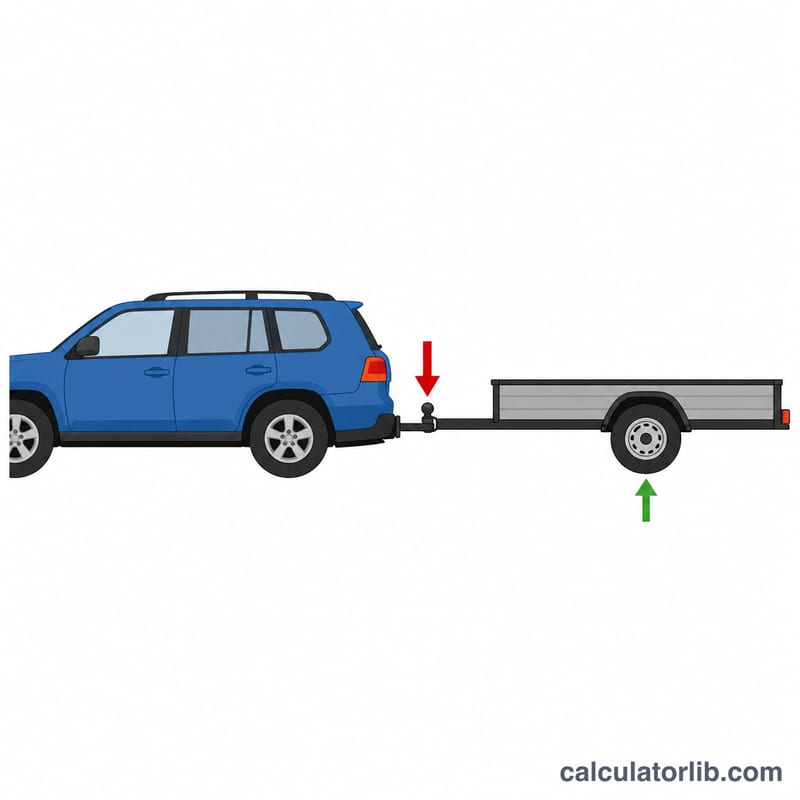
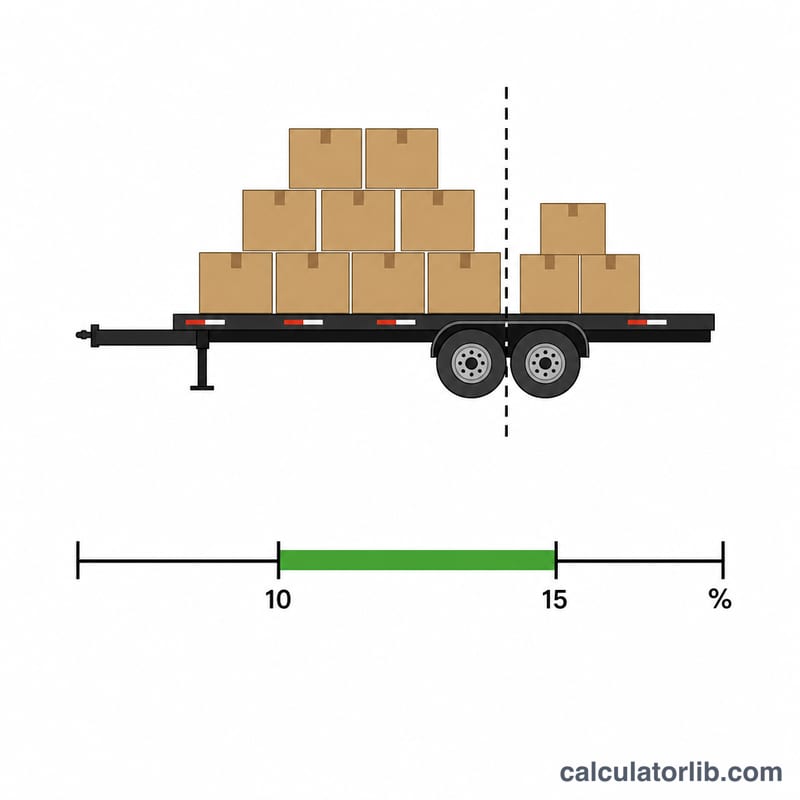
Tongue weight (TW) is the downward force the trailer's coupler exerts on the tow vehicle's hitch ball. It is one of the most important factors in safe towing: too little tongue weight lets the trailer sway dangerously, while too much can overload the rear axle of the tow vehicle and lift the front wheels, hurting steering and braking. The widely accepted guideline is that tongue weight should be 10-15% of the total loaded trailer weight.
How to Use This Calculator
Enter the total loaded weight of your trailer (including cargo) and the target tongue weight percentage. The calculator returns the required tongue weight in pounds, shows the recommended 10-15% range, and tells you whether your chosen percentage is within the safe zone. If you do not have a target percentage in mind, 12% is a good central value.
The Formula Explained
The math is straightforward: $$\text{Tongue Weight} = \text{Trailer Weight} \times \frac{\text{Tongue \%}}{100}$$ For example, a 5,000 lb trailer at 12% has a tongue weight of \(5{,}000 \times 0.12 = 600\) lb. The safe range for that same trailer is 500 lb (10%) to 750 lb (15%).
Worked Example
Suppose you tow a 7,000 lb loaded boat trailer and want 13% tongue weight. $$\text{TW} = 7{,}000 \times 0.13 = 910 \text{ lb}$$ That falls inside the recommended 700-1,050 lb range, so your load distribution is good. You can verify the actual tongue weight with a bathroom scale and a lever setup or a dedicated tongue-weight scale.
FAQ
What if my tongue weight is too low? Move cargo forward (ahead of the trailer axle) to shift more weight onto the hitch and reduce sway.
What if it's too high? Move cargo rearward slightly, but never below 10%, and confirm your hitch and vehicle are rated for the load.
Does the hitch ball rating matter? Yes. Your hitch, ball mount, and ball must all be rated for at least the calculated tongue weight and the total trailer weight.