
What is the Pipe Weight Calculator?
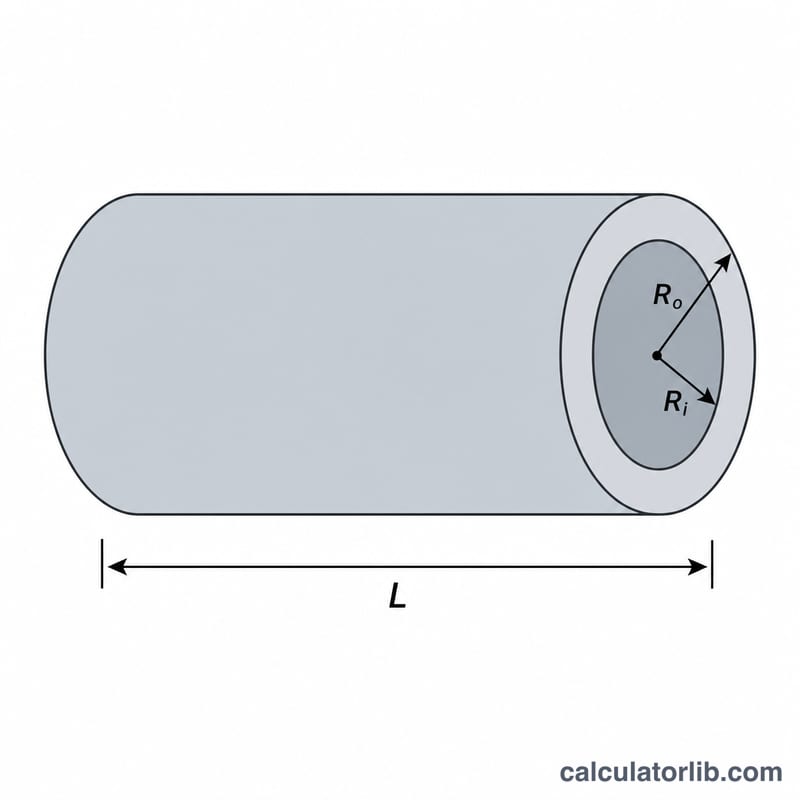
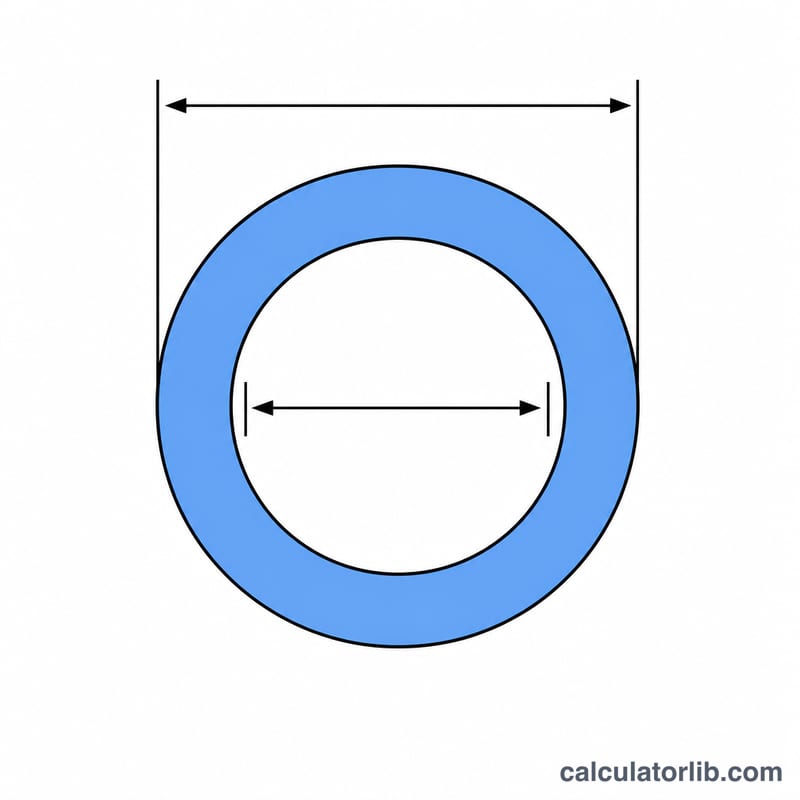
The Pipe Weight Calculator estimates how much a hollow pipe weighs based on its outside diameter (OD), inside diameter (ID), length and the density of the material it is made from. It works for steel, stainless steel, copper, aluminium, PVC and any other material — you just supply the correct density. This is a universal physics/geometry tool with no country-specific assumptions.
How to use it
Enter the outside diameter and inside diameter in millimetres, the length in metres, and the material density in kilograms per cubic metre (for example carbon steel ≈ 7850 kg/m³, aluminium ≈ 2700 kg/m³, copper ≈ 8960 kg/m³). The calculator returns the total weight in kilograms, along with the weight per metre, the cross-sectional ring area and the material volume.
The formula explained
A pipe is a hollow cylinder. Its solid cross-section is a ring (annulus) whose area equals \(\pi \times (\text{OD}^2 - \text{ID}^2) / 4\). Multiplying that area by the length gives the volume of material, and multiplying the volume by the density gives the mass:
$$W = \frac{\pi}{4}\left(\left(\frac{\text{OD (mm)}}{1000}\right)^{2} - \left(\frac{\text{ID (mm)}}{1000}\right)^{2}\right) \times \text{Length (m)} \times \text{Density}$$
Internally the diameters are converted from millimetres to metres so the area is in m², the volume in m³ and the weight in kilograms.
Worked example
Take a steel pipe with OD = 100 mm, ID = 90 mm, length = 6 m and density = 7850 kg/m³. Convert: OD = 0.1 m, ID = 0.09 m.
$$\text{Area} = \pi \times (0.1^2 - 0.09^2) / 4 = \pi \times (0.01 - 0.0081)/4 = \pi \times 0.0019/4 \approx 0.0014923 \text{ m}^2$$
$$\text{Volume} = 0.0014923 \times 6 \approx 0.0089536 \text{ m}^3$$
$$W \approx 0.0089536 \times 7850 \approx 70.28 \text{ kg}$$
FAQ
What density should I use? Use the density of the pipe material: carbon/mild steel ≈ 7850 kg/m³, stainless steel ≈ 8000, aluminium ≈ 2700, copper ≈ 8960, PVC ≈ 1400.
Can I use it for a solid bar? Yes — set the inside diameter (ID) to 0 and it becomes a solid cylinder.
What if I only know wall thickness? Compute \(\text{ID} = \text{OD} - 2 \times \text{wall thickness}\), then enter that ID.