
What the Rebar Calculator Does
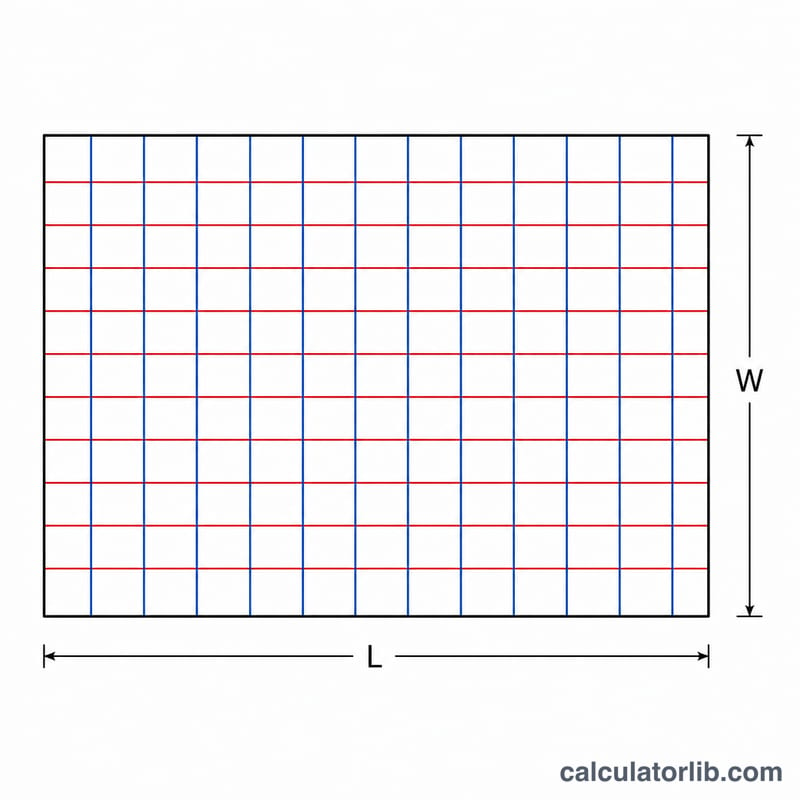
This rebar calculator estimates the amount of reinforcing steel needed for a rectangular concrete slab laid out as a two-way mesh. From the slab length, width and the on-center bar spacing, it returns the number of bars running in each direction, the total length of rebar required, and how many standard-length bars you should buy. It is useful for footings, driveways, patios and floor slabs.
How to Use It
Enter the slab length and width in meters, the desired bar spacing (center to center), and the standard bar length you can purchase (commonly 12 m). The calculator counts bars in both directions and sums the steel needed. All measurements use the same unit, so the results scale directly if you work in feet instead of meters.
The Formula Explained
For a span of length \(L\) at spacing \(s\), the number of bars is \(\lfloor L / s \rfloor + 1\). The floor divides the span into equal gaps, and the +1 accounts for the bar at the starting edge. Bars laid in the long direction are spaced across the width, so their count uses width / spacing; bars laid in the short direction use length / spacing. Total length multiplies each bar count by the span it covers and adds the two together.
$$L_{total} = N_L \cdot \text{Length} + N_W \cdot \text{Width}$$ $$\text{where}\quad \left\{ \begin{aligned} N_L &= \left\lfloor \frac{\text{Width}}{\text{Spacing}} \right\rfloor + 1 \\ N_W &= \left\lfloor \frac{\text{Length}}{\text{Spacing}} \right\rfloor + 1 \end{aligned} \right.$$ $$\text{Pieces} = \left\lceil \frac{L_{total}}{\text{Standard Bar Length}} \right\rceil$$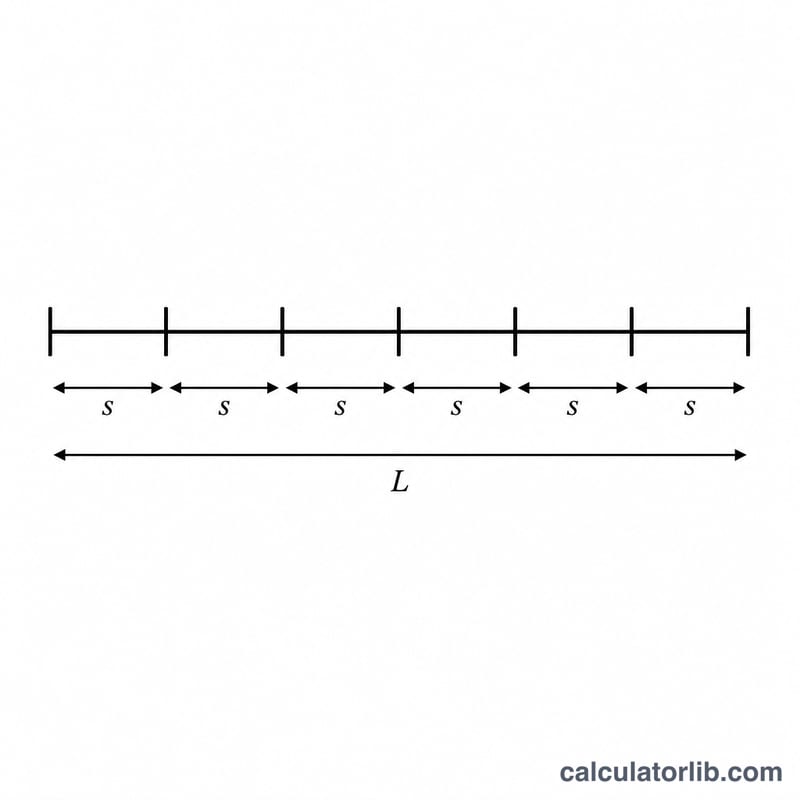
Worked Example
Take a slab 10 m long by 6 m wide with 0.2 m spacing. Bars spanning the length: \(\lfloor 6 / 0.2 \rfloor + 1 = 30 + 1 = 31\) bars, each 10 m long = 310 m. Bars spanning the width: \(\lfloor 10 / 0.2 \rfloor + 1 = 50 + 1 = 51\) bars, each 6 m long = 306 m. Total = 616 m of rebar across 82 bars. At 12 m per bar, you need \(\lceil 616 / 12 \rceil = 52\) pieces.
FAQ
Does this include laps or waste? No. Add 10–15% for lap splices, bends and offcuts when ordering.
Can I use feet? Yes—enter all four values in feet and the totals come out in feet.
What spacing should I use? Follow your engineer's drawings; common slab spacing ranges from 150 mm to 300 mm depending on load.