
What is the Sand Calculator?
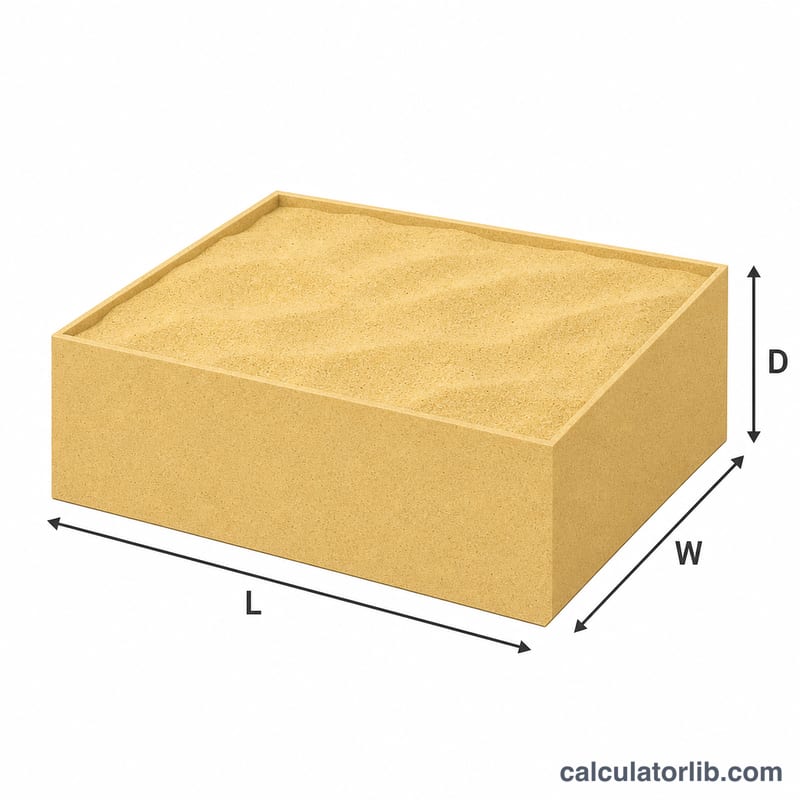
The Sand Calculator estimates how much sand you need for a project — a sandbox, paver base, drainage layer, garden bed, or backfill. It converts your measured area and depth into cubic feet, cubic yards, and weight in tons and pounds, so you can order the right quantity and avoid costly over- or under-buying.
How to use it
Measure the length and width of the area in feet and the depth you want to fill in inches. Enter those three numbers, then enter the bulk density of your sand in tons per cubic yard (the default 1.35 is a good average for dry construction sand; wet or compacted sand can run 1.4–1.7). The calculator returns the total tons of sand required plus the volume in cubic feet and cubic yards.
The formula explained
First the surface area is found as Length × Width. Depth is converted from inches to feet by dividing by 12. Multiplying area by depth gives volume in cubic feet, which is divided by 27 (the number of cubic feet in one cubic yard) to get cubic yards. Finally, cubic yards are multiplied by the density to get weight:
$$\text{Tons} = \left( \text{Area} \times \text{Depth} \div 27 \right) \times \text{Density}$$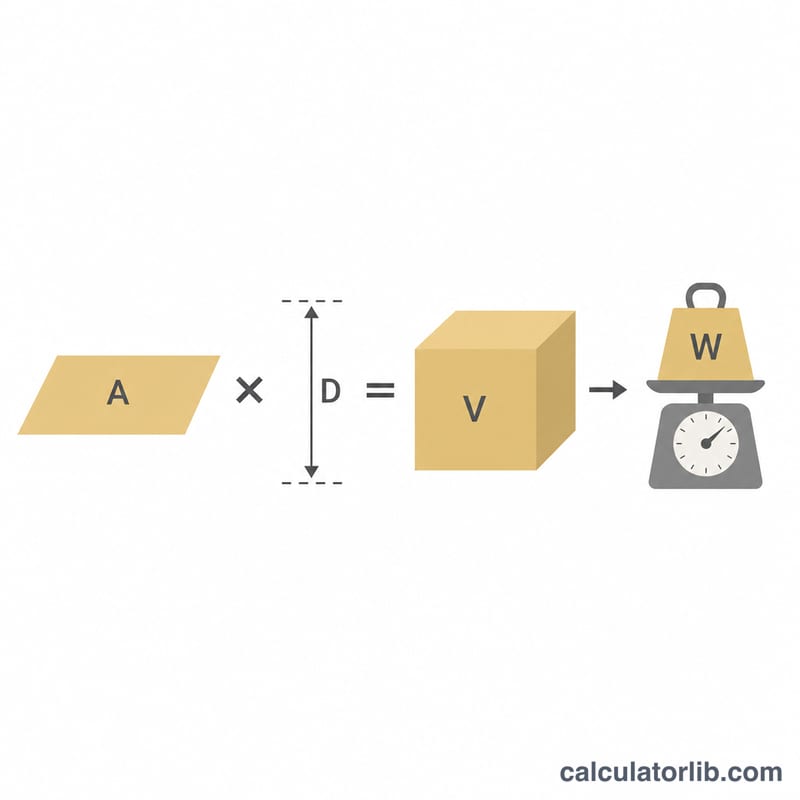
Worked example
For a 20 ft by 10 ft area filled 2 inches deep: area = 200 ft². Depth = \(2 \div 12 = 0.1667\) ft. Volume = \(200 \times 0.1667 = 33.33\) ft³ = 1.235 yd³. At 1.35 tons/yd³ that is about 1.67 tons, or roughly 3,333 pounds of sand.
FAQ
What density should I use? Dry sand is about 1.35 tons/yd³; wet or compacted sand is heavier. Check with your supplier for an exact figure.
Should I order extra? Yes — add 5–10% to allow for compaction, spillage, and uneven ground.
Can I use it for gravel or topsoil? Yes, just change the density value to match the material.