
What Is the Spindle Spacing Calculator?
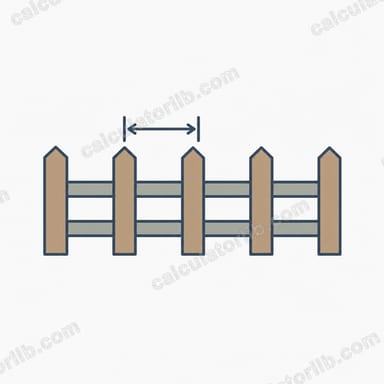
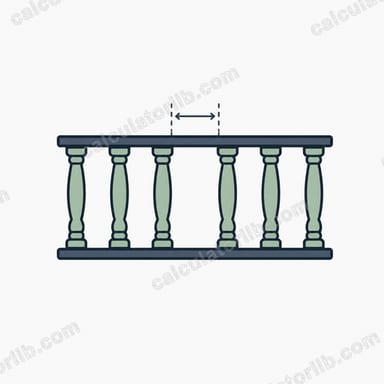
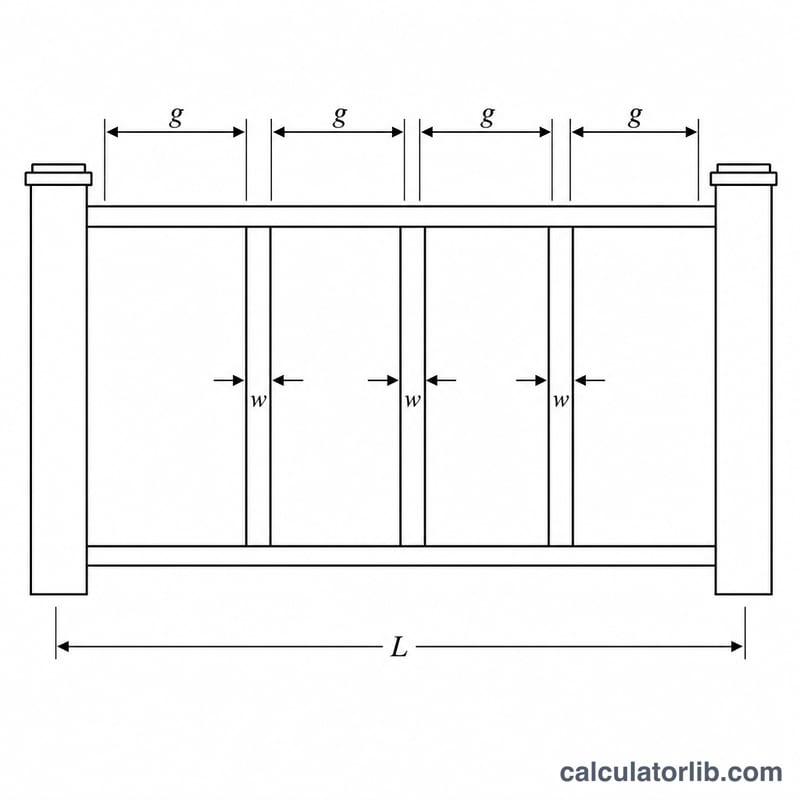
This tool helps you lay out spindles, balusters, pickets, or fence posts evenly along a railing or deck run. Given the total run length, the number of spindles you want, and the width of each spindle, it returns the exact gap to leave between them so everything ends up symmetrical with equal spaces at both ends.
How to Use It
Enter three values: the total run length (the clear distance the spindles must fill), the number of spindles, and the width of a single spindle. Use any consistent unit — millimetres are assumed here, but inches work the same way. The calculator shows the gap per opening, the number of gaps, the combined spindle width, and the centre-to-centre spacing for marking out.
The Formula Explained
Placing n spindles in a run creates n + 1 gaps (one at each end plus the spaces between). First subtract the total width occupied by spindles (n \(\times\) spindle width) from the run, then divide the remaining space equally among the n + 1 gaps:
$$\text{Gap} = \frac{\text{Total Run} - n \times \text{Spindle Width}}{n + 1}$$
Worked Example
Suppose a railing run is 1000 mm, you want 10 spindles, and each spindle is 40 mm wide. The spindles use \(10 \times 40 = 400\) mm. That leaves 600 mm spread across 11 gaps: \(600 \div 11 \approx 54.55\) mm per gap. Centre-to-centre spacing is \(54.55 + 40 = 94.55\) mm.
FAQ
Why n + 1 gaps instead of n − 1? Because this layout leaves an equal margin at both ends of the run, which looks balanced. If your spindles butt against posts and you only want gaps between spindles, divide by (n − 1) instead.
What about building codes? Many codes require the gap to be small enough that a 100 mm (4 inch) sphere cannot pass through. Check your local regulation and increase the spindle count if your gap is too large.
Can I use inches? Yes — enter all dimensions in inches and the gap will be returned in inches.