
What Is the Spiral Staircase Calculator?
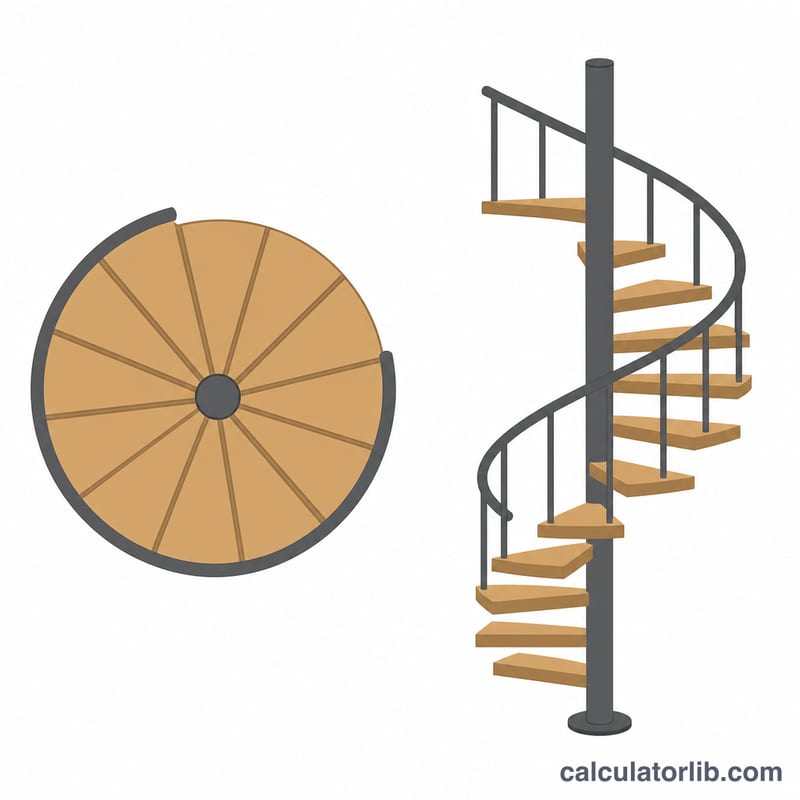
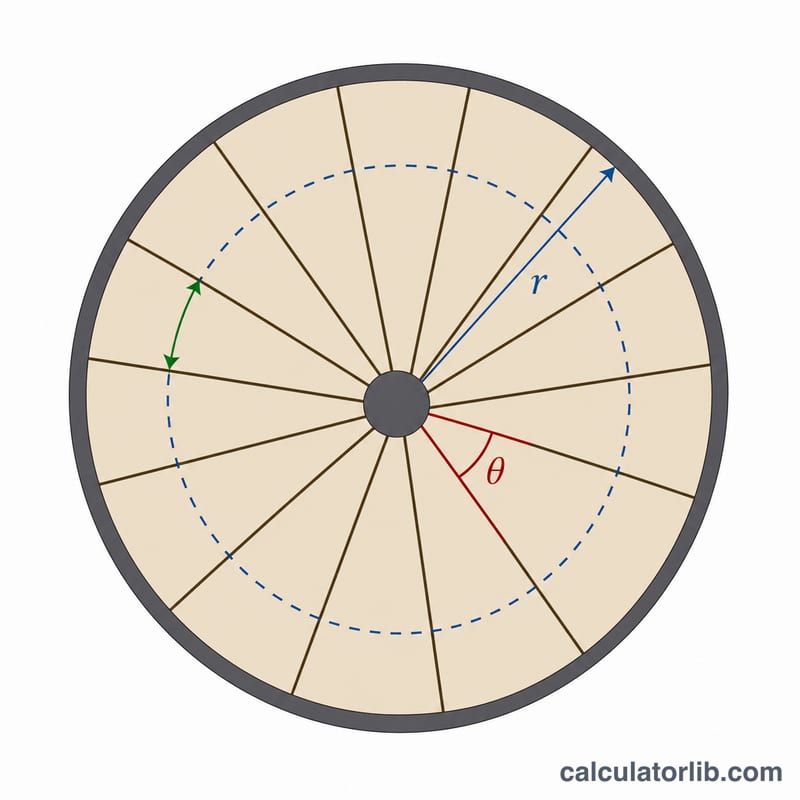
This calculator helps you plan a spiral staircase by working out how many steps you need to reach an upper floor, the exact (actual) step height once the rise is divided evenly, and the rotation angle between each tread. It also estimates the usable tread depth along the walkline so you can check the staircase will be comfortable to climb. The tool uses universal geometry, so it works with any unit you treat as centimetres or any consistent length unit.
How to Use It
Enter the total rise (floor-to-floor height), your desired step height (typically 17–20 cm), the total rotation the spiral makes (usually 270°, 360° or more), and the staircase radius. The calculator rounds up to a whole number of steps, then recalculates the true step height so every riser is identical.
The Formula Explained
The number of steps is the total rise divided by your desired step height, rounded up: \( \text{Steps} = \left\lceil \dfrac{\text{Total Rise}}{\text{Step Height}} \right\rceil \). Because rounding usually leaves a slightly smaller riser, the actual step height \( = \dfrac{\text{Total Rise}}{\text{Steps}} \). The tread angle is simply \( \dfrac{\text{Total Rotation}}{\text{Steps}} \). Tread depth along the walkline (taken at half the radius) is the arc length:
$$ \text{depth} = \frac{\pi}{180} \times \text{angle} \times \frac{\text{radius}}{2} $$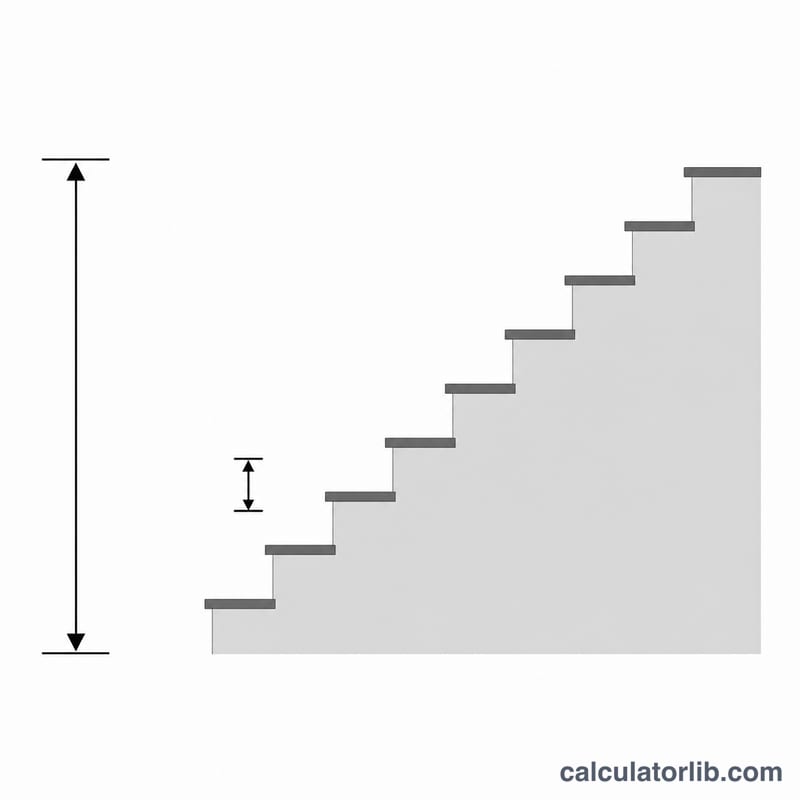
Worked Example
Suppose the total rise is 280 cm with a desired step height of 18 cm over a 360° turn and a 75 cm radius.
$$ \text{Steps} = \left\lceil \frac{280}{18} \right\rceil = \lceil 15.56 \rceil = 16 $$$$ \text{Actual step height} = \frac{280}{16} = 17.5 \text{ cm} $$$$ \text{Tread angle} = \frac{360}{16} = 22.5° $$$$ \text{Walkline depth} = \frac{\pi}{180} \times 22.5 \times 37.5 \approx 14.73 \text{ cm} $$FAQ
Why is the actual step height lower than what I entered? Because the number of steps must be a whole number, the rise is divided evenly, slightly reducing each riser.
What is the top landing step? The final "step" is the upper floor itself, so the number of treads you walk on is one fewer than the riser count.
What rotation should I choose? 360° is common for a full turn between floors; tighter spaces may use 270°, while taller stairs may exceed 360°.