
What Is a Stair Carpet Calculator?
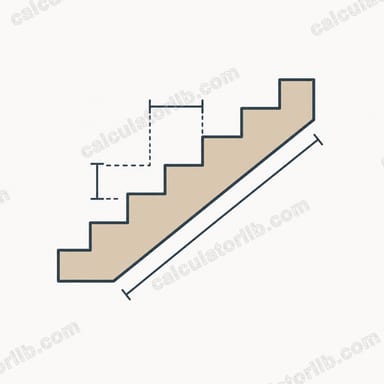
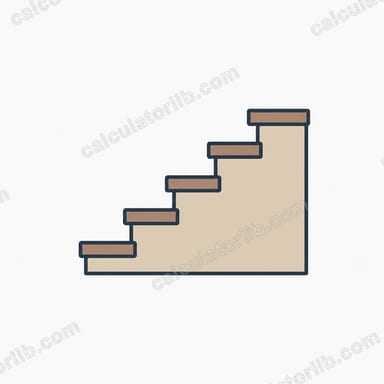
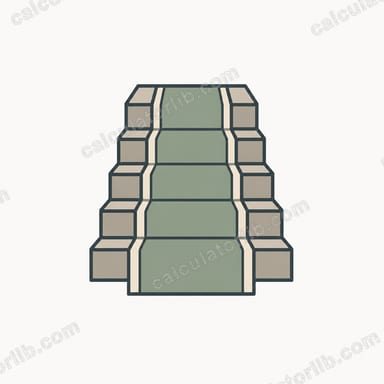
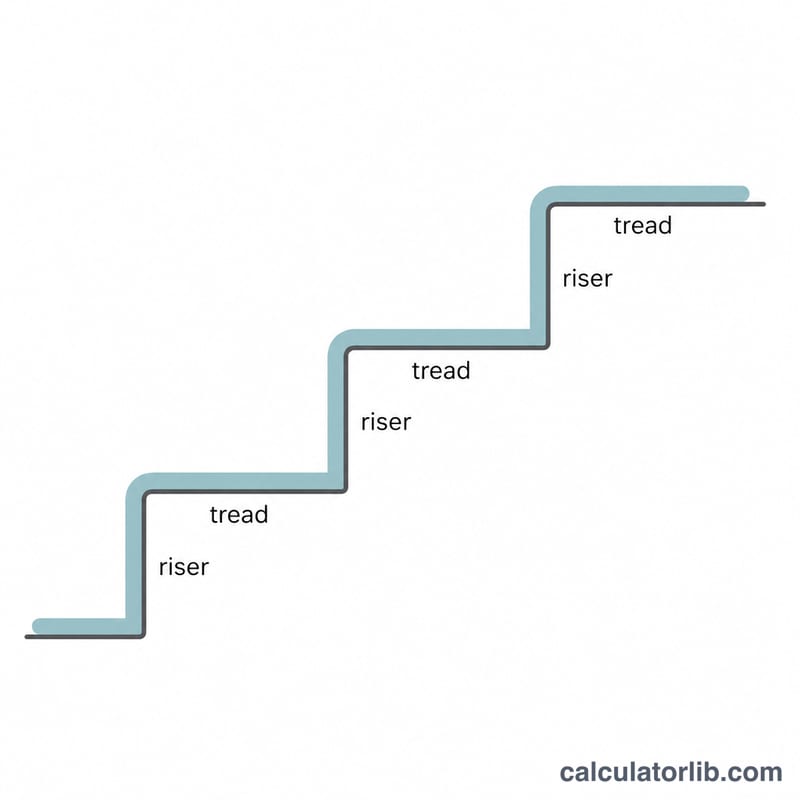
This tool estimates how much carpet runner you need to cover a flight of stairs. It accounts for both the horizontal tread (where you step) and the vertical riser (the front face of each step), then multiplies by the stair width to give the total area. Whether you are buying a fitted runner or wall-to-wall stair carpet, knowing the length and area helps you order the right amount and avoid costly waste.
How to Use It
Enter the number of steps in your flight, the tread depth and riser height of a single step (in inches), and the width of the staircase. The calculator returns the total carpet length in inches and feet, plus the total area in square feet and square yards. Carpet is often sold by the linear foot or square yard, so both figures are provided.
The Formula
Each step needs carpet to cover one tread plus one riser. So the length per step equals tread depth plus riser height. Multiply by the number of steps for total length: $$\text{carpetLength} = \text{numSteps} \times (\text{treadDepth} + \text{riserHeight})$$. The area is simply that length multiplied by the stair width: $$\text{area} = \text{carpetLength} \times \text{stairWidth}$$. Convert inches to feet by dividing by 12, square inches to square feet by dividing by 144, and square feet to square yards by dividing by 9.
Worked Example
For a standard 13-step flight with 10 in treads, 7.5 in risers and 36 in width: $$\text{length} = 13 \times (10 + 7.5) = 13 \times 17.5 = 227.5 \text{ in} = 18.96 \text{ ft}$$ $$\text{Area} = 227.5 \times 36 = 8190 \text{ sq in} = 56.875 \text{ sq ft} = 6.32 \text{ sq yd}$$ Add about 10% extra for trimming, pattern matching, and padding around the nosing.
FAQ
Should I add extra carpet? Yes — add roughly 10% for trimming, tucking under the nosing, and pattern matching.
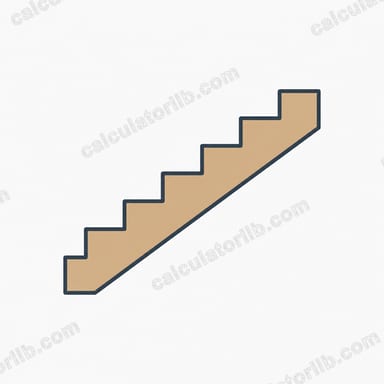
What is tread depth vs riser height? Tread depth is the horizontal surface you step on; riser height is the vertical face between two steps.
Do winder or curved stairs differ? Yes — curved or winding steps need more carpet and are best measured individually; this calculator assumes straight, uniform steps.